“I Can Replace You by Morning,” the Duke Said — The Entire Household Followed Her Out
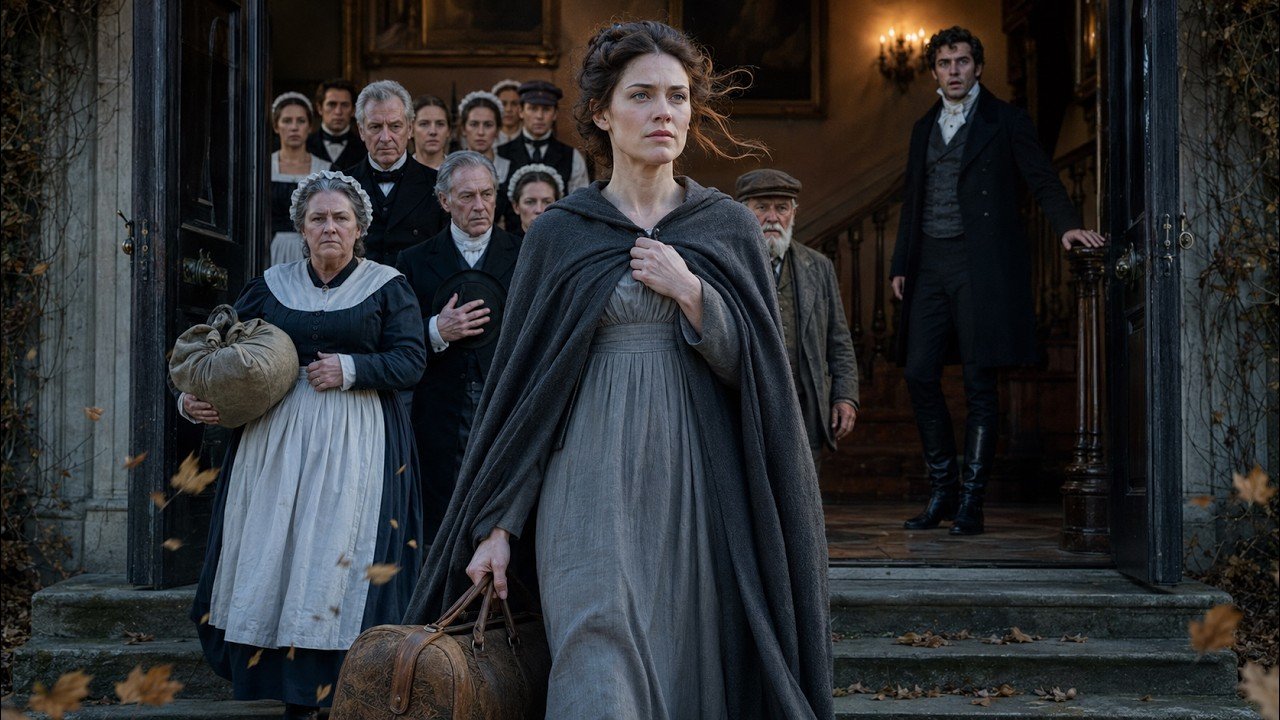
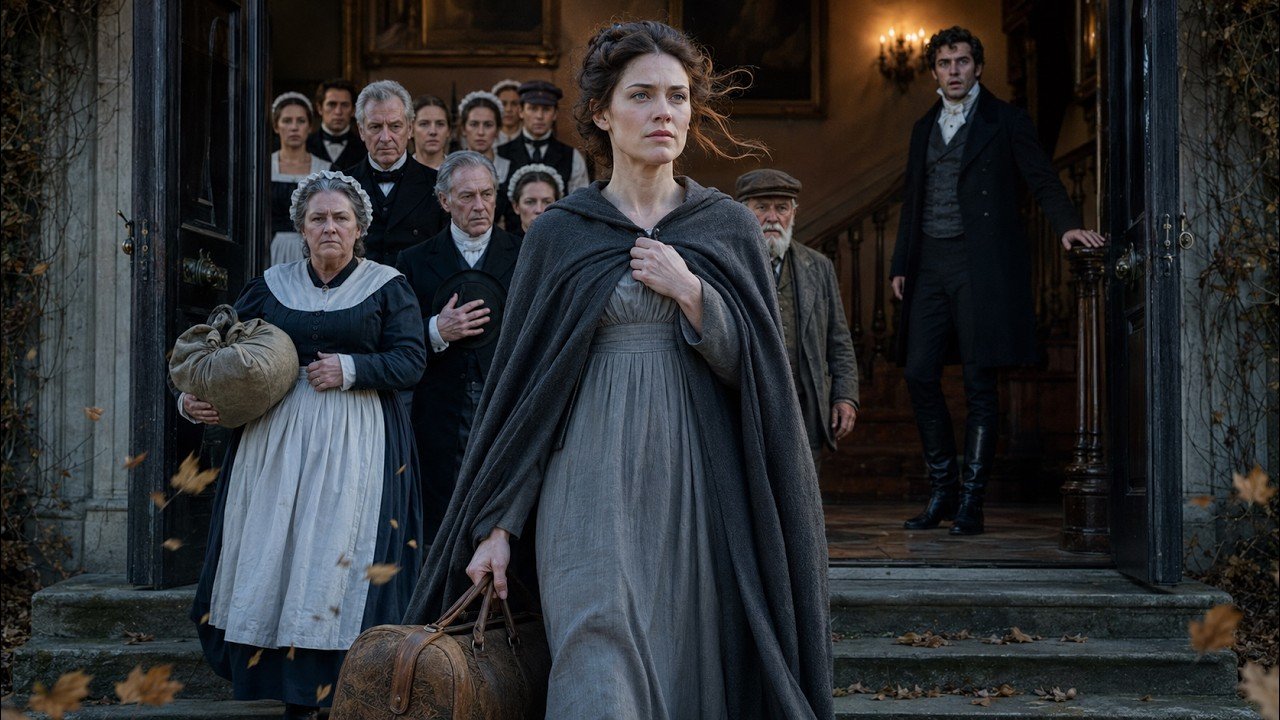
The words hung in the air of the Duke's study, colder and sharper than the October wind rattling the windowpanes of Kestrel Chase. "I can replace you by morning." Prudence Penrose stood before him, her hands clasped loosely at her waiSt. She did not flinch. She did not cry. She had learned long ago that tears changed nothing. They were a currency with no value in her world. Before her, on the great mahogany desk, lay the estate ledger, open to a page that was both a perfect piece of forgery and a perfect condemnation. Beside it lay a small, exquisite pearl brooch, an object she had never seen before in her life. Gideon Devereux, the Duke of Kestrel Chase, stood by the fireplace, his broad shoulders silhouetted against the low flames. His face was a mask of stone, carved by war and loss, and now by this fresh, bitter betrayal. "The evidence is plain," he said, his voice low and devoid of heat. It was worse than shouting. It was a statement of fact, a sentence passed. Prudence looked from the ledger to the brooch, then back to the Duke's unreadable face. There was nothing to say. To deny it would be to beg, and she would not beg. To argue would be to plead, and she would not plead. The trap was too well made. The accusation was a lie, but the evidence was real. It existed. It lay there on the desk between them. For a man like Gideon Devereux, a man who valued proof above all else, that was the end of the matter. "I see," she said, her own voice a quiet echo in the cavernous room. She gave a small, formal curtsy, a gesture of dismissal she had performed a thousand times for his aunt. Then she turned and walked towards the door. Her back was straight, her head was high. She did not look back. The heavy oak door clicked shut behind her, leaving the duke alone with the fire, the lie, and the sudden, unnerving silence of a house that had just lost its heart. It had all begun six months earlier with the duke's return. Before that, Kestrel Chase had been the sole domain of his aunt, Lady Honora Bellamy, and Prudence Penrose, her late husband's ward, had been Lady Honora's shadow. She was 26 years old, plain of face and quiet of manner, possessed of a razor-sharp mind and a memory for numbers that Lady Honora had exploited for nearly a decade. Prudence was the unpaid, unacknowledged steward of the vast estate. She managed the accounts, negotiated with tenants and tradesmen, planned the menus, and oversaw the staff, all while being presented to the world as little more than a poor relation, a companion to fetch shawls and read aloud when her ladyship's eyes grew tired. The household ran on Prudence's invisible labor. The tenants received fair hearings, the suppliers were paid on time, and the books balanced to the penny, but it was Lady Honora who received the credit. It was Lady Honora who was praised for her shrewd management in the drawing rooms of Marley, the nearby town. Prudence remained in the background, a ghost in a gray dress, her worth measured only by her utility. She ate her meals in her small room, not at the great dining table, and her presence in the grander parts of the house was tolerated only when she was on an errand. She endured it with a quiet, unyielding dignity. It was not a life she had chosen, but it was the one she had, and she performed her duties with a precision that was its own form of rebellion. Then, the Duke came home. Gideon Devereux had been a name, a portrait in the long gallery, a source of funds from a distant war. He returned a stranger. A widower in his early 30s, his wife and infant son lost to a fever years ago, he was hardened by his time in the army. He was tall and powerfully built, but moved with a heavy stillness, as if some essential spring within him had been broken. He was silent, watchful, and emotionally sealed. His arrival threw the household into a state of quiet panic, all of it orchestrated by Lady Honora, who saw her reign threatened. She fluttered around him, a flurry of feigned maternal concern and unsolicited advice, attempting to manage him as she managed everyone else. He endured her with a chilling lack of response, his gray eyes missing nothing. He first truly saw Prudence on his third day home. She was in the hall, speaking quietly with a carter who had delivered a load of oats. The man was attempting to overcharge, presenting an invoice for 20 bushels when he had delivered only 15. Lady Honora, eager to appear magnanimous, had been on the verge of simply paying it. "The discrepancy is five bushels, Master Giles," Prudence said, her voice low but firm. She held the delivery chit in one hand. "The granary log, which you signed, confirms 15. The invoice must be corrected." The carter blustered, "A simple mistake, miss. My boy must have written it down wrong." "A simple mistake of nearly a pound," Prudence replied, her gaze unwavering. "Please have the correct invoice sent. We will pay it then." The man grumbled, but he knew he was beaten. He took the false invoice and departed. Prudence made a neat note in a small pocket ledger and turned to go, only to find the Duke standing in the doorway of his study, watching her. His expression was impossible to read. She expected a reprimand for overstepping her station. She was, after all, merely the companion. He said nothing. He simply held her gaze for a long, unnerving moment, then turned and went back into his study. It was not pity in his eyes. It was something harder and more respectful. It was recognition. For a week, nothing changed. Then, one evening, a footman brought a summons. The Duke wished to see her. Prudence entered the study, the same room where she would one day be dismissed, and found him with the estate ledgers spread across his desk. They were her ledgers, the ones she had painstakingly kept for years. "These are your work," he said. It was not a question. I maintain them for my lady, Prudence answered carefully. You do more than maintain them, he said, his finger tracing a line of figures. You have cross-referenced every expense against inventory receipts for the last 5 years. You have identified and recovered over 200 lb in overcharges and fraudulent billing. You have tracked the yield of every field and calculated the cost of every repair down to the last nail. He looked up at her, his eyes searching her face. My aunt tells me she manages the estate. Prudence remained silent. It was not her place to contradict Lady Honora. Gideon's mouth tightened. I require honesty, Miss Penrose, plainly. Who runs Kestrel Chase? She met his gaze. The truth was a risk, but a lie was an insult to the man he appeared to be. I keep the books, Your Grace. I speak with the tenants and the tradesmen. I advise Lady Honora on the necessary expenditures. And does she follow your advice? Usually, Your Grace. He gave a short, humorless laugh. I see. She follows your advice and takes the credit. He closed the ledger with a decisive thud. This arrangement is at an end. As of tomorrow, you are no longer my aunt's companion. You are my estate secretary. You will be paid a salary of 50 lb per annum. You will have full authority over the household accounts and a seat at this desk. Your word will be considered my own. If Is that understood? Prudence was stunned into silence. A salary? Authority? A name for what she did? It was more than she had ever dared to imagine. "Yes, Your Grace," she managed to say. "My aunt will be displeased," he stated, his tone flat. "Her allowance will not change, but her access to the estate funds will cease. Any attempts to interfere with your work are to be reported to me directly." He paused. "Can you do this?" It was a challenge, and for the first time in a very long time, Prudence felt a flicker of something other than endurance. It felt like purpose. "Yes, Your Grace," she said again, and this time her voice was steady and clear. Lady Honora's displeasure was an Arctic gale. She confronted Prudence in the hallway the next morning, her face a mask of polite fury. "I cannot believe Gideon has been so foolish," she hissed, her voice low and venomous. "To elevate a charity case, a new body, above his own blood. You will regret this, miss. Mark my words." Prudence simply bowed her head. "Your Grace has given me my duties, my lady. I intend to perform them." She moved her few belongings from her cramped attic room to a small but pleasant chamber on the second floor, one with a window that overlooked the neglected gardens. And she began her work now in the open. The transformation of Kestrel Chase started not with a grand gesture, but with a thousand small competent acts. The first thing she did was speak to the cook, a grim-faced woman named Hannah, who had served the family for 30 years. The kitchen allowance had been squeezed mercilessly by Lady Honora, resulting in thin soups and repetitive, dreary meals. "The Duke has authorized a new budget for the kitchens," Prudence said, showing Hannah the figures in the new ledger. "We are to eat well again." Hannah stared at the numbers, then at Prudence's earnest face. A flicker of disbelief, then grudging respect, entered her eyes. "About time," she grunted. "The boy looks half-starved." Within a week, the aroma of roasting meat and baking bread began to fill the cold stone corridors of the great house. The staff, who had been subsisting on little more than gruel, found their own meals improved. Their sullen silence began to be replaced by quiet conversation. Loyalty in a great house is often won through the stomach, and Prudence had just secured her first allies. Her domain was the Duke's study, which had become her office. She spent her days there, untangling the knots of a decade of mismanagement by proxy. She discovered tenants whose rents had been secretly raised by Lady Honora's grasping son, Osmond, with the excess pocketed. She found contracts for supplies that were padded and inefficient. Systematically, calmly, she began to set things right. She wrote letters in her clear, precise hand. She met with farmers in the courtyard. She walked the fields to see the state of the drainage herself. The Duke was a constant, silent presence. He would spend hours in the same room reading or dealing with his own correspondence, rarely speaking. Yet, he was always aware of her. He would watch her, his expression thoughtful. One afternoon, as she worked late, the light fading, he rose without a word and lit the lamp on her desk. Another evening, he found her hunched over a map of the estate, a frown of concentration on her face. He walked over and pointed to a section of woodland. "That boundary is incorrect," he said. "My grandfather sold the coppice at Sorrell Down to the vicarage in '88. The deed is in the bottom drawer of the large cabinet." She found the deed exactly where he'd said. She realized then that his silence was not disintereSt. He knew his estate. He was testing her, watching to see if her competence was as real as it seemed. Their conversations were brief and practical, always tethered to the business of the estate. Yet, a strange, unspoken rhythm developed between them, a shared purpose. The house itself seemed to respond. Fires were lit in grates that had been cold for years. The dust covers were removed from the furniture in the long gallery. The silver was polished until it gleamed. Kestrel Chase was slowly, quietly waking up. Prudence's one private solace was the derelict rose garden. It was a sheltered, walled space that had once been the pride of the Duke's late mother. Now, it was a tangle of weeds and thorns. Yet, in one corner, a single, stubborn, white rose bush still produced a few miraculous blooMs. An Alba Maxima, old and tough. She began to spend half an hour there each evening after her work was done, patiently clearing the weeds, pruning the dead wood. One evening, the Duke found her there. She was on her knees, carefully tying a wandering stem to the crumbling wall. She looked up, startled, soil on her cheek. "My mother planted this garden," he said, his voice softer than she had ever heard it. He looked at the chaos of weeds, then at the small patch she had cleared. "She loved the white roses." "They are resilient," Prudence said simply, gesturing to the lone bush. He stood there for a long time, watching her work. He did not offer to help, but he did not leave. He just stood, a silent guardian, as the dusk settled around them. From that day on, it became their unspoken ritual. She would work in the garden, and he would often appear, standing by the wall, watching. The silence between them was no longer empty. It was filled with a fragile, growing awareness. This quiet transformation did not go unnoticed. Lady Honora and her foppish son, Osmond, watched with mounting fury. They were relegated to the status of guests in their own home, their influence gone. With them in their bitterness was Miss Arabella Sinclair, a local beauty of good family, whom Lady Honora had long intended for the Duke. Arabella saw Prudence not as a secretary, but as a rival, and her contempt was palpable. The opposition began with social snubs. At the rare dinners the Duke now hosted, Prudence was seated at the table by his explicit command. Lady Honora and Arabella would direct all conversation away from her, treating her as if her chair were empty. When a guest unknowingly addressed a question to Prudence, Arabella would answer for her with a condescending smile. "Oh, Miss Penrose is entirely occupied with her little books. She has no time for gossip." Prudence weathered these small cruelties with the same composure she did everything else. She answered when spoken to, ate her meal quietly, and refused to be drawn into their petty wars. Her composure seemed only to infuriate them more. The attacks escalated. A rumor began to circulate in the village of Marley that the new estate secretary was lining her own pockets, that she was a grasping opportunist who had somehow bewitched the grieving Duke. Lady Honora would sigh dramatically in the draper shop. "One tries to be charitable to the poor girl, of course, but she has developed such expensive tastes." Then came the first direct act of sabotage. Prudence had arranged for the re-roofing of several tenant cottages before the winter rains. The contract was signed, the price fair. Two days before the work was to begin, a letter arrived for the contractor, written on estate stationery and bearing a passable forgery of Prudence's signature, canceling the work. It was only because the roofer, a man whose family had served Kestrel Chase for generations, rode over to ask Prudence why that the plot was discovered. Prudence took the forged letter directly to the Duke. He examined the signature, his jaw tight. "This is not your handwriting." "No, your grace." "Who did this?" "I cannot say for certain." He looked at her, and she knew he was thinking of his aunt. "Leave it with me," he said. That evening, there was a closed-door meeting between the Duke and his aunt. No one knew what was said, but Lady Honora emerged pale with rage, and for a week, a tense peace settled over the house. But they were not done. They were merely regrouping for a more devastating assault. They knew the Duke's one unshakable principle, his reliance on evidence. So, they decided to manufacture it. The plan was simple and vicious. Osmond, who had a talent for mimicry, spent days practicing Prudence's neat, precise script. Lady Honora, meanwhile, made a trip to a jeweler in the county town, purchasing a small, expensive pearl brooch. The final piece was the ledger itself. The trap was set. They waited for the perfect moment to spring it. The moment came on a Tuesday. The Duke had been in London for 2 days. Lady Honora chose a page in the household expenses ledger, one detailing payments to local suppliers. Osmond carefully lifted the page and replaced it with a forgery. The new page included a fictitious entry, a payment of 50 pounds, Prudence's entire annual salary, to a London jeweler for an unspecified item. The sum was then subtracted from the estate's cash on hand, making it appear as if the money had simply vanished. The final touch was to find the newly purchased brooch tucked away at the very back of a drawer in Prudence's desk. The Duke returned that afternoon. Before he had even taken off his riding coat, Lady Honora was upon him, her face a picture of distress. Gideon, thank heavens you are back. Something terrible has happened. A discrepancy, a theft. She led him to the study, where Miss Sinclair and a trembling Osmond were waiting. With practiced reluctance, Lady Honora explained her discovery. She had been looking over the books, she said, just to ensure everything was in order in his absence, when she noticed the shocking entry. 50 pounds gone. "I couldn't believe it," she said, dabbing her eyes with a lace handkerchief. "I thought it must be a mistake. But then, Osmond, dear boy, tell him what you found." Osmond, looking miserable, explained that he had been searching for a spare nib for his pen and had, with the utmost reluctance, opened a drawer in Miss Penrose's desk. And there, he had found the brooch. He produced it with a trembling hand. Gideon looked at the ledger. He looked at the brooch. His face became expressionless. "Fetch Miss Penrose," he said, his voice dangerously quiet. And so, Prudence was summoned to the study to face the perfectly constructed lie. She saw the ledger, the brooch, the triumphant malice in Lady Honora's eyes, the simpering pity on Arabella's face, and the shuttered, cold disappointment on the Duke's. She understood in an instant that there was no way out. Her word against a forged document, a planted object, and three witnesses. This was the moment that would define everything. Gideon Devereux was a man forged in the crucible of war, where a moment's misjudgment, a single misplaced trust, could mean death. He had returned to Kestrel Chase, a man determined to live by facts, by evidence, by things he could see and touch. Feelings were deceptive. Charm was a weapon. But numbers on a page, an object in a drawer, these were real. He had allowed himself, slowly and reluctantly, to trust Prudence Penrose. He trusted her competence, her quietness, her lack of artifice. He had begun to feel the house warm around him, and he knew it was her doing. He had found himself seeking her presence, the steady, calm center she provided in his chaotic world. He had watched her in the garden, bringing life back to the thorns, and had felt a painful, unfamiliar hope stir within him. And now, this. The evidence was irrefutable. A fraudulent entry in her own hand, a stolen sum, an expensive jewel hidden in her desk. It was a betrayal so complete, so blatant, that it felt like a physical blow. It confirmed his deepest, most cynical belief that trust was a fool's game. His gaze fell on the ledger. The handwriting was a perfect match for hers. The numbers were clear. 50 lb He picked up the brooch. It was new, expensive, something a woman on a modest salary could not possibly afford. The story it told was simple and sordid. She had used her position to steal. His heart, which had just begun to thaw, froze over once more. The pain was sharp, but he walled it behind a barrier of cold logic. The facts were the facts. Miss Penrose, he began, his voice flat and hard. My aunt has brought a serious matter to my attention. He gestured to the ledger. There is an entry here for a payment of 50 lb to a London jeweler. The cash is missing from the safe. Can you explain this? Prudence looked at the entry. Osman's forgery was masterful. I did not make that entry, Your Grace. And yet, it is your handwriting, he stated. It appears to be, she conceded softly. But it is not. Arabella let out a small, theatrical gasp. Lady Honora shook her head sadly. My dear, it is one thing to make a mistake, but to lie. Gideon silenced her with a single, sharp look. He held up the brooch. And this, it was found in your desk. Did you purchase it? I have never seen it before today, Your Grace. He stared at her, searching for any sign of deceit, any crack in her composure. But her face was a calm, pale mask. She was not hysterical. She was not weeping. She was simply denying the undeniable. To his wounded, logical mind, this composure was the final proof of her guilt. An innocent person would be outraged, frantic. A practiced thief would be calm. "So you are saying," he said slowly, spelling it out as if for a child, "that someone forged an entry in the ledger in a perfect copy of your hand, stole £50 from the safe, purchased this specific brooch, and planted it in your desk, all to incriminate you?" "Yes, your grace. That is what I am saying." He let out a breath, a harsh, bitter sound. It was too elaborate, too theatrical. The simpler explanation was always the truer one. She was a thief. The one person he had begun to trust was a common thief. And that is when he said the words, the words that would echo in the silent halls of Kestrel Chase for years to come. He was not speaking only to her, but to his own shattered hope. "I require honesty above all, Miss Penrose. The evidence is plain. I have no more use for you here." He turned away, unable to look at her any longer. "I can replace you by morning." For a long moment, there was only the sound of the crackling fire. Prudence absorbed the blow without a tremor. She had survived a decade of being invisible. She would survive this. It was the end of a chapter, not the end of her life. She had her dignity, and no one could take that from her. "I see." She said. Her voice was a mere whisper, but it cut through the room's tension. She gave the small, formal curtsy. And then she was gone. The door clicked shut. Lady Honoria's face was a mask of triumph. "You did the right thing, Gideon. It is a terrible shame, but the estate must be protected." Gideon did not answer. He stared into the fire, a cold, dead feeling spreading through his cheSt. He had done the logical thing, the necessary thing. So, why did it feel as though he had just cut out his own heart? Prudence walked up the grand staircase, each step an act of will. She did not allow her shoulders to slump. She did not allow her eyes to fill. She went to her room, the pleasant chamber on the second floor, and began to pack. There was not much to put in her single, worn carpet bag. A few plain dresses, her mending kit, the one book of poetry her father had left her, and the small pocket ledger where she kept her own careful notes. Her real work, the great ledgers of Kestrel Chase, remained in the study, now a testament to her supposed crime. As she was folding her last dress, there was a soft knock on the door. It was Hannah, the cook, her weathered face grim. In her hands, she held a cloth-wrapped bundle. "You'll need this for the road." She said, her voice gruff. She placed the bundle on the bed. It was bread, cheese, and a small flask of what smelled like cider. "The coach to Dunsmuir doesn't leave until dawn. You can't go out into the night." "Thank you, Hannah." Prudence said, her voice thick for the first time. The simple act of kindness was more undoing than the Duke's cold dismissal. "He's a fool." The cook stated, not bothering to lower her voice. "A blind fool. We all know you're no thief. We see who does the work. We see who has the care of this place." The door opened again, and this time it was two of the young housemaids, Tilly and Bess, their eyes red. One of them held out a small, clumsily wrapped package. "It's a woolen shawl, miss. We we saved up for it. For you." Prudence looked from their tear-streaked faces to the formidable cook, and something within her, the wall she had so carefully constructed, began to crack. These people, the ones she had worked alongside, the ones she had fought for in her quiet way, they did not believe the lie. They saw her. Downstairs, the Duke was drinking. He had poured a brandy and was staring out the window at the deepening twilight. The satisfaction he should have felt at rooting out a traitor was absent. In its place was a hollow ache. He had restored order. He had acted on the evidence. He had done his duty. He kept repeating these facts to himself, but they brought no comfort. He heard his aunt's voice, bright and brittle in the hall, directing the staff to prepare for a celebratory dinner. "We shall have the French wine tonight, Hob." She called to the butler. "A special occasion." The house felt wrong. The silence that had once been peaceful now felt accusatory. He thought of the rose garden, of Prudence on her knees in the dirt, her face earnest and focused. He thought of her clear, steady gaze. A thief. It did not fit. But the evidence the evidence was plain. His thoughts were interrupted by his cousin, Osmond, who shuffled into the room looking even more miserable than before. "A splendid evening, isn't it?" Osmond said, attempting a jaunty tone that fell painfully flat. "Mother is in fine spirits." Gideon turned from the window and fixed his cousin with a cold stare. "Are you?" Osmond flinched. "Well, I it's a regrettable business, of course, but necessary." "Tell me again." Gideon said, his voice low and dangerous. "How you came to find the brooch." "I told you." "I was looking for a pen nib." Osmond could not meet his eyes. "A pen nib." Gideon repeated. "In Miss Penrose's desk? A woman so meticulous, she keeps an inventory of the estate's entire supply of stationery. You thought she would have a spare nib lying about in a random drawer?" Osmond's face went pale. I I didn't think. No. Gideon said, taking a step closer. Osmond shrank back. You didn't think. You have never had a genuine thought in your life, have you, cousin? You simply do as your mother bids. He pointed to the ledger still on the desk. That is a clever forgery. Very clever, almost perfect. But not quite. Look. He pointed to the letter P in Penrose's name on the forged line. Her P is made with a single fluid stroke. This one has a small hesitation at the top of the curve. A tiny blob of ink where the forger paused to ensure the shape was correct. I saw it the moment I looked. I just chose not to believe it. The blood drained from Osmond's face. He looked like a cornered rat. You have a talent for mimicry, don't you, Osmond? Gideon continued, his voice relentless. You do sketches. You copy handwriting for sport. He picked up the brooch. And this, my aunt claimed she never left the estate. Yet this brooch is from a jeweler in the county town. A shop she visited two weeks ago. I have the bill from the inn where she took luncheon. It's in my coat pocket. He was not sure why he had kept the bill. A random piece of paper. But now, it was another piece of evidence. Evidence that contradicted the story he had been told. "She bought the brooch," Gideon stated, "and you forged the ledger. And you planted it. Together. Why?" Osmond began to tremble violently. "Mother, she said Miss Penrose was ruining everything, that she was turning you against us. She said you meant to marry her, that this this common little secretary would become the Duchess of Kestrel Chase." The words hit Gideon with the force of a physical blow. "Marry her." The idea was so startling, so utterly foreign. And yet, as soon as it was spoken, it felt like an undeniable truth. It was what the quiet moments in the garden had been leading to. It was what the shared purpose in the study had been building. It was the future he had not dared to let himself imagine. And he had just destroyed it. "Get out," Gideon whispered, his voice hoarse with a sudden, terrible clarity. "Gideon, I "Get out." This time, it was a roar. Osmond scrambled from the room, tripping over his own feet in his haste. Gideon stood alone, the whole sorted conspiracy laid bare. It was not a clever theft. It was a clumsy, cruel plot born of jealousy and fear. And he, the man of logic and evidence, had fallen for it completely. He had looked at the truth, Prudence's unwavering calm, her simple denial, and called it a lie. And he had looked at a lie, the forged page, the planted jewel, and called it evidence. He had said, "I can replace you by morning." The arrogance of it. The sheer blind stupidity. You could replace a secretary. You could not replace integrity. You could not replace the one person who had made this empty mausoleum feel like a home again. He turned and strode out of the study, his purpose clear. He had to find her. He had to fix this. He found the entire household gathered in the main hall. Prudence was standing by the great front door, her bag at her feet. She was wearing a plain cloak, her face pale but composed. And surrounding her, in a silent, unmovable formation, was the staff. Hannah, the cook, Hob, the butler, the footmen, the maids, the stable boys, even the ancient gardener. They were not blocking her way. They were standing with her. Lady Honora was there, her face flushed with fury. What is the meaning of this? Get back to your duties at once. The Duke has dismissed this woman. Hannah stepped forward. She was a large woman, and when she planted her feet, she seemed as rooted as an old oak. If Miss Penrose goes, we go, she said, her voice ringing in the cavernous hall. Lady Honora laughed, a high, brittle sound. Don't be ridiculous. You have nowhere to go. "We'll take our chances," Hob the butler said, his voice quiet but firm. "We'd rather serve with honesty in a ditch than with deceit in a palace." A murmur of agreement went through the staff. They stood shoulder to shoulder, a silent army of loyalty. They had chosen their side. It was into this tableau that Gideon strode. All eyes turned to him. Lady Honora rushed to his side. "Gideon, thank goodness. This is insurrection. They are siding with a thief." Gideon ignored her. His eyes were only for Prudence. She stood by the door watching him, her expression unreadable. She was not asking for anything. She was simply waiting to leave. He walked past his aunt, past the defiant staff, until he was standing directly in front of her. The entire hall held its breath. "I was wrong," he said. His voice was not loud, but it carried to every corner of the hall. It was the sound of a proud, broken man admitting his failure. "The ledger was a forgery. The brooch was planted. It was a lie, and I chose to believe it." He looked at his aunt, his face like granite. "It was your lie." Lady Honora paled. "Gideon, I I did it for you, for the family, to protect you from a scheming adventuress." "You did it for yourself," he said coldly. "You will pack your bags, you and Osmond. A carriage will be ready in an hour. You will be provided with an allowance, but you will not set foot in Kestrel Chase again. He turned back to Prudence. The air was thick with unspoken words. He had publicly vindicated her. He had exposed the plot. He had banished the villains, but the wound remained. The cruellest words he had ever spoken still hung between them. I can replace you by morning. He saw the memory of it in her eyes. An apology was not enough. A retraction was not enough. He had to erase those words with a truth that was bigger and more powerful. He did the only thing he could think of. In the great hall of Kestrel Chase, in front of the entire household, Gideon Devereux, the Duke, went down on one knee before the dismissed secretary. He took her hand. It was cool and steady in his. "I said I could replace you," he began, his voice thick with emotion. "It was the most foolish, arrogant lie I have ever told. The truth, Prudence, is that you are irreplaceable." He looked up at her, his heart in his eyes. "The truth is that in 6 months you have brought more life and honor to this house than it has seen in a decade. The truth is that I have come to rely not just on your competence, but on your character, on your quiet strength, on your presence." He took a deep breath. "I am asking you not to leave. I am asking you to stay. I am asking you to be the Duchess of Kestrel Chase. To rule this house and me beside you. Not as an employee. As my wife. As my equal. A collective gasp went through the staff. Lady Honora looked as if she might faint. Arabella Sinclair, who had been watching from the gallery, simply turned and fled. Prudence stared down at the Duke. At this powerful, broken man kneeling on the cold stone floor before her. Her mind, the mind that tracked numbers and details, was a whirl. But her heart, the heart she had guarded for so long, was suddenly painfully still. He was not rescuing her. He was choosing her. He was not offering her a position. He was offering her a life. He was offering her his own broken, healing heart. She thought of the cold years of being invisible. She thought of his silent presence in the rose garden. She thought of the simple decency of the staff standing behind her. Her arc was from enduring to choosing. And now, the choice was hers. Her hand tightened on his. "Yes," she said. The word was quiet, but it was absolute. Plainly, "Yes." He rose to his feet, his face transformed by a relief so profound it was almost painful to witness. He did not kiss her. Not yet. He simply held her hand, turning to face the assembled staff. "The household," he announced, his voice ringing with a new, clear authority, "is no longer in need of a new secretary. It is in need of preparing for a wedding." A slow smile spread across Hannah's face. And then, for the first time in years, the great hall of Kestrel Chase echoed with the sound of spontaneous, heartfelt applause. One year later, the late afternoon sun slanted through the windows of the study. The room was the same, but everything was different. It was warmer, filled with the scent of beeswax and the roses that now bloomed in profusion in the restored garden. The great ledgers were still there, but they were no longer a source of pain. They were a symbol of a victory won. Prudence Devereux, the Duchess of Kestrel Chase, sat at the desk, not with an estate account book, but with a sketchbook. She was designing a new wing for the local school in Marley. She was no longer plain Miss Penrose. Happiness had been a surprising beautifier. It had softened the stern lines of her face and put a constant, quiet light in her eyes. The door opened and Gideon came in. He moved with an ease and lightness that had been absent when he first returned. The war was finally over, not just on the continent, but inside him. He came and stood behind her, resting his hands on her shoulders. "Dr. Fletcher sends his compliments," he said. "He says the school board has never seen such a well-reasoned and affordable proposal." "It is just a matter of ensuring the numbers are correct," she said with a smile, leaning back against him. He bent and kissed the top of her head. "Everything with you is a matter of ensuring things are correct. That is why this house, this land, that is why I am finally whole." He looked down at the desk. Besides her sketchbook lay a small velvet-lined box. Inside it, nestled on the silk, was not a pearl brooch, but a single, perfectly preserved white rose, the first bloom from the old Alba Maxima bush that she had saved, the one he had pressed for her and had set by a jeweler into a simple silver locket. It was her most treasured possession. It was not a symbol of a crime, but a promise, a symbol of resilience, of a love that had grown in the most unlikely of places. He picked up her hand, the one that had balanced ledgers and cleared weeds, and brought it to his lips. The staff no longer walked on eggshells. The house was filled with laughter and the scent of Hannah's baking. Kestrel Chase was not just a great house anymore. It was a home. Together, they had built it. Plainly, together.