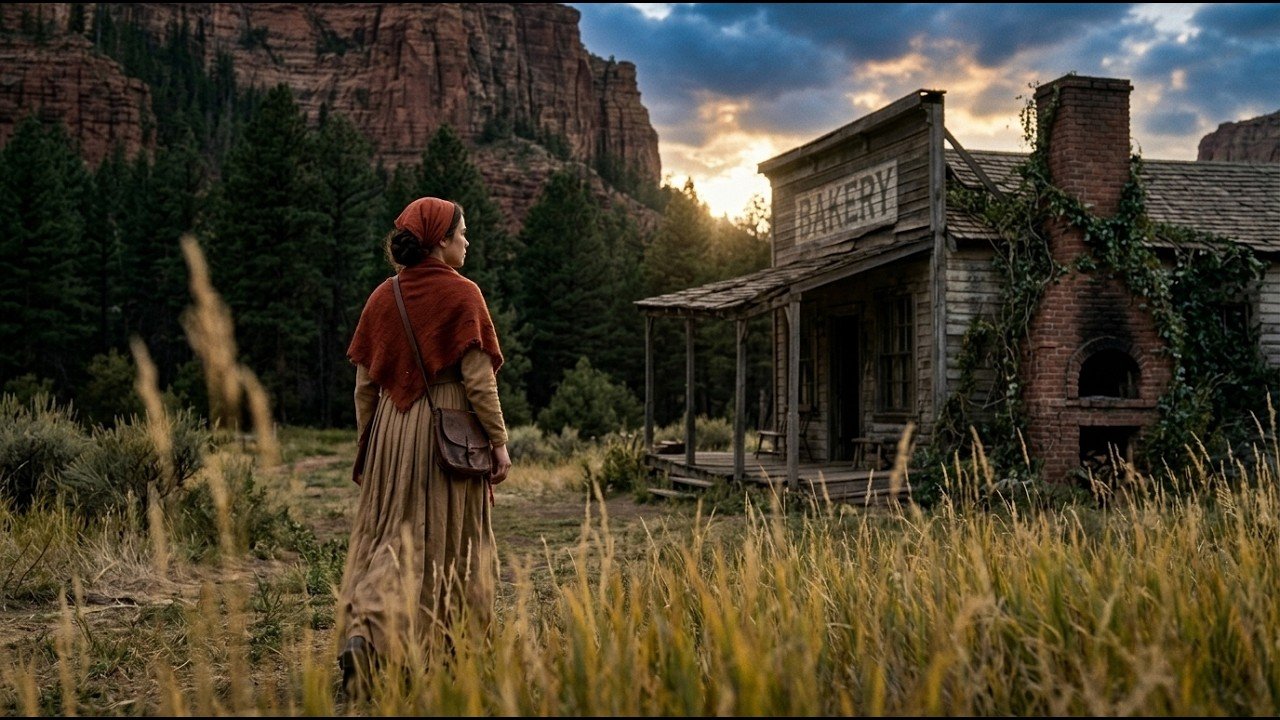
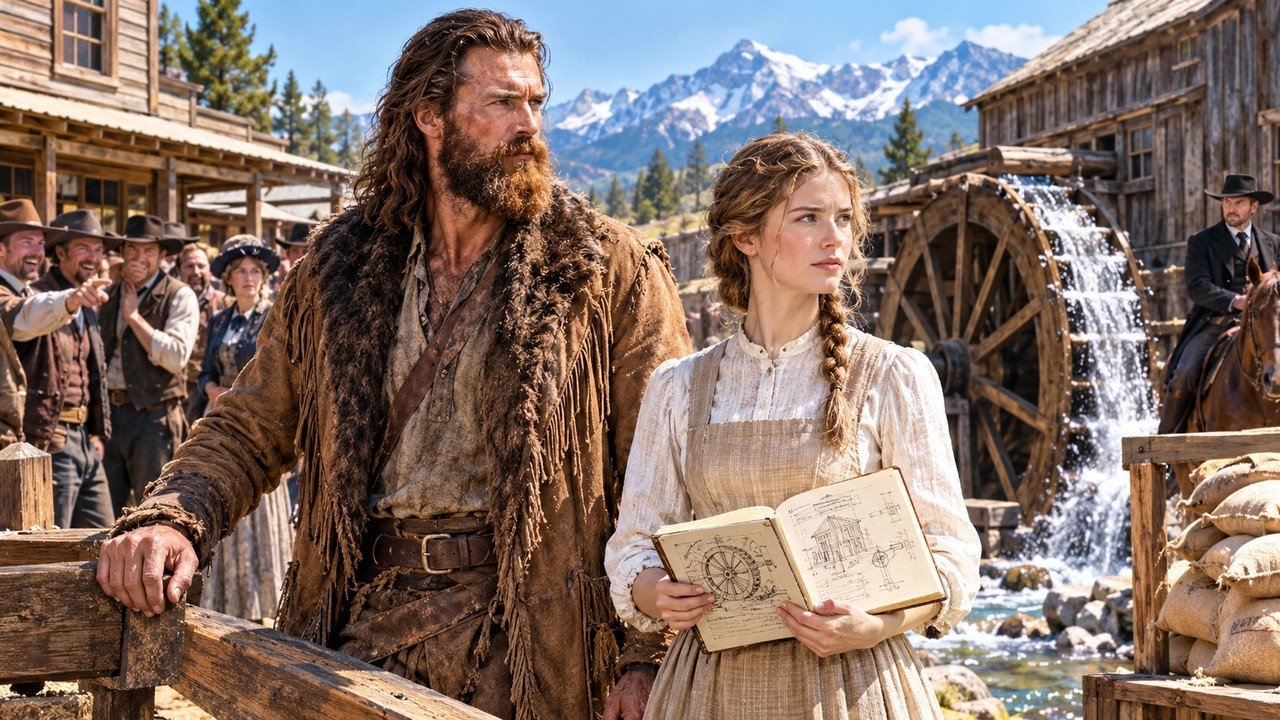
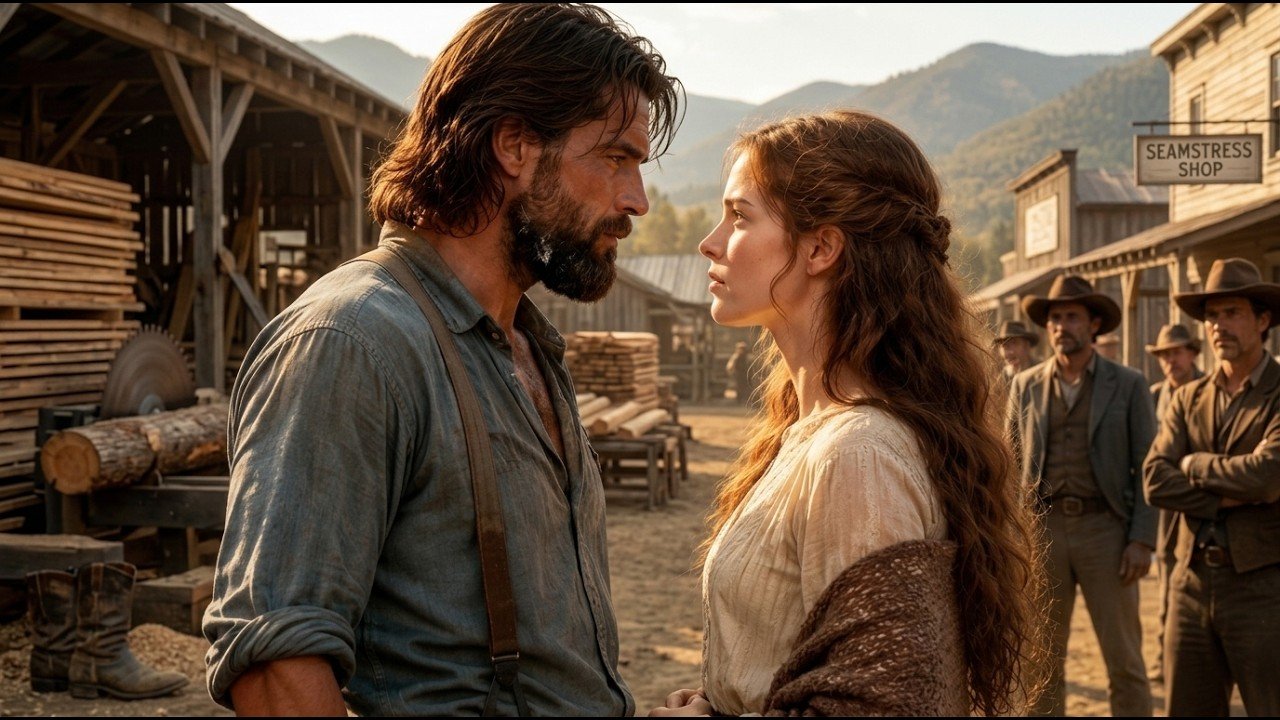
A Blacksmith’s Daughter Was Traded for Debt—A Mountain Man Paid It and Uncovered a Lie
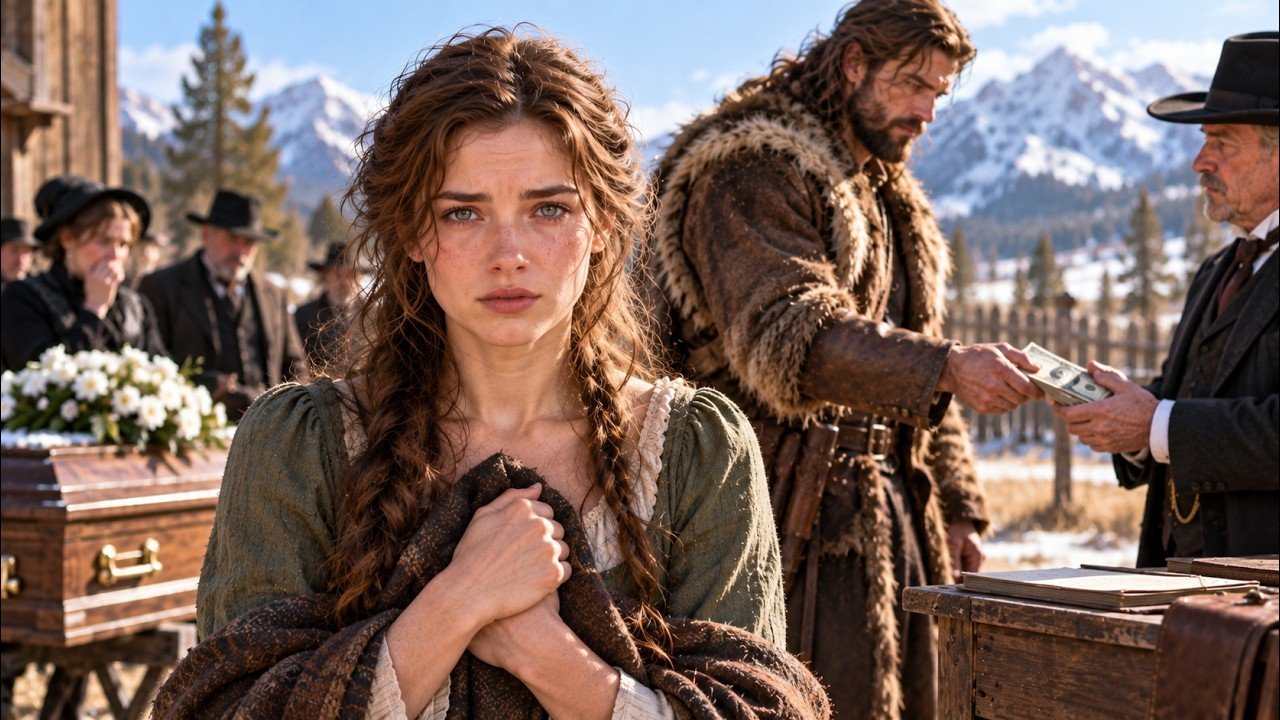
Vernon Crowell set the ledger on top of Adah Mercer's father's coffin like it was a writing desk. The man hadn't even been in the ground 12 hours. Crael didn't apologize for the timing, didn't remove his hat. He simply opened the book, pressed the spine flat with one practiced hand, and announced to the 20 odd people gathered under the cold November sky that Samuel Mercer had died owing $1,700, and the debt belonged to whoever inherited his estate. Ada was the only one who'd inherited anything from her father, which meant the debt was hers. There's a man coming in from the mountains, Crowell said almost pleasantly. Name of Garrick Voss. He and I have been in a dispute over some animals his land claims were damaged by. He's agreed to forgive what my mining company owes him in exchange for a settlement. He closed the ledger. The settlement is you, Miss Mercer. Half of Dry Mercy heard it. Nobody said a word. If you've ever wondered what you would do in that moment when the town watches and says nothing stay with me because what happened next changed everything. If this is your first time here, welcome. Subscribe to the channel so you never miss a story like this one. Hit the like button and leave a comment with your city and country. I want to see how far these stories travel. Now, let's find out what a mountain man does when a woman says no. Ada had been standing at the edge of the grave. Her boots were wet through. She'd been awake since the previous morning. When the doctor had come to tell her what she already knew, her father was gone, and she should start thinking about what came next. What came next turned out to be Vernon Crowell climbing out of a buckboard carriage in his good wool coat, while Ada's hand still smelled like the soap she'd used to wash her father's face. She didn't cry when Crowell opened the ledger. She'd already done her crying alone in the smithy at 3:00 in the morning with the forge cold and the sound of wind coming in under the door. She didn't have anything left for public grieving, and she wouldn't have spent it in front of Crowell anyway. What she felt instead was a strange mechanical stillness, $1,700. She ran the number through her head the way she ran heat calculations at the forge, looking for where it didn't add up. Her father had owed money. She knew that. Store credit going back two winters, iron shipments he'd been slow to pay off, a bottle of medicine that had cost more than it should have because Crowell was the only merchant within 60 mi. But $1,700 was not what she'd calculated when she lay awake the week before her father died, trying to understand what she'd be left with. The number felt wrong. She didn't say that out loud. Not then. She was still staring at the ledger on top of her father's coffin, trying to understand how a man could do that. Just set his paperwork on a pine box and start talking about settlements. She became aware that people were looking at her. All of Dry Mercy, or what remained of it, because the mines had been playing out for 2 years, and half the town had already moved on had gathered for the burial. Martha Lund from the dry goods counter. Old Fen Ree, who'd worked the smelter before his lungs gave. Two women Ada didn't know by name, who'd come in with one of the mining crews 6 months prior. Dr. Harriet Ren standing slightly apart from the rest with her hands folded inside her coat, watching Crowell with an expression that was not quite a frown, but close. None of them spoke. Cra had a way of filling silence. He'd built his supply house on it. He let the quiet sit long enough that speaking into it felt like an act of defiance, and most people in Dry Mercy had debts of their own they didn't want examined. "The arrangement is straightforward," Crowell continued. Voss drops his claim against my mining company. Your father's debt disappears from my books. You go with him. He looked at Ada directly for the first time. There's nothing else left for you here, Miss Mercer. Not with winter coming. Ada heard the gravel crunch before she saw him. The man who came around the edge of the gathering was not what she had pictured from the stories, and the stories had been bad enough. The stories said Garrick Voss had killed three men in a dispute over a river crossing. The stories said he'd spent six winters above the snow line without coming down once, and something in his head had shifted permanent. The stories said he was huge and scarred and barely spoke above a growl, and nobody who went up into his territory uninvited came back the same way they'd gone up. The stories, as it turned out, had gotten the size right. He was on a black horse that looked like it had been built to carry him, specifically. Buffalo coat so heavy and dark it absorbed light. Rifle across his saddle with the casual placement of something he never forgot was there. His face was scarred along the left jaw and cheek old scars healed over rough, and he had the kind of stillness that didn't come from being at peace. It came from having been in enough dangerous situations that your body had learned to stop announcing what it was about to do. He pulled the horse up at the edge of the gathering and looked at the coffin first, then at Crowell, then at Ada. The whole thing took maybe 4 seconds, and Ada felt every one of them. "She's yours," Crowell said. Garrick Voss didn't move. He looked at Ada for another long moment. "Not the way she'd been looked at all morning, like she was a problem requiring a solution. He looked at her the way a man looks at something when he's trying to understand it." "You agree to this?" He said. His voice was low, not a growl like the story said. Just a voice that didn't carry more than it needed to. Ada's throat closed up. She tried to speak and couldn't immediately, and she hated herself for that. She'd spent 28 years living in a town full of men who took silent who took silence for permission, and she was not going to stand here at her father's graveside and give them another reason to write things in ledgers about her. "Would it matter," she said. Garrick Voss looked at her a moment longer. "To me," he said. She told him no. It came out flat and cold, and she meant it exactly that way. Something changed in Garrick's face. Not an expression exactly, more like a calculation concluding. He reached into the saddle bag at his right hip. Ada braced herself for something. She wasn't sure what. She braced herself the way you do when you've been standing at the wrong end of a very long day and you're not sure what's coming. Gold coins hit the lid of her father's coffin, not scattered, stacked and dropped with the particular deliberateness of a man who knows what money sounds like and is using it to make a point. Crowell's face went through several things very quickly. "That's to clear her father's documented debts," Garrick said. He hadn't raised his voice. "The ones you can show me receipts for today, right now." This wasn't Crowell started. Wasn't mine either. Garrick's gaze moved off Ada and settled on Crowell with an unpleasantness that was entirely contained and somehow worse for it. Whatever you told this town, I agreed to, I didn't agree to it. I came here for the 40 animals your mining operation ran off my winter range. I want that in livestock or I wanted in gold. He paused. I don't want a woman. The silence after that was a different kind of silence than the one Crowell manufactured. Crowell recovered quickly. He was good at recovering. He'd spent 30 years in frontier commerce, and he'd learned that a man who panics in public loses authority he can't get back. The arrangement was communicated clearly, he said, in the reasonable tone he used when he was explaining to someone why their own misunderstanding was the problem. You agreed to a settlement. Miss Mercer's situation was outlined. Show me where I signed it. Cra stopped. Garrick repeated it. Show me the paper where I agreed to take a woman instead of the animals or the money your company owes me. Show me my name on it. There was no paper. Ada understood in a cold and clarifying way that there had never been a paper. Krillles had simply told the town there was an arrangement and the town had believed him because Krill held most of their debts and nobody had reason to push back. She watched Cruel's jaw work. He was recalculating. The debt remains, Crowell said, finally pivoting. Whatever Voss does or doesn't accept, Samuel Mercer died owing this town's commercial interests a significant sum. That obligation transfers to what sum? Ada said. Cra looked at her. He hadn't expected her to speak again. What sum? She said again that my father actually owed. Not what you're carrying on your books. What he actually owed. Miss Mercer, I don't think because I've been helping him with his accounts for 6 years. Ada said, "I know what we bought. I know what we paid for. And $1,700 is not a number I recognize." Krl's expression shifted into something that looked almost like pity, which was the face he wore when he was explaining to people that their memory of events was incorrect. Your father kept his difficulties private, he said. That's not uncommon. Men often. I want to see your receipts. Ada Martha Lun said her name softly, a warning. I want to see them, Ada said. She didn't look away from Cra. You want to talk about what my father owed? Show me what he bought and when he bought it and what he paid for each thing. I'll wait. She would not have won that argument today. She knew it even as she made it. Cra had his books and his legal language and 30 years of knowing which strings to pull in a county where the nearest courthouse was 2 days by stage. She had a wet pair of boots and a fresh grave and a number that didn't add up. But she said it anyway because silence was one thing she was done giving Crowel for free. Garrick Voss was watching her, not the way most men watched her, not assessing or dismissive or waiting for her to finish so they could explain things more slowly. He was watching with the same calculating attention he'd used when he first looked at her, like he was still working something out. I'll pay what's documented today, said to Crowell. You'll give me receipts for every line item. Any claims you can't produce original paper for, we settle separately. He looked back at the coffin, then at Ada. That frees you from what's legitimate. The rest is between you and Crael. That's not Crowell began. It's what I'm offering. Garrick's voice hadn't changed volume once. You want my freight claim settled? This is how it settles. You want to argue about it? I'll find a federal land agent and we can discuss what your mining operation was doing on my winter range in the first place. Cra went very still. Ada didn't know enough about territorial law to know whether that threat had teeth, but she could see from the flicker behind Crowell's eyes that he wasn't certain either, and uncertainty was not something Crow liked to display. "Fine," Crowell said. The word came out like something he was making himself chew and swallow. "I'll prepare the documented iteMs." What followed was 20 minutes of the most tedious and excruciating public accounting Ada had ever witnessed. Cra produced papers from a satchel his man Milo Finner carried. Garrick examined each one with an unhurried patience that Ada suspected was designed to be maddening. Several items Cruell cited an equipment note from three winters prior. A balance carried forward from a supplier Ada didn't recognize had no original receipts attached. Garrick set those aside. When it was done, the documented sum came to $412. Garrick counted gold onto the coffin lid. Ada watched her father's debt, the real part of it, the part that could be proven, paid out in clean coins, while Crowell stood there with the remaining pages of his ledger in his hand and nowhere to put them. She's free, Garrick said. The undocumented items are undocumented. Garrick finally looked away from Crowell. He looked at Ada. You're free, Miss Mercer. What you do next is your business. She should have felt something enormous in that moment. Relief or gratitude, or at least the release of the fear she'd been carrying since Crowwell opened that ledger. What she actually felt was a sharp particular exhaustion that had nothing to do with sleep. She was free. Free in November, in a town where Crowell held the lean on her father's smithy, free with a trunk of her belongings and a pair of wet boots and no stage running until the pass cleared. She looked at the forge across the street from the churchyard. The building her father had built with borrowed money and paid off. Actually paid off, she was nearly certain, before the drinking caught him, and the illness followed the drinking and the debt followed the illness. The building where she'd spent more hours than she'd ever spent anywhere else in her life, where she knew exactly how much pressure to use on which grade of iron and how to read a fire's color, like another person read a clock. Cra's name was not on that building, but Cra's paper was. The smithy, she said. The house both carry out standing notes, Cra said smoothly. He'd recovered himself. He was good at recovery. The forge equipment itself was used as collateral againSt. Those are the undocumented items, Ada said. Some of them are documented quite thoroughly. Then I want to see the documentation. Miss Mercer. Crowell tilted his head almost gentle. You've had a very hard morning. These are matters that can be discussed when you're feeling more settled. It was the word settled that did it. She heard it the way she'd been hearing it her whole life. The implication that her thinking was disordered, that her emotions were making her see things wrong. That a calmer version of herself would understand that these situations were more complicated than they appeared and men like Cra. I'm not unsettled, Ada said. I'm calculating. Garrick Voss made a sound that wasn't quite a laugh. Not warm exactly. But there, Milo Fenner, standing three feet to Crowell's left, looked at his boots. "Go home, Miss Mercer," Crowell said. "ReSt. We'll speak soon." That was when Ada understood the full shape of it. Going home meant going to a house with Crow's lean on it. The smithy was already functionally his. The stage wouldn't run again until the pass cleared, which could be 2 weeks or could be six. She'd seen it go both ways. She had her trunk and the clothes she was wearing and the coins in her pocket, which amounted to just over $8. Dry Mercy in November was not a place where $8 bought you much. She turned around and found Garrick Voss still on his horse, watching her with that same steady evaluating expression. You said I could go, she said. Where exactly does that leave me? That's not my problem to solve, he said. It wasn't unkind. It was just true. No, Ada agreed. It isn't. She picked up her trunk. She carried it four steps before Garrick swung down from the horse without being asked and took the other handle, not trying to take it from her, just taking half. She led him, because half was practical. They set it down near the horse. "Where's your cabin?" Aa said up. "How far up? Far enough that Cra won't follow in November." She looked at the stage road. She looked at her father's forge with Cra's paper on it. She looked at the churchyard where her father was being covered over by two men with shovels who were not making eye contact with anyone. How long until the pass opened? She said could be 6 weeks. Could be 12. That was the full arithmetic of her choices. Crowell's town or a mountain man's cabin through the worst of a Montana winter. And whatever price came with the second option. Do you expect something in return? She asked. He looked at her for a long moment. I expected the mining company to pay me 40 animals worth of gold, he said. I've lowered my expectations considerably today. She almost laughed. She was close enough to it that it frightened her slightly. That's not an answer to my question, she said. No, Garrick agreed. It isn't. He didn't give her an answer. He mounted his horse and told her the trail was narrow above the first switchback and she should tie her trunk to the pack saddle rather than carry it. It was not reassurance. It was information. Ada had been offered both in her life, and she knew which one was more useful. She tied off her trunk. The ascent began, as most difficult things do, quietly, with no ceremony, and with the sense that the worst of it was still ahead. The trail climbed out of dry mercy through a stand of bare-limmed cottonwood that clattered in the wind like something trying to warn her. Ada kept her eyes on the path and her hands inside her coat, and did not look back at the town. Looking back was for people who had something left there. She was walking toward a cabin she'd never seen, belonging to a man she didn't know, because the alternative was a house that wasn't hers anymore, and a winter she couldn't afford in a town that had watched her father's coffin used as a writing desk and said nothing. Garrick rode at a pace that let her keep up without appearing to try. That registered with her when she slipped on a patch of ice near the second switchback, he didn't reach for her, didn't speak. He just slowed the horse until she'd steadied herself and then continued. She was waiting for the price to show itself, the unspoken thing. The expectation that had been obvious from the start, which she'd been given long enough to forget before he revealed it. The price didn't come. What came instead, as the trail leveled onto a short ridge and the valley fell away below them, was the cold. Real cold. Not Dry Mercy's November chill, but the kind of cold that lives up high and means it. Ada had thought she was dressed for winter. She was dressed for town winter, which turned out to be a different category entirely. She didn't say anything. Garrick reached behind his saddle and pulled out a rolled blanket without turning around. He held it out to the side. Aida took it. No comment, no look, no visible acknowledgement that he'd done a thing at all. She wrapped it around her shoulders and kept walking. The cabin appeared as the light went flat gray. In the hour before sunset, when the sky stops committing to either dark or light, and everything looks a little temporary, was not what she'd expected. Not the crude shelter she'd imagined from a man, the stories described as barely distinguishable from the wilderness around him. It was low and solid, built into a slight southward slope that would catch what sun the November sky offered. A workshop attached to the main structure. A small barn separate fencing in various states of repair leading away into the scrub and timber. Horses in the paddic. Six or seven she counted out of habit in good condition. A breeding operation of some kind. Real animals, not the rough working stock the mines used. Garrick unsaddled the black horse in silence. Ada looked at the workshop. Through its open wall she could see an anvil, an old one, good size, still solidly mounted. A workbench along the near wall. Tongs and hammers hung on handforged brackets that were, she noted, professionally, starting to pull loose at the right hand end. She looked at the main cabin. You should go in, Garrick said. Fires banked, needs feeding. She went in. The inside of the cabin was cleaner than she'd expected and smaller than it looked from outside, which was the way of things built by one person for one person. A stove, a table, two chairs, which felt deliberate, shelves with supplies organized with the compressed efficiency of a man who'd spent years in places where wasted space meant wasted survival. One bed. Ada stood there and looked at it. She was tired enough to have sat down on the floor, and she was still standing, calculating, because this was where the price was going to show itself. This was the moment, the polite charade of the mountain trail, the blanket, the unremarkable transport. And now they were inside and there was one bed. She heard Garrick come in behind her. She turned around before he could speak. I'm not There's the workshop, he said. He wasn't looking at the bed. He wasn't looking at her in any pointed way at all. He was looking at the stove where the banked fire needed attending. I'll sleep there. You don't have to fire needs wood, he said. He went to the stove and opened it. Ada watched him coax the coals back up with three pieces of split pine. His hands were efficient. No wasted motion. The fire caught properly in under a minute, and he set the grate and closed the door. "Door bolts from your side," he said, nodding at the interior door that connected the cabin to the workshop. "That one and the exterior." He picked up his coat from where he'd set it inside the door. "Wait," Aida said. He turned. She had about six different things she wanted to say, none of them landing cleanly. She wanted to ask what he expected. She wanted to ask why he'd done what he'd done in the churchyard. She wanted to ask about the freight claim and whether Crowell would come after him for it and and what kind of man paid gold for a stranger's father's debts without explanation. What came out was why. Garrick looked at her for a moment. He had the kind of face that had weathered so many versions of itself that it was difficult to read. Because he said, "Crow put your name in a contract you never signed." Then he went out through the connecting door into the workshop and pulled it most of the way shut. Ada listened for sounds on the other side of it. She heard a blanket unfold. She heard the creek of what she took to be a cot or a low bench. She heard silence settle over the cabin. Settled here heavily with weight, the kind that lived in places where the nearest human sound was miles away. She bolted both doors. She sat on the edge of the bed with her coat still on and waited for the price to arrive. It didn't. The fire ticked in the stove. Outside, one of the horses moved in the paddic. The wind came down off the peaks and pressed briefly against the window and withdrew. Adah Mercer, who had not cried since 3:00 in the morning beside a cold forge, sat on the edge of a stranger's bed in the dark above a dying town, and tried to understand what kind of man paid someone's debts without naming a price for it. She didn't figure it out that night. She fell asleep before she could, still in her coat, boots still on, one hand flat against the mattress like she was checking whether it was real. Outside, the temperature dropped 12°. The horses in the paddic pressed together for warmth. In the workshop, the terrifying mountain man lay on a cot with a folded horse blanket for warmth and stared at the ceiling until he was sure she was asleep. Then he got up quietly and fed the stove from his side. He didn't want to wake her to ask. He figured she'd been asked enough things today. She was awake before him. That surprised her. She'd expected a man who lived alone in the mountains above a dying mining town to be up before the light, moving through his morning with the automated efficiency of someone who'd been doing the same tasks in the same order for years. Instead, she woke to a cabin that was still dark and quiet, the stove on her side burned down to cold ash, and the faint sound of a horse moving in the paddic. Ate to lay still for a moment, listening to the unfamiliar sounds of the place. Then she got up because lying still had never solved anything for her and it wasn't going to start now. She rebuilt the fire herself. The wood box beside the stove was full. She noted this and filed it, and she'd been building fires in worse stoves than this one since she was 9 years old. By the time she had it going, she was warmer, and her hands had something to do, which was the closest thing to comfort she'd found since Crow had opened that ledger. She didn't unbolt the workshop door. She put water on to heat and looked around the cabin more carefully than she had the night before, when exhaustion and weariness had narrowed her attention to the bed and the bolts. In daylight, the gray, watery light of a November morning at elevation, the space told a different story than it had in the dark. The supplies on the shelves were organized with real discipline. Flour, cornmeal, dried beans, salt pork, smoked venison, not the haphazard accumulation of a man who bought things without thinking, but the deliberate stores of someone who understood exactly how long a winter could run. The tools hung in precise order on iron brackets along the wall beside the stove, a knife, a handsaw, three different sizes of hatchet, a coil of rope so neatly wounded, had clearly been rewound after every use. The only thing in the cabin that looked like it had been left where it fell was a pair of leather gloves on the table, dropped rather than placed, one inside out. That small piece of disorder made Ada feel slightly better about the man in a way she couldn't fully explain. She heard the workshop door. Garrick came through it carrying his coat and looking like someone who had slept adequately but not well. He stopped when he saw the fire going and the water on the stove and Ada standing in the middle of his cabin with her arms crossed. "Morning," he said. "Morning," she said. He went to the shelves and began assembling what turned out to be breakfast cornmeal and salt pork with the same unhurried efficiency he seemed to apply to everything. Ada watched him for a moment, then picked up one of the two plates stacked on the shelf and held it out. He looked at the plate. He took it. They ate standing up, which Aida suspected was his normal practice. The cabin had a table with two chairs, but she got the impression the chairs were there the way some things were there because someone had made them, and they'd ended up there rather than because he used them regularly. The cornmeal was plain and hot, and she ate all of it. I want to look at the workshop, she said. Garrick set down his plate. Nothing in it to interest you. You have an anvil. He looked at her. I could see it through the wall yesterday, Ada said. Mounted on a cut oak block. The brackets pulling out on the right side, which means someone's been striking off center, which means the work coming off it is drifting. She paused. Let me look. He picked up his plate again, finished the last of his cornmeal, set it on the shelf. He walked to the workshop door and opened it. Ada followed him in. The workshop was larger than the space available to it should have allowed. The builder had extended the roof line out over what had once been a leanto, creating a half-covered working area that caught enough daylight to work by in the morning hours. The anvil she'd seen through the wall was a 200lb cast iron face with a good horn, old but serviceable, and yes, the mounting bracket on the right was pulling a/4 in from the block. She could see it from across the room. Beside the anvil, a coal forge with hand bellows, more than she'd expected. A decent quench tank, though the water in it had gone brown and stagnant. Hammers, five of them. Various weights hung on the wall with less care than the rest of Garrick's tools, which meant either the smithing was recent or he hadn't built this part of his organization. She picked up the heaviest hammer. Three-PB cross peen, the face slightly mushroomed at the edges from being used against work that was probably too cold. She turned it over in her hands. "How long have you had this setup?" She said. 3 years. Who put it in? I did. She looked at the bracket again. Then at the scatter of iron pieces on the workbench, a half-shaped hinge, a horseshoe with the toe badly squared, something that had started as a hook and not quite finished. She picked up the horseshoe. You made this, she said, tried to. She turned it over. The iron had been worked too cold. She could read it in the grain of the metal where it had compressed instead of moved. The shape was close, but the distribution was off, so it would sit wrong under load. A horse working hard ground in a shoe like this would be sore-footed within a month. How many horses out there need re-shoeing? She said. Garrick was quiet long enough that she looked up at him. Four, he said, maybe five. And the ones who are currently shot. Another pause. Two of those were mine, he said. Meaning the horseshoes. The rest came down from Billings last month, and I haven't gotten to them. Ada set the defective shoe on the workbench. She looked at the coal forge, the bellows, the quench tank with its bad water. She thought about four or five horses going into a Montana winter on work done by a man who was teaching himself blacksmithing from nothing. With no one to tell him his heat was wrong, she thought about what those horses were worth to him. She thought about her $8 and her trunk and 6 to 12 weeks until a stage ran. "I want to empty the quench tank," she said. The water's been sitting. Garrick looked at her for a moment. "All right," he said. It was that simple. Not a discussion, not a negotiation. He just said, "All right," and moved to help her tip the tank. They worked in silence for most of that first morning. Ada drained the quench tank and refilled it from the barrel outside. She receated the anvil bracket. Garrick held the block while she redrove the iron pins and rehung the hammers in weight order on the wall. She lit the forge for the first time and burned it clean, working the bellows herself until the coal bed was properly established, the heat rising off it in that particular wavering. She knew the way she knew her own heartbeat. Garrick watched. He didn't pretend he wasn't watching, and he didn't make a performance of watching. He just stood at the edge of the working space and observed the way a person watches something they want to understand. When she picked up the cross peen and took the first piece of iron to heat a rough bar, she found in a scrap bin that she planned to work into a proper mounting hook for the bellow's handle. She forgot he was there. This was the thing about forging that Ada had never been able to explain to anyone who hadn't done it themselves. You couldn't think about anything else while you were doing it. The fire required your attention. The iron required your attention. The window of workable heat was maybe 90 seconds, sometimes less. And in those 90 seconds, you had to do everything right because the metal didn't negotiate. It got cold and it stopped moving, and whatever you'd done to it in those seconds was what you had. There was nothing in Ada's life that had taught her to be present the way standing at an anvil had. She drew the iron out when the color was right bright orange, tipping toward yellow at the end, and set it to the horn and began working the curve. Four strikes, rotate. Four strikes, check the color. It was cooling fast in the November air. Back to the fire. She felt rather than heard Garrick move closer. The second heat she shaped the hook. The third she refined it. The fourth she cleaned the face and set the mounting eye. She quenched it in the refilled tank and lifted it out and it was good. Solid. The curve was right. The eye would take a bolt without walking. She held it up for him to see. He looked at it. That's the bellow's handle mount, she said. Give me 2 hours this afternoon and I'll work a replacement for that horseshoe. Garrick took the hook from her. He examined it the way he'd examined everything else she'd seen him look at thoroughly. Turning it over, not performing assessment, but actually doing it. Where'd you learn? He said, my father's forge. She set down the hammer. I've been working it since I was 11. He taught me everything he knew by the time I was 14. And then I kept learning. Garrick turned the hook over one more time. The shoe that needs replacing, he said. The bay mare. She's been off her left foreg. She's been off it because the shoe's sitting wrong. Ada didn't say this to be harsh. She said it because it was true and he needed to know it. Bring her in after the noon hour, and I'll pull it and do it right. He did. The mayor was a good-eered animal, better than Ada had expected from the look of the paddic, and she stood through the work without much complaint. Pulling the old shoe took less than a minute. Ada cleaned the hoof, assessed the walls and soul, took the measurements she needed. Garrick stood at the mayor's head the whole time, one hand on her neck. He didn't offer advice. He didn't get in the way. He watched and occasionally spoke quietly to the animal, and that was all. The new shoe took four heats and 40 minutes. When Ada finished, she put the mayor's foot down, and the animal immediately shifted her weight forward onto it, testing, then settled. Derrick was looking at the horse. She's not going to be immediately. Ada started. She's better. Garrick said he'd seen it in the mayor's posture before Ada finished her sentence already. Ada wiped her hands on the rag she'd found hanging off a nail. It'll take a day or two before she's fully comfortable. The hoof's been compensating. She expected some acknowledgement of the work. Not a fusive. She didn't want a fusive, but something. A thank you, maybe a nod. What she got was Garrick taking the mayor back to the paddock and returning with a second horse, a blocky gray geling with three shoes that were original Garrick work and one that had come down from Billings. He set the geling's lead rope on the fence post and looked at Ada. She looked at the horse. She went and got her hammer. The afternoon went like that. She shot two horses before the light failed completely and the cold drove her inside. Garrick built the fire without discussion, while Ada cleaned the tools, hanging them back in wait order, draining a little of the quench water so it wouldn't freeze at the top overnight. She came into the cabin, and he had a pot of something already going on the stove. Beans and venison, heavy and good smelling, and she sat in one of the chairs because her back was starting to remind her that she'd been standing over a forge for most of the day. She watched him stir the pot. "I'm keeping track," she said. He glanced at her. What? I'm using wood, food, the coal for the forge. I'm writing it down. She pulled the small notebook from her coat pocket. She'd had it since the previous winter. She'd been keeping accounts in it for the smithy, the kind her father had stopped keeping track of. It had 100 pages, and she'd used 40 of them. She'd started a new column on the first blank page she'd found that morning. When I leave in the spring, I'll repay it. Garrick turned back to the pot. He didn't say anything. I need to know what you charge for coal, she said. And what your rate is for the stove wood, I can estimate the food. But if you tell me what you paid at the supply house, Ada, she stopped. He said her name the same way he said everything. Without extra weight, without theater, just the word. In the voice that didn't carry more than it needed to. There's no charge, he said. I'm not asking you to be charitable. I know that. Then name a number. He put a lid on the pot and turned around. He looked at her for a moment. The particular measuring look she was already starting to recognize. The one that meant he was deciding how much he wanted to say. You did 4 hours of smithing today. He said that mayor's been three-legged for 2 weeks. The geling was heading the same direction. Those are breeding animals, not pack horses. You want to put a number on what today was worth? You figure out what a lame breeding mayor costs me in a spring folding season. Ada was quiet. I'm not doing charity, he said. I'm telling you what square. She looked down at her notebook. Then she looked back up at him. I still want to write it down, she said. What I use. He picked up the ladle. He seemed to be choosing his next words. Fine, he said. Write it down. She wrote it down that night by fire light while Garrick sat at the table across from her and cleaned a rifle with the same steady economical attention he brought to everything. She listed the coal she'd used. She listed what she estimated for the wood and the food. She listed the use of the workshop, which she wrote as workshop access per day. She noted the value of what she'd done. The four shoes, the bellow's mount, the bracket repair. She kept the accounting scrupulously honeSt. She valued her work at the same rate she'd have charged a stranger in Dry Mercy. Not a premium and not a discount. When she added it up, she owed him nothing. She was slightly ahead. She showed it to him. Garrick looked at it for a long time. She expected approval, or at least acknowledgement. Instead, he picked up her pencil without asking, turned to a blank page near the back of the notebook, and wrote three lines. He handed it back. She read what he'd written. Room zero. Food. Zero. Firewood. Zero below that. One more line. Stop counting the wrong things. Ada stared at the page. Something moved through her that she didn't have clean language for. It wasn't gratitude. It wasn't anger exactly, though she was something adjacent to it. She could feel the edge of it behind her sternum. It was the feeling of having built something careful and having someone walk through it without noticing it was there. She looked up. That's not your decision to make. She said, "You're turning a winter into a transaction." Garrick said, "He wasn't agitated. He was just saying it. That's what Crowell does." The comparison landed like a hammer finding a bad weld. She heard the ping of it and felt the wrongness in it and she wanted to reject it entirely and she couldn't because somewhere under her initial anger she understood what he meant. She understood it and she hated understanding it. It's not the same. She said, "No," he agreed. "It's not. I don't want to owe you." "I know. I don't." She stopped herself. She was about to say something true but not complete. And she'd learned years ago that halftruths and arguments just gave the other person more ammunition. She closed her mouth and thought about it properly. What she was doing, she admitted privately, was not entirely about fairness. Some of it was. Some of it was the real and practical fear of arriving in spring with an invisible debt she didn't know the terms of. But some of it was something else. Some of it was the habit of tracking everything, of making sure every transaction was legible, so that no one could ever again hold a number over her head and claim she'd agreed to it without knowing. Cra's $1,700 had taught her that her father's slow, private collapse into debt had taught her that before Crow ever opened a ledger. She didn't say any of this. She looked at the page with Garrick's three lines on it. I'm going to keep my record, she said. My way. All right, Garrick said, but I heard what you said. All right, he said again. He went back to cleaning the rifle. Ada turned to a fresh page and started her ledger again, but this time she wrote only what she'd used, not what she owed. She didn't assign a dollar figure to Garrick's hospitality. She didn't assign a dollar figure to the room or the food or the firewood. It was a small concession, and she knew he knew it was a small concession. He didn't point it out. That she decided was a small concession from him. The days found a shape after that. Ada was at the forge by midm morning after the worst of the cold had lifted enough that her hands could do proper work. She worked through the remaining horses, a total of seven animals, five that needed new shoes and two that were adequately shaw but needed their feet trimmed and balanced. She found a cracked hinge on the barn door and replaced it. She rebuilt three traps whose spring mechanisms had rusted. Not her usual work, but the principle was the same. Iron and heat and the patience to do a thing correctly. Garrick, in turn, taught her the mountain, not systematically. He didn't have the personality for systematic, but over the course of those first weeks, he taught her in the way of demonstration and occasional correction and brief direct instruction a great deal about surviving at elevation in winter. He showed her how to read the sky for the kind of weather that would make the trail back to dry mercy genuinely lethal. He showed her where the creek ran thin and where it was likely to crust over with deceptive ice. He showed her the most efficient path from the cabin to the treeine and back with two alternates in case the main trail drifted under. He gave this information the same way he gave everything without preamble, without making a production of the giving. One morning he set a pair of snowshoes beside the door without comment. Ada looked at them. Too small for you, she said. Made for you, he said. She looked at them again. The rawhide lacing was new, the ash frames clean. When did you last week after the first snowfall? He was pulling on his coat. You've been taking the path too wide around the south side of the paddic. In a real snowfall, you'll lose an extra 20 minutes getting to the barn. The snowshoes were made correctly. She could see that immediately the proportions were right for her height and stride. He would have had to observe her walking to know how to make them right. She didn't ask when he'd done that. She picked them up. Thank you, she said. He looked briefly startled. Then he nodded and went outside. Ada stood in the doorway watching him cross to the barn and thought that this was the strangeness of him. In a few seconds, he would sacrifice his freight claim and pay a dead man's debts without being asked. But a thank you landed on him like something he hadn't expected. She wasn't sure what to do with that information yet. She was building a file of it, though. The same way she built an understanding of a new iron small observations. Careful handling, patience with the thing until it told her what it was. The broken horseshoe was one of those observations. She'd noticed it her second morning in the workshop when the light was better, and she was reorganizing the wall above the bellows. It hung on a single square nail beside the door. Not displayed, not hidden, but there with the specific weight of a thing someone had decided to keep and then never decided where to put. It was cracked cleanly through the toe. The kind of fracture that happened under sudden catastrophic load. Old iron. The rust was deep and even, the kind of patina that took years in open weather. She didn't ask about it the first day she saw it. She didn't ask about it the second day or the third. She developed a theory about it the way you developed theories about iron before you worked it, before you knew exactly what you were dealing with. She thought it might be a reminder. She thought it might be a record of something. She thought the fact that he'd kept it, specifically the broken one, and not a good one, was probably the most important thing about it. She asked on a Thursday evening when the snow had kept them both inside and they'd been sitting by the stove for 2 hours in near silence, which was a kind of silence she was getting used to. The horseshoe on the workshop wall, she said. Garrick was mending a piece of harness leather. His hands didn't stop moving. What about it? He said, "Where did it come from?" He kept working the leather. The fire ticked. Outside, the wind had been building since midday, and now it moved the roof in a way that Ada had learned to recognize as serious. "A freight crossing," he said finally. "Spring ice. Willow Creek, southeast of here, about 9 years ago." Ada waited. "I was a wagon scout," he said. "For a freight company out of Helena. Good money, reliable work." He turned the harness leather over. April run. The company owner had commitments goods that needed to arrive on a schedule. The ice on Willow Creek was wrong. I knew it. The weight distribution of the loaded wagons was wrong for what the creek bed would hold. He set down the harness. I told him refused to take the convoy across that crossing. He said I was being overcautious. He paused. He found another scout who was willing. Ada was very still. Three workers drowned. Garrick said the third wagon broke through. He looked at the fire. Company blamed me for abandoning the convoy. Said my refusal caused panic and confusion. The second scout was a company man. He said what they needed him to say. A short flat pause. I spent two years trying to clear my name with the territorial freight association. At the end of it, I had no reputation and no work. Ada looked at her hands. That's not your fault, she said. No, he agreed. But three men died. One man's greed and another man's compliance sent three men through ice. That's where the fault sits. Garrick said nothing. You know that, Ada said. He turned to look at her. Not the measuring look, something more direct. I know it up here, he said, and touched his temple briefly. The rest of it takes longer. Ada thought about her father, about watching him agree to one extension of credit after another, telling her each time that he had it managed, that things would turn around. She'd been angry at him for years. For the concealment, for the pride that wouldn't let him say plainly that they were struggling, for leaving her with a number she hadn't known was wrong until it was too late to prove it. She still loved him. She'd wept for him at 3:00 in the morning in a cold forge. But the love and the anger lived in the same place, and she understood something about damage done to you by someone else and how long it took to locate it correctly. Someone else's version of the truth, she said. He looked at her. That's what they gave you, she said. Their version of what happened. You disobeyed. Therefore, you caused it. And you took it because you were the one standing there when it happened and they had the ledger and you didn't. Something moved across Garrick's face. She couldn't name it precisely. She didn't have enough of him yet to read the smaller things, but it changed. Something like that, he said quietly. Ada looked at the workshop door, thinking of the horseshoe hanging on the other side of it. She didn't say anything else about it that night. There was nothing else to say that wasn't either too small or too large for the moment, and she'd learned from Garrick's example somewhat about the use of silence. They sat beside the fire while the storm pressed against the roof. After a while, Garrick picked up the harness leather again. After a while, Ada got out her notebook and began working through the figures on her father's debt that she'd been reconstructing from memory. What she knew they'd ordered, what she knew they'd paid. Dates and quantities pieced together from 6 years of helping keep the smithies in formal accounts. The numbers didn't yet add up to anything she could prove. But they were adding up to something she was starting to believe. She didn't share that with Garrick yet. She needed more before she said anything because she'd spent enough years watching her father get talked out of things he knew were true by men with better paperwork. And she was not going to make the same claim until she had something harder than a feeling behind it. What she had right now was a feeling, a feeling and a dead man's hammer in her hand. And 6 to 10 weeks before the pass opened, she turned to a clean page. She started writing down what she remembered. Outside, the snow came down heavy and committed, the kind that filled everything in and made the world very small and very present. The cabin held the warmth of the fire. The horses in the barn below moved occasionally, and Ada had learned that sound meant they were comfortable. It was stillness you listened for, the stillness that meant something was wrong. Garrick sat down the harness at some point, and she looked up to find him asleep in his chair, which she understood was an unusual concession from a man who slept in his workshop to give her privacy. He didn't stir at the sound of her moving around to bank the fire before going to bed. She looked at him for a moment. The scars on his jaw and cheek were different in Firelight Softer. Or maybe she was just used to them now. He looked asleep like a much more ordinary man than he appeared awake. Older slightly, like the effort of being contained all the time, was something his face let go of when he wasn't watching. She banked the stove carefully so the fire would hold through the night. She went through the connecting door and bolted it from her side habit now, not fear, and lay in the dark, listening to the storm. She thought about three men going through spring ice. She thought about a scout who'd said no and been punished for it anyway. She thought about a ledger held over a woman's head like a debt she'd never actually agreed to. She thought about all the ways people with paper and language and official standing got to tell you what had happened, what you owed, what the truth was, and how the people without those things were supposed to argue back with nothing but their memory of events. She was a blacksmith. She knew the difference between something shaped right and something shaped to look right. She'd spent two weeks in this cabin, beginning to understand that Garrick Voss was shaped right, that the structure of him went all the way through, not just on the visible surface. She fell asleep before she finished the thought. In the morning, she went to the workshop before breakfast for the first time, and she stood in front of the broken horseshoe for a long while. Then she got the fire going and went back inside to make cornmeal. She didn't take the shoe down. Not yet. But she thought about what iron remembered when you melted it down. How the metal in a ruined piece was still good metal still usable, still worth something. How the crack in it wasn't the end of what it could become. She thought about that while she stirred the pot. Garrick came in from the barn and stopped when he saw breakfast already made. He sat down at the table, which was not his usual practice. Ada set a plate in front of him and sat across from him with her own. They ate without speaking, which had become its own kind of conversation. Outside, the storm had cleared in the night, and the sky was the flat, brilliant blue that meant genuine cold, the kind that went into your lungs like a blade. Perfect working weather if you were working inside. The forge would run clean on a day like this. Ada looked at her notebook lying on the shelf where she'd left it. She looked at the page count, left 60 blank pages approximately. She thought she was going to need most of them before this winter was done. The week after the storm, Ada shot her first rabbit. She wasn't proud of it in the way she'd expected to be. She'd expected some kind of satisfaction, the clean, pragmatic satisfaction of a skill acquired and applied. What she actually felt was a very brief and quiet sorrow for the animal, followed immediately by the recognition that this was what survival at elevation looked like in December, and sorrow was a luxury she'd table until spring. Garrick had been teaching her to set snares for 2 weeks. He was a careful teacher, not patient in the warm, encouraging way, but patient in the way of someone who understood that there was a right method and a wrong method, and getting from one to the other required repetition rather than praise. He showed her things once, clearly. He let her fail the first time without comment. He corrected the second failure, specifically, naming what was wrong without expanding into what was right about everything else. Ada learned faster under that approach than she had under any other. She came back through the snow with the rabbit, and he looked at it without expression. "You left the snare set," he said. "It wasn't a question." He'd noticed she'd been gone the right amount of time. "I reset it after," she said. He nodded once and went back to what he was doing, which was repairing the fence line on the east side of the paddic or something. He thought a young bull elk. She thought the wind had pushed two posts out of true. Ada took the rabbit inside and cleaned it herself. She'd cleaned fish before. Never a mammal. The first cut was wrong, and she knew it. Before she finished making it, she stopped. She thought about the problem geometrically, the way she thought about iron before she worked it. Where did things need to separate? In what order, following what lines? She started again. It was not elegant, but it was correct. By the time she had it in the pot with what remained of the onions from the root cellar and the last of the dried sage, it smelled like something worth eating. She was still standing at the stove when Garrick came in and stopped just inside the door, reading the room the way he always did stove. Fire her, anything else that had changed. You figured it out, he said. Eventually, I would have shown you. I know, Ada said. I wanted to do it firSt. He pulled off his gloves. He had a look. She was learning to read. Not quite amusement, but the thing adjacent to it in a man who didn't quite get to amusement very easily. All right, he said. It's not going to be good the first time, she said. The cuts were wrong. First ones usually are. I know that. She stirred the pot. He moved to the basin and washed his hands. The east fence is going to need new posts by January, he said. Grounds frozen 6 in down already. If I don't get them set before the next hard freeze, it'll have to wait until spring. How long does it take? Half a day with two people. Tomorrow morning, Aida said she was thinking about the fence. He was quiet in the way that meant he was also thinking about the fence. Probably the same things she was. Which posts, which order, how much the ground would have moved by morning. Neither of them was thinking about the fact that this was a completely ordinary exchange about fence posts between two people who had not been each other 6 weeks prior. Neither of them remarked on it. The fence posts went in the next morning. Ada held and tamped while Garrick drove, and the work was cold and physical and straightforward in the way that most good work was. Halfway through, her hands lost feeling inside her gloves, and she stopped to beat them against her thighs until sensation came back. Garrick noticed and handed her a second pair of gloves, his own, oversized without stopping work. She put them on over hers and kept going. They finished before noon. Ada looked at the line of new posts, solid and properly set, and felt the particular satisfaction of a thing done correctly before it became a problem. Garrick looked at them, too. "Good line," he said. It was the most direct compliment she'd gotten from him, and it landed with more weight than it had any right to, which she filed away privately to think about later. December wore on. Aida's days acquired a rhythm that she stopped consciously registering after a while, which was the sign that it had become genuinely ordinary. She rose before he did. She'd always been a morning person. Her body didn't care about cold or dark, and had the fire going and water heating by the time he came in from checking the animals. She worked the forge in the middle hours when the temperature allowed it. She set snares in the late afternoon along roots she now knew well enough to walk in the dark. She kept her notebook current. The notebook had become something different than it started as. It still had her accounting, what she'd used, what she'd contributed, kept scrupulously current because she couldn't make herself stop, and because she'd decided privately that Garrick had been right about one thing, and she'd been right about another, and the two things could coexiSt. But it also had the reconstruction she'd been building from memory. Her father's orders, the payments she could recall, the the dates and quantities she'd helped manage for 6 years of working the Mercer Forge. Every time she added to it, the number she arrived at got further from $1,700. She didn't have proof yet. Memory wasn't proof. Memory was the shape of the thing she was looking for, and she was going to need something harder than memory before she said anything to anyone. She kept writing. The mayor's name, she'd learned, was Ida. She'd been Garrick's first breeding animal, brought up from a ranch outside Billings four years prior, and she was now carrying a full dew in late March. She was also, Ada had noticed, the most difficult animal in the paddock opinionated boundary testing, prone to communicating her displeasure through a combination of ear position and selective deafness that Ada found more relatable than she'd expected. It was Ida who led her into the ravine, not intentionally. Animals didn't plan things like that. But Ida had been restless for 3 days ahead of the weather, moving her weight back and in the paddic, calling intermittently at nothing. And on the morning of the 17th of December, while Tyza was in the workshop, and Garrick was checking the timber run above the cabin, the mayor got through a section of fence that had looked solid and followed her own restless logic toward the creek drainage east of the property. Ada found the open fence firSt. She went after the horse because that was the obvious thing to do and because she knew the terrain now well enough to track the hoof prints in the snow. She followed them northeast along the creek bank for maybe 300 yard before she heard the mayor not calling but the particular sharp breathing of an animal in trouble. She came around a bend in the creek and saw Ida had broken through a shelf of crusted snow that overhung a 6-ft drop to the lower creek bed. She was in the ice and mud below, not badly injured, but struggling to find purchase. Her legs churning without traction, the weight of the fo making her clumsy. Garrick was already there. He'd come from the timber run, higher up, and seen it before Ada. He was on the bank at the top of the drop, working with the rope he always carried, trying to get a loop down to the animal without spooking her worse. The snow shelf he was standing on was the same kind Ada could see had given under the mere wind deposited. Thin underneath, held together by cold and not much else. Ada opened her mouth to say, "Don't." The shelf gave. It didn't collapse dramatically. It just stopped being solid. One moment Garrick was on the bank and the next the bank wasn't there anymore and he went down the six feet sideways, his shoulder taking the creek bed first and then his leg folding under him at an angle Adah felt in her own body before she heard anything. He made one short hard sound, then silence. The mayor lurched sideways when he landed and found her feet somehow four legs scrambling, belly dragging, the survival instinct overriding the pregnancy weight, and hauled herself out of the icehole onto firmer ground, blowing hard, shaking. Garrick was on the creek bed. Ada went down after him. She didn't go the way he'd gone. She found a place 6 ft along the bank where it was lower and the snow looked attached to something and she went down carefully faced to the slope the way he'd taught her on the steep sections of trail. She got to him in under a minute. He was sitting up which was either good or bad depending on what had happened to him and his face was the color of something that had been bleached. He was holding the leg below the knee with both hands and he was not moving. How bad? She said broken. He said it without question or uncertainty. The flat declarative of someone who had broken things before. Lower leg. Maybe one, maybe both. Can you move it? I can move my foot. That was something. She'd grown up in a town with a doctor, and she'd absorbed enough of doctor. Ren's practical anatomy to know that the foot moving meant the worst possibilities were not the present situation. I need to get you back, she said. The mayor, the mayor is standing on the bank looking disgusted with herself. Aida had glanced at the animal on her way down. Ida was upright, breathing hard, no visible injuries. She'll follow us home. Where's your knife? Left boot. She found the knife and cut a straight branch from the deadfall at the edge of the creek bed. A good dry piece about 4 ft wrist thick. She packed snow against the leg below the knee while he gripped the creek bank and held still, which caused him visibly, and he didn't make a sound doing it. She bound the branch to his leg with the rope she'd pulled off him, working the wraps the way she worked iron methodically, keeping her attention on the problem. That's too tight, he said. Tell me when the feeling goes. He didn't say anything. She pulled the sled from the utility space in the barn while he worked himself to the bank on his arMs. She did not help him up the slope. She knew somehow that helping him up the slope would be the wrong kind of help. That there was a particular pride in managing that transition himself and she would cost him something if she removed it. She positioned herself where she could catch him if he lost it completely and she did not look directly at him doing it. He made it up the bank. He made it onto the sled. They got back to the cabin in 40 minutes with Ida following at a distance like a large chasened shadow. What followed was the worst part of a bad day. Ada had set a leg before. She'd done it for a minor who'd come to her father's smithy 3 years back. The smithy being the nearest thing to a medical facility on short notice in dry mercy. And she'd done it with doctor. Ren talking her through it from across the room. She did not have doctor Ren. Now she had her memory of that afternoon and a cleareyed understanding of what needed to happen and the knowledge that if she did didn't it right Garrick would be permanently impaired and their winter survival would become considerably more complicated. She put water on to boil. She told him what she was going to do. He lay on the bed, his bed not hers, and looked at the ceiling and said, "All right." She set the leg. He gripped the bed frame so hard she could hear the wood strain. And he made the same short hard sound he'd made on the creek bed and then went completely silent and stayed that way while she finished. When she looked up, his face was wet. She handed him a cloth and went to the window and looked outside at nothing for a moment. Good, he said behind her. His voice was rougher than usual. That's good. She turned around. I may have gotten it wrong. You didn't. I might have, Ada. He waited until she looked at him. You didn't. She pulled a chair to the side of the bed and sat in it because her legs were done holding her up with any confidence. I'm going to need to look at it again tomorrow. She said and the day after. If the swelling I know you're going to be off it for at least 3 weeks, probably four. The terrain up here I know, he said again. She looked at him. He was pale and his jaw was set and he was looking at the ceiling again, working through something privately. She knew the expression now. It was the one he wore when he was calculating what something coSt. What needs doing that you can't tell me about? She said. He looked at her. The horses, she said. The traps. What else? He told her. It took about 10 minutes, and it was more than she'd expected. The traps on the south run needed checking every 3 days or they'd freeze open and lose their tension. The bay geling was due for front shoes by the end of the week. The timber run above the cabin had a section of trail that would ice over in cold, clear weather and needed grit put down, otherwise the horses couldn't make it up to the higher grazing area in January. The root cellar needed to be checked for freeze damage after the storm. Ada wrote it down. There's more, he said. Write it down yourself. She handed him the notebook. I'll be back in an hour. I need to put Ida somewhere she can't do it again. She went outside. She stood in the cold for a moment, looking at the paddic, at Ida standing near the barn, looking precisely as miserable as she deserved to. Ada took three slow breaths. Then she went to deal with the horse. The weeks that followed were the hardest working weeks of Ada's life, which was a significant benchmark. She had spent years in a forge years of physical labor, of heat and heavy iron, and long days that started before sunrise. She was strong in the specific way of a person who has done consistent hard work since adolescence. Not the generalized strength of someone who exercises, but the precise functional strength of someone who knows exactly which muscles a given task requires and has built them accordingly. That was not the same as running a mountain homestead alone in December. She checked the south trap line and reset the ones that had frozen. She put grit on the iced section of the timber, trail hauling the sand up by hand. One bucket at a time, three separate trips, because the bucket was all she could carry on the steep section. She shot the geling, which she could do in her sleep by now, and trimmed the hooves on two of the other horses. She split firewood for 2 hours every morning, because the pile was going down faster than she'd calculated, and she'd calculated conservatively. She learned in a very short period that Garrick had been doing the work of two people for years, and making it look like one. He was not a good patient. He was not demanding or difficult. She'd expected difficult and it didn't come. He was instead the kind of bad patient who hated being a patient, which was its own particular problem. He would try to get up and do things, not dramatically, not in a way that invited argument. He would simply assess the situation and conclude that he was needed somewhere and begin trying to go there. And Ada would come back from the trap line or the the paddic to find him at the workbench on one leg trying to sharpen the knife he'd decided needed sharpening. Down, she'd say. Down, he sat. He hated it every time, and he did it every time, which Ada eventually recognized as its own kind of consideration. She didn't have time to be frightened during those first weeks. Fear she discovered required leisure when there was always something that needed doing right now before dark before the temperature dropped another 10° as her body simply moved through the tasks and held the fear in reserve for some future accounting that never quite arrived. It wasn't until the third week on a night when she was so tired that sitting down at the table felt like a physical achievement that she let herself acknowledge what had actually happened at the creek. She'd gone down that bank without thinking about it. She hadn't assessed the risk. Hadn't made a decision. Had simply seen him go down and gone after him because that was what you did. She sat with that for a moment. It told her something about what he'd become in her understanding of the world. No longer the category of man she needed to monitor for the hidden price, but something else. Someone else. A person whose safety she had an involuntary stake in the way you had a stake in a fire you'd been tending. Not ownership, not debt, but a genuine concern about whether it kept burning. She heard him moving in the other room. "I'm awake," she called. He came to the connecting door. He'd gotten better with the improvised crutch she'd made him. A solid piece of ash with a padded crosspiece, properly fitted to his height, which had taken her two evenings to get right. "He moved carefully, but he moved." "You should sleep," he said. "You were going to the workshop." He didn't deny it. Whatever you're planning to do can wait until tomorrow and I'll help you do it. Ada said the harness on the needs tomorrow. He stood in the doorway for a moment. He did that occasionally stood somewhere between two choices, not visibly deliberating, but also not moving. And Ada had learned that the best thing to do in those moments was nothing. He came to his conclusions the same way she came to hers, and hers never improved when someone was watching her impatiently. The ran could take a mare, he said. It took her a second to understand he was talking about breeding about the spring season. She came into condition 2 weeks ahead of what I expected. He said, "If I miss the window with the ran, I don't get it back until next year." Adah pulled her notebook. Tell me what I need to know. He came in properly and sat and for the next hour he talked through the breeding schedule he'd had in mind for the spring which animals, which pairings, what signs to watch for. Ada wrote it down in the compact, functional shortorthhand she used for things she needed to remember precisely. He was meticulous about it, and she could hear the care in his voice in a way that it wasn't there when he talked about most other things. These horses were the work he'd built after Willow Creek. The life he'd constructed in the place the freight company had ruined him for. She looked up at one point and found him watching her right. You don't have to do this, he said. I know that. I mean, he stopped. Started again. I'm saying you didn't sign on for a breeding operation. You came up here to survive a winter. Ada set down her pencil. What's your point? I'm asking if it's too much. She thought about that honestly. She was exhausted in a way that had become almost structural built into how her body felt. A permanent baseline of tired that she was working within rather than againSt. She was cold most of the day. She was doing work she hadn't been trained for alongside work she had and the untrained parts were harder and slower. No, she said it's not too much. You don't have to. Garrick. She said his name the way he said hers without extra weight. Just the word enough to stop the sentence. I'm not doing this because I have to. I know what have to looks like. This isn't it. He was quiet. Eat something. She said you didn't eat at noon. I He looked briefly caught. How did you The plates in exactly the same position I left it. He ate. Two days later, Aida found the papers. She hadn't been looking for them. She'd been in the workshop searching for the bag of roofing nails. She needed to fix the south corner of the barn where the boards had started to separate a job she was doing in stages. An hour here and there between more urgent tasks. The roofing nails were in a wooden crate on the lower shelf, and next to them was a leather satchel with a buckle latch that had been pushed back into the shadow under the shelf, out of the way. She would have left it alone, but it was warm inside the workshop, and she was resting her knee against the shelf, and the satchel shifted under her weight, and the buckle opened, and two pieces of paper slid out onto the workshop floor. She picked them up. They were freight receipts, old ones. The paper had that particular yellowed quality that meant years, not months, and the ink had gone brown at the edges. She was about to put them back when she saw the letter head, a Helena Freight Company, and below that a consignment date and the name of the receiving party, Samuel Mercer, Dry Mercy, Montana Territory. Adah's hand stopped moving. She looked at the date, August, 1,878, 3 years before her father died. She looked at the items listed. Iron rod stock 40 lb, sheet stock 30, highcarbon rod 15. She looked at the amounts paid and the signature at the bottom, her father's handwriting, his specific way of making the capital S. She'd been watching that signature her whole life. She stood up. She went through the satchel. There were 11 receipts in it, all iron deliveries, all addressed to the Mercer Forge. Dates ranging from 1,877 to 1,880. All showing payment received, all signed in her father's hand. She sat down on the workshop floor and spread them out and looked at them. Crow's ledger had charged her father for iron deliveries in 1,878. Multiple deliveries across that year and the following two. She didn't have Croll's ledger. She'd never held it in her hands, but she remembered the line items he'd cited at the churchyard. The ones without original documentation, the ones Garrick had set aside. She looked at the receipts. These were some of those deliveries, paid for in full, in her father's hand. She heard Garrick's crutch in the doorway behind her. She didn't look up right away. She was still working through it. The dates, the amounts, the implications, the shape of what she was looking at was familiar. The way a flaw in iron was familiar before you knew its exact nature. You saw the thing in the structure, and your hands knew it was wrong. Before your mind caught up with why, Ada, she looked up. He was in the doorway with the crutch under his arm, and his face had gone still in a particular way she hadn't seen on him before. He was looking at the papers spread on the floor. "Where did you find those?" He said. The crate. I was looking for roofing nails. She held up one of the receipts. This is my father's signature. He came into the workshop. She spread them in order by date and explained what she was seeing. She didn't editorialize. She just laid out the facts the way she laid out iron before she worked it. These dates, these amounts, these signatures. These were the deliveries Crowwell had cited as undocumented debt. Here they were, documented. Garrick listened without interrupting. How did you come to have these? She said when she'd finished. He was quiet for a moment. I did freight work for that Helena company. He said before Willow Creek. I ran the Northern Roots billings down through the Rockies servicing the mining settlements. Dry Mercy was on my route. He looked at the receipts. Your father signed for those deliveries himself. I have them because the company practice was to hold the driver's copies as root records. And you kept them. I kept everything from those roots. He said. After Willow Creek, when the company was building the case that I'd abandoned the convoy, I kept every record I had from every run I'd made. I thought I'd need them. He paused. I didn't end up needing most of them. Ada looked at the papers. Crowell told the town my father owed for these, she said. Garrick said nothing. These are proof he'd already paid for them. She sorted them into two groups. The ones covering the years she was most certain Crowell had cited and the ones from earlier. How many more of these do you have? More than those. Show me. He went back to the shelf and pulled out two more satchels she hadn't seen. Both pushed back further than the firSt. He set them on the workbench, and she opened them and found receipts from a dozen different settling merchants, mine operators, and small businesses. The full record of three years of freight runs through northern Montana territory, preserved with the careful completeness of a man who had learned the hard way what happened when you couldn't prove your version of events. Ada went through every receipt with her father's name on it. There were 19 in total. She laid them out on the workbench in chronological order and stood there looking at them. 19 documented deliveries, all paid, all signed. She thought about Crowell standing at her father's coffin reading from a ledger. She thought about the flat reasonable certainty in his voice when he told her she must not have understood the full picture of her father's finances. She thought about the way he'd looked at her when she pushed back patient, indulgent, explaining to her carefully that her emotions were getting in the way of her comprehension. She picked up the nearest receipt and looked at her father's signature, the S, the particular lean of the M. The way his handwriting had gotten slightly shakier in the later years when his hands had started to go. She had been so certain the debt was real. She had spent the last 6 weeks half convinced that her father had hidden real failures from her. Not just the late payments and the slow months, but something much worse. Some accumulation of bills she hadn't known about. Some version of events where Crowell's number was honeSt. Because that was what Crowell had done when he'd put that ledger on the coffin. Not just claimed a debt, but planted a doubt, made her wonder if she had understood her father at all. Her eyes went hot. She was not going to cry in Garrick's workshop. She blinked twice and looked at the ceiling and waited for the feeling to pass to somewhere she could put it properly later. "Ada," Garrick said. "I'm fine. I know." He waited. She looked back at the receipts. "He paid for it," she said. "He paid for most of it. The real debt was." She ran the numbers in her head, estimating 400, maybe 500, not 17. No, Garrick said quietly. Not 17. Cra inflated it specifically to take the forge. She could see the shape of it now, clear and complete. The way a finished piece looked when you lifted it off the anvil and held it up. The forge is worth money, the equipment, the building. The mining claims need iron work. He needs a smithy or he needs to pay to have things transported to one and that costs him. If he owns the forge outright, he owns the only smithy within 40 mi, Garrick said. And everything that depends on one. She pressed her hands flat on the workbench and looked at the receipts and thought about her father working himself sick in that forge. Coming home smelling of coal and iron every night of his life, building something he wanted to leave her. She thought about what it had cost him. I need more than these. She said, "These prove the deliveries were paid for. I need Crow's ledger or a copy of it, and I need someone who can testify to when the payments were made and what the actual balance was." Dr. Ren knew your father's accounts, Garrick said. She tended him for 4 years. He was honest with her in ways he wasn't with the town. Ada remembered the doctor, standing apart from the gathering at the churchyard, watching Crowell with that expression that was almost a frown. She'll talk, Ada said. It wasn't a question. It was something she knew from watching. Doctor Ren's face. She'll talk, Garrick. Agreed. Ada picked up one receipt, the first one in the sequence. August 1,878. Her father's signature neat and confident before the sickness had taken the steadiness from his hands and held it carefully. "I'm not ready yet," she said. "I need more. I know. I'm not going back until I can walk in with something solid enough that he can't talk over it. I know, Garrick said for the third time. He said it with a patience that was not the patience of someone waiting for her to finish. It was the patience of someone who understood exactly what she meant and had reason to understand it and was simply confirming he was beside her while she worked through it. She looked at him. There was something particular about the look he was giving her. Not the measuring look, not the assessment, something more direct than either. A look that had let down whatever Garrick usually kept between himself and the world and was watching her without any of the distance she'd grown accustomed to. "You've been sitting on these for 9 years," she said. Wasn't sure they were useful to anyone. "They're useful to me. I know that now." She set the receipt down. The workshop was cold and quiet and smelled of coal and iron and old leather. And the light through the gap in the south wall was doing what December light did at this altitude, burning clear and cold and sideways, giving everything sharp shadows. She was standing 18 in from him. He was on one leg with a crutch, which meant he was not moving unless he decided to. She thought about three men going through spring ice. She thought about a man who'd spent 9 years believing he was in some way responsible for an order he'd refused to carry out, because powerful men had told him the refusal itself was the crime. She thought about a woman who had spent her life building things in a forge that the law had always treated as belonging to whichever man was nearest to her. She thought about two different wounds shaped by the same instrument. She stepped forward. He went very still. She put her hand against his jaw, the scarred side, the side that told the story, and kissed him. He didn't move immediately. Then he moved very carefully, one hand coming up to rest at her shoulder, not pulling her in, just there. He stopped. She pulled back slightly and found him looking at her with an expression that was unguarded in a way she hadn't seen his face be unguarded before. "You're sure," he said. "Not a question and not a statement. Something between them that required an answer. I'm sure," she said. He looked at her for a moment longer. Then the distance between them finally slowly changed. Outside the December light held flat and clear against the mountains, the sky so deeply blue it was almost painful to look at. In the paddic, Ida stood at the fence in her customary posture of tolerant dissatisfaction, watching nothing in particular. The workshop was warm from the forge Ada had left banked. The receipts lay spread on the workbench, her father's signature 19 times. They weren't going anywhere. January came in like something that had been waiting outside all December and finally decided it had been patient enough. The temperature dropped 17° in 2 days and stayed there. The creek east of the property froze solid to the bottom in the shallow sections. The horse's water trough required breaking twice a day, and even the short walk from the cabin to the barn acquired a particular cruelty, the kind of cold that found the gap between your collar and your hat, and moved in permanently. Garrick's leg was healing. Ada could see it in the small adjustments he made to the crutch, the way he was redistributing his weight toward it carefully, testing. She'd rewrapped it three times in the past two weeks, each time noting the swelling had gone down further, the discoloration retreating toward the center of the injury. He didn't ask her how it looked. He read it from her face, which she'd noticed he was quite good at reading the things she wasn't saying. She was doing more of the same with him. They had not talked much about what had happened in the workshop. Not because it sat badly between them. It didn't, which was its own kind of new information, but because neither of them had the particular vocabulary for a thing that had happened quietly and without drama, and changed the way the air in a room felt. Garrick was not a man who named things before he was sure of them. Ada was not a woman who announced feelings she hadn't yet fully located. So they worked and they ate and they sat by the fire in the evenings, and the distance between them was different than it had been, and neither of them felt the need to explain it aloud. What Ada did in the evenings was work through the accounts. The 19 receipts from Garrick's satchels were the beginning. Once she had those laid out in order, she'd started building backward and forward from them. Using her notebook reconstruction, the date she remembered from managing her father's books, the general rhythm of the forg's supply needs that she knew from six years of being in the middle of it. Iron came in roughly three times a year, late spring before the mining season peaked, late summer for the fall rush, and early winter if her father had managed the budget carefully enough. She knew what the standard order quantities were. She knew roughly what had been paid and when. The receipts showed that the deliveries Garrick had carried were documented and settled. But that wasn't the whole picture. There were other suppliers. Not everything came through the Helena freight route. There were smaller local purchases, credit extended directly by Croll's supply house for goods you couldn't get anywhere else within a day's ride. That part was legitimate. The question was how much of it. She built two columns in her notebook. The first was what she was confident her father had actually owed. Working from memory and from the documentation she had. The second was what Crowell had cited at the churchyard, cross-referenced against the line items she could partially reconstruct from the months she'd helped keep the accounts. The columns did not match. The gap between them was not a matter of memory errors or estimation rounding. The gap was large and systematic, and it followed a pattern. The discrepancies clustered in the final 18 months before her father's death during the period when he'd been sick and she'd been running the forge largely on her own and the bookkeeping had slipped because there was always something more urgent than bookkeeping. That pattern meant something. She was still sitting with it, working through the numbers for the fourth time, looking for the error in her own reasoning before she committed to what the numbers seemed to be saying. When Garrick came in from the barn and stopped at the table and looked at what she'd spread in front of her. "Show me," he said. She showed him. He listened to the whole thing without speaking. He was good at that, at receiving information without interrupting it, waiting until the picture was complete before he started examining pieces of it. When she finished, he sat down across from her and looked at the two columns, the pattern, he said, all in the last year and a half. When he was sick, when he couldn't check his own accounts closely. Ada traced the column of numbers with one finger. I was managing the forge by then. I kept track of the work orders, the output, what we were charging, but I wasn't seeing the supplier bills the same way. He handled those separately, paid them himself on the weeks when he was well enough to do it. So, there were weeks when he wasn't, more toward the end. She looked at the figures. He was sick for 8 months before he died. The last four of those, he wasn't making it to the supply house himself. Things were being delivered on account. She set down her pencil. If Crowell was managing the deliveries and the billing during that period, and my father wasn't comparing what arrived against what was charged, he could charge for deliveries that never happened, Garrick said. Or charge twice for ones that did. She picked up the nearest of his receipts. This one iron rod stock, November 1,879. It shows up in Crowell's ledger as an unpaid balance. But here it is, paid in full in my father's hand. Garrick looked at it. Then he looked at the column she'd built. How many times? He said. At least four deliveries I can document. Charged again in the final period. Maybe more. She turned to a clean page and started writing the specific instances as she enumerated them. And there are line items in Crow's claimed balance that don't correspond to any delivery I ever saw arrive. Items listed under a general supply category with no specific date. Paper he invented. Paper he invented when my father was too sick to dispute it. She stopped writing. She looked at what she'd laid out on the table, the receipts, her notebook pages, the two mismatched columns, and felt the thing she'd been building toward for 2 months settle into a shape that was finally stable. Not just a feeling, not just her memory against his ledger, a structure, a case not complete yet. She was still missing Crow's actual books, and there were gaps in her reconstruction that testimony alone might not fill. But the shape was there, and the shape was damning. He built the debt, she said, specifically to seize the forge. My father was going to clear the real balance. He almost had the last legitimate amount was manageable. And then he got sick and Crowell started adding paper. She pressed her hands flat on the table. The forge was always the goal. Not the money, Garrick was quiet. He needed a smithy, Ada said. Or control of one. The mine operations everything that runs on iron work up here. You can't function without a forge. If you own it, you charge what you want. If you own the debt on it, you seize it and then you own it. And the woman who ran it was part of the problem to be solved, Garrick said. Aida looked at him. If you stay, he said, you're a witness. You know the accounts. You're a threat to the story he's been telling. She hadn't quite laid it out that far. She had now. The transaction at the churchyard, she said. That wasn't just about the freight claim. No, Garrick said it wasn't. She sat with that for a moment. The full geometry of it, the way a trap was constructed, not just for the immediate closing, but for what it prevented afterward. Getting Ada away from dry mercy. Ideally in circumstances that made her seem either dead, disgraced, or too far gone to matter. That cleared the field. No witness, no knowledge of the accounts, just a ledger and a dead man's name on it. He miscalculated, Ada said. Garrick said nothing. But the look on his face was a particular kind of quiet. He didn't know you'd tear up the receipts, she said. He thought you'd take the settlement and leave. He thought I'd disappear into the mountains and not come back or come back without anything that could challenge him. She looked at the receipts. He didn't know you had these. He didn't know you'd be worth worrying about after winter, Garrick said, and it was the flattest, most accurate compliment she'd ever received. She went back to the numbers. She was going to go back to them until they were airtight, because she had not come this far to make a claim she couldn't fully support, and because she'd seen enough of how Crowell operated to know that a weak case handed to him was a weapon he'd use. 3 days later, the riders came. Ada heard the horses before she saw them. She was in the workshop building a replacement hinge for the barn door's upper joint. The original had cracked in the deep cold, which he'd half expected and had the iron pre-shaped for. She was at the stage that required her full attention, the heat window narrow and the dimensions precise, and she was not going to stop mid-stroke for the sound of horses. She finished the piece, quenched it, checked the fit. Then she went to the workshop door and looked down the trail. Two horses, two men. One of them she recognized Milo Fenner's particular way of sitting a saddle, square shouldered and slightly forward as if he was permanently bracing for something. The others she didn't know by sight, but she knew the type. Hired muscle, young, kept around for the physical presence rather than the thinking. She looked at the cabin. Garrick was in the doorway already. He moved better now 4 weeks out from the injury. The crutch used for longer distances, but not for standing, and he was standing without it. He'd seen the riders at the same moment she had, and his hand was at his right side in the particular resting position. That meant he was aware of where the rifle was. She crossed to him. "Fenner," she said. "I see him." "Don't." He looked at her sideways. "Don't reach for the rifle," she said. "Not yet. Let me hear what he says." Garrick's jaw set, but he moved his hand. Fenner pulled up at the edge of the paddic with the professional ease of a man who'd ridden into hostile country before, and had decided to be unimpressed by it. The other rider stopped two horse lengths back. "Miss Mercer," Fenner said. His voice was neutral. He had a neutral voice. Ada had noticed it at the churchyard, the voice of a man who'd learned to carry his employer's words without inflecting them. I'm here on official business. State it, she said. He reached into his coat and produced papers folded, official looking with a seal of some kind at the top. He didn't offer them. He held them where they could be seen. Mr. Craell has filed an attachment order, Fenner said, against Mr. Voss's horse property up to the value of the outstanding Mercer debt balance. Ada heard Garrick make a sound that wasn't a word. On what grounds? She said, "Mr. Voss made partial payment of Miss Mercer's inherited debt at the December settlement. By doing so, he assumed partial responsibility for the obligation. Fenner said it the way you read from a document, not his words, Crowell's words delivered by a man being paid to deliver them." "The outstanding balance remains collectible against any party who has acknowledged the debt. He paid legitimate documented debts, Ada said with receipts. That doesn't make him a co-signer. The legal interpretation is wrong. She kept her voice level. That's not how assumption of debt works under territorial law, and you know it, and Crowell knows it, and this paper knows it. She nodded at the attachment order. This is paper designed to frighten people who don't know the law well enough to push back. Fenner looked at her for a moment. Something moved behind his eyes. Not quite discomfort, but something adjacent to it. Regardless of the legal interpretation, he said, "Mr. Cra has the right to present the claim and and collect on it how," Garrick said. His voice had gone to the register Ada as associated with the very quiet things he said when he meant them moSt. "You're going to take my horses." Fenner didn't answer immediately. "Six horses," Garrick said. "Three in full. One four-year-old breeding stallion." He was not raising his voice. He was making an inventory. You're going to take six horses in January down a trail that ices in clear weather on a spirious attachment order filed by a man who has been systematically defrauding people for years. I'm carrying out my employer's instruction. No. Ada said it before Garrick could continue. You're standing in someone else's yard in January carrying papers that won't hold up and you know it. She looked at Fenner directly. How long have you worked for Crowell? He blinked. 8 years? 10. He didn't answer, but she watched his jaw work slightly. In 8 or 10 years, she said, you've watched him do this to other people. Haven't you? Not just my father. Other accounts that went funny in the final months. Other properties that ended up in his hands through debt that nobody could quite explain. Fenner was looking at her with an expression she couldn't fully read. "Miss Mercer, did the Callaway mine end up in Crowell's hands?" She said. "The one east of town." The Callaways had it for 4 years and then they were gone. And last I heard it was running under Crowell's mining company name. She was drawing on memory things she'd heard in the forge. Conversations her father had had with miners who came in for repair work. Was that another debt that got complicated at the end? Fenner's face had gone still. The hired writer behind him shifted in his saddle. I have an order to present, Fenner said. He was falling back on the professional neutrality. What Mr. Voss or you choose to do in response is your business. Give me the papers, Ada said. He handed them over. She read them. The language was dense and deliberate legal vocabulary designed to sound more comprehensive than it was. The kind of document that required careful reading to understand exactly what it could and couldn't actually compel. She read it twice. This is a notice of claim, she said, not an order of seizure. There's a 30-day response window built into territorial attachment law. She folded the papers. "We have 30 days to contest this before anything can be collected." Fenner looked at her steadily. "That's correct," he said. "Then your employer knows exactly what he's doing," Ada said. "He's not coming for the horses today. He's starting a clock." She looked at the papers in her hand. "He's telling us that hiding up here doesn't work. That he can keep generating paper faster than the winter keeps him out." Fenner said nothing. Garrick was standing very still beside her. She could feel it without looking at him. The contained quality of a man holding something back by a mechanism of will rather than comfort. The particular stillness that preceded a decision she didn't want him making. You've delivered your employer's message, Ada said to Fenner. You can go. Fenner looked at her for a moment longer, then at Garrick, then back at her. Miss Mercer, he said quietly. And it was different. The professional neutrality dropped for just a sentence. Something more like a man talking to another person rather than a messenger reading a dispatch. The pass clears in March. He said nothing more. He turned his horse and rode back down the trail. The hired rider falling in behind him. Ada stood in the cold and watched them go. She heard Garrick move behind her. "Go inside," she said. "Ada, give me a minute." He gave her the minute. She stood there until the sound of the horses was gone, and the trail was empty again, and the mountains were just the mountains indifferent, enormous. The same in January as they were in AuguSt. Not caring one way or another about contracts or forges or women who'd spent two months building a case they weren't yet ready to use. 30 days she went inside. Garrick was at the table with the rifle across it, which was where he put things when he was thinking about using them. His hands weren't on it. He was looking at it. Don't, she said. He's going to keep I know. She sat down across from him. I know what he's going to keep doing. He's going to keep generating paper. Every 30 days, he can file a new notice. Every notice costs us response time and legal standing and money we don't have for a territorial court proceeding. She looked at him steadily. That's how he does it. Not with violence, with paperwork. I'm aware of how he does it, Garrick said. Then you're also aware that riding down that mountain with a rifle accomplishes exactly nothing. He was quiet. Even if you frighten him, Ada said. Even if you put a rifle in his face and make him agree to withdraw the papers, the papers still exiSt. The clerk has already filed them. The debt claim is already on record. And now you're the dangerous mountain man who threatened a respectable merchant and he's the victim. And everything I've been building for 2 months becomes the complaint of a woman who's associated with a violent criminal. She spread her hands on the table. He wins, Garrick looked at her. He wins, she said again. And not just this. He wins the narrative. Every story the town has been telling about you gets confirmed, and every story they might be persuaded to tell about him gets buried. The rifle was still on the table between them. Garrick put his hand on it. He picked it up. He stood up fully upright, the bad leg taking weight with only a slight adjustment and and carried it to the wall and hung it back on its brackets. He stood with his back to her for a moment. "I know what you're going to say next," he said. "We have to go back," Aida said. He turned around. We have to go back, she said again, before the 30 days are up. Before he files another notice, before the pass makes it impossible. We have to go back and we have to take everything we have and we have to stand in front of those people and make them understand what he's done. The town watched him put a ledger on your father's coffin, Garrick said. It was not argument. It was the problem, stated plainly. The town watched it, Ada agreed. And nobody said anything because he holds their debts, too. Most of them. She thought about Martha Lond at the dry goods counter, the particular flinch she'd had when Ada started pushing back at the churchyard. But most isn't all. And the ones who don't owe him are the ones we need. Dr. Ren. Dr. Ren and Fenner. Garrick looked at her. He's uncomfortable. Ada said, "I saw it at the churchyard and I saw it again just now. He's been working for Crowwell for 8 or 10 years and something has shifted." She thought about the single sentence Fenner had said before he rode away. The past clears in March said in a different voice than everything before it. He told us how long we have. He didn't have to do that. He could have been mocking us. He wasn't. She was certain of it in the way she was certain of iron. Not from logic, but from accumulated reading. He was telling us the deadline. Garrick sat back down at the table. He was doing the thing where he went very still and thought through the full shape of something before he committed to a position. She waited. If we go back, he said finally, and it doesn't work. Then we're no worse off than we are now, Ada said. He already has the attachment order filed. He already has the forge on lean. Staying up here doesn't solve anything. It just delays it. It could delay it until spring. He looked at her directly. The FO are due in late March. If I'm not here. She felt it then. The thing she hadn't fully understood until he named it. He wasn't holding back because he doubted her case. He wasn't even holding back because he was afraid of what Crowell would do. He was calculating what going back would cost the horses. Everything he'd built after Willow Creek, the quiet life at Elevation, the animals he'd bred with the particular care of a man who decided that horses were an enterprise worth giving himself to. Not because horses were uncomplicated, but because their needs were honest and their gratitude was uncomplicated, and they didn't file attachment orders when you refused to take an unsafe crossing. He was being asked to risk all of it for her. She looked at him and felt something move through her that was not entirely comfortable. She was used to being the one who assessed costs. She was not used to being the thing another person was calculating the cost of uting window. She said end of March for two of them midappril for Ida. How early do we need to be back? He thought about it. Mid-March would give us margin. That's 9 weeks from now. She did the arithmetic. Fenner said the pass clears in March. Early March is possible. The pass has been known to clear by the 5th in a mild year. She looked at him. We go in February. 2 weeks, three at moSt. Either it works in 3 weeks or it was never going to work at all. And if it doesn't work in 3 weeks, Garrick said, "Then we come back," Adah said. "And we're here for the FO." He looked at the table. She waited. "I need to know," she said, "that when we walk into Dry Mercy, you're walking beside me, not in front of me." She'd been thinking about how to say this for a week since she'd first understood that going back was the only answer. I need you to understand that if you're standing in front of me with a rifle, I'm invisible. Everything I've built becomes noise behind the thing the town expects, the dangerous mountain man, the frightened woman. I need to be the one who presents the case. Garrick was quiet for a moment. I'm not good at standing beside, he said. It was honest rather than apologetic. I know, she looked at him. Do it anyway. He held her gaze. "All right," he said. She stood up and went to the shelf where her notebook was and picked it up. She opened it to the page where she'd been working the accounts and read through what she had, what was solid, what's what was estimated, what was inference that still needed documentation. "I need Cra's actual ledger," she said. Or a copy, "The one he used to file the debt claim. Can you get it without his cooperation?" The county clerk would have a copy of any debt claim submitted for record. She was thinking out loud. The clerk's office is in dry mercy. It's part of the assay office on the main street. If the claim was formally filed, there's a record. And if it wasn't formally filed, Garrick said, "Then his attachment order is void." She looked up. "He'd need a formal filing to enforce a collection, which means he's been filing." Ada said he's too careful not to have filed. But the filed copy is a copy, and a copy is a document that exists independently of Crowell's control. She wrote a note in the margin of her notebook. If his filed ledger contradicts the payment receipts we have, the discrepancy is visible to anyone who looks. That's not a matter of my word against his. That's a matter of two documents that can't both be true. Garrick was watching her the way he sometimes watched her at the forge with the specific attention of someone who understood what they were seeing and was following the work for its own interest, not because they needed to direct it. You've been building this the whole time, he said. I've been building it since the churchyard, she said. Since he stood there with that ledger and told me my father owed $1,700 in the absolutely certain voice of a man who expects nobody to check his numbers. She closed the notebook. I want to go over everything again tonight, she said. Everything we have, every receipt, every figure, every date, I've reconstructed. I want to find every gap and either close it or know exactly what I'm walking in without. He nodded. And I want your honest assessment, she said. Not what you think I want to hear. Whether you think the case is solid enough, he looked at her steadily. You'll know if I'm not being honeSt. I know, she said. That's why I'm asking you. That night they worked until the fire burned low. Garrick went through the receipts the way he went through things methodically, checking each one against the figures she'd reconstructed, flagging the three places where her memories were softer than the reSt. Ada went through the attachment papers Fenner had left, pulling apart the specific legal claims, identifying which ones required documented debt of record and which ones were creative interpretation of territorial statutes that probably wouldn't survive actual scrutiny. By midnight, they had a clear picture. The strong elements, 19 documented and paid deliveries that contradicted Crow's claimed balance, the pattern of double and triple billing in the final 18 months of her father's life, the gap between the legitimate debt somewhere between $4 and $600 and the claimed 1700. The weak elements, two of the receipt dates, were close enough to disputed delivery windows that could argue they predated later additional orders. The reconstruction of the final 8 months relied partly on Adah's memory rather than documentation. She didn't have Crow's original ledger, only what she'd heard him sight at the churchyard. "Dr. Ren," Garrick said she knew when he was too sick to place orders. Ada said, "If she's willing to testify to his condition during the disputed months, it closes the memory gap. She'll testify." "You're certain." "I've met her twice," he said. Both times Crowell was involved in something she found distasteful. She doesn't hide it," he paused. "She also knew your father for years. She's not going to let his name carry a fraud." Ada looked at the receipt spread across the table. She thought about her father, not the sick man at the end, but the man she'd grown up beside in the forge. The man who' taught her that iron had memory, that you could read what had happened to a piece of metal from the structure of it if you knew how to look. He hadn't been a perfect man. He'd been proud, secretive, and he'd kept things from her she deserved to know. But he'd built something real, and he'd taught her everything he knew about building, and she was going to walk back into dry mercy and prove that what Crowell had done to his name was a lie. The horseshoe, she said. Garrick looked at her in the workshop, she said. I want to take it down. He was quiet for a moment. All right, he said. She went to the workshop door and opened it. The fire in the small stove was still going, casting enough light to see by. The horseshoe hung on its nail beside the door. The same cracked piece of old iron she'd been looking at for 2 months. The thing he'd kept for for 9 years as evidence of a guilt that wasn't his. She took it down. It was heavier than it looked. Old iron always was. She turned it in her hands, feeling the fracture at the toe, where the catastrophic load had split it through. She thought about what iron remembered. She thought about what you could make from a broken thing if you melted it down properly and gave it new shape. She carried it back inside and set it on the shelf beside her notebook. Garrick watched her without speaking. Not yet, she said, but I know what I'm going to do with it. He looked at the horseshoe on the shelf for a moment. When this is over, she said. He nodded once. She sat back down and picked up her pencil. I need to write it all out clean, she said. Everything in order, every piece of evidence in the sequence it needs to be presented. When we walk into that town, I want to know exactly what I'm going to say and exactly what I'm going to put in front of people and exactly what happens when Crowell starts trying to talk over me. He will, Garrick said. I know. She opened to a fresh page. That's why I'm going to be faster. Outside, the January cold pressed against the walls of the cabin and held there the way cold did at elevation. Not wind, not drama, just the steady committed weight of a temperature that intended to stay. The horses in the barn moved occasionally. The fire burned. Ada rode in her careful. Compressed hand dates, quantities, names, amounts building the structure that was going to have to hold when she walked it into a room full of people who had watched Vernon Crowell run this town for 30 years and convinced themselves that things were the way he said. They were because the alternative was too expensive. She wrote until her hand cramped. Then she switched hands and kept writing. Garrick fell asleep in his chair again, which had become something she expected now. His body's way of telling her the day was done before his will quite admitted it. She looked at him for a moment in the firelight. The scarred jaw, the hands that had carried freight across northern Montana for years before one company's greed had cost three men their lives and cost him everything he'd built. He'd kept a broken horseshoe for 9 years. She was going to take it with her when they went back down the mountain. She turned back to her notebook. One more page, one more column. The case was almost ready. The pass would clear in March. Adah Mercer intended to be in Dry Mercy before the snow was gone. They came down from the mountain on the 4th of February. The pass was not fully clear. There were sections where the snow was still thigh deep, and the horses moved through it with the labored, deliberate effort of animals doing serious work. Ada was on the black horse, which Garrick had insisted on without making it a discussion, and she'd accepted because the trail was steep in places, and she knew her own limits well enough to know that this was not the morning to argue about horse flesh. Garrick rode beside her where the trail allowed it, and behind her where it didn't. He did not ride in front. She'd noticed that. She hadn't said anything about it. The valley appeared below them in the late morning, dry mercy in February, which meant a scattering of smoke columns against a white sky and the look of a place that had spent 3 months waiting for something to change and hadn't yet decided what. The mining operation on the east hill was running. She could see the equipment shed smoke from half a mile out. The main street had been cleared and redrifted and cleared again. The waist streets, as in small, cold towns, were all winter, a permanent negotiation between the effort of clearance and the indifference of the weather. Ada put her hand in her coat pocket and felt the folded notebook. She'd checked the contents twice this morning before they left. She would not check them again. Doctor Ren's house was on the south end of the main street, the same building as her practice. A low- roofed structure with a painted sign that had weathered to near allegibility, but you knew it was there if you'd been to Dry Mercy before. Ada knocked before she'd fully dismounted. The door opened in less than 20 seconds, which meant either doctor. Ren had seen them coming, or she kept the kind of schedule that had her awake and at the door at all hours regardless. She looked at Ada, then at Garrick on his horse, then at Ada again. "Come in," she said. The conversation took two hours. Ada laid out everything. The receipts, the reconstruction, the pattern of billing in the final 18 months, the attachment order with its 30-day window. Dr. Ren listened with the particular focused quality of a woman who had spent decades receiving information in highstakes situations, and had learned to absorb it without interrupting. She asked three questions, all of them precise, and aimed at the exact places where Ada's case was thinneSt. When Ada finished, Dr. Ren sat back in her chair. I know your father was too ill to place orders after September of 1,880, she said. I have my own records showing house calls through that period. I can tell you the specific weeks he was bedfast and the specific weeks he was ambulatory. That covers the disputed window. Ada said, "It covers most of it." Doctor Ren looked at the receipt spread on her table. There's one delivery Crow will claim was placed in October. I have a record of treating your father for a lung episode that week. He was not placing orders in October. Will you say that in front of people? Ada said in front of Crowell. Dr. Ren looked at her over the rims of her reading glasses. I'll say it in front of a territorial judge if it comes to that. She said it won't be the first time I've testified against a man with a ledger in a convenient memory. Garrick from his chair near the door said nothing. But Ada felt him shift his weight slightly the way he did when something landed correctly. They went to the assay office next. The county clerk's records were kept in the back room, organized with the methodical, uninspired completeness of a man who'd been doing the same filing for 15 years and had no strong feelings about it. Ada asked for the formal debt claim on the Mercer Forge. The clerk found it in 11 minutes, which was faster than she'd expected, and the copy he produced was exactly what she'd needed. Crow's filed ledger in its official form with the line items visible and the dates recorded. She stood at the clerk's counter and compared it against her notebook. The October delivery was there charged to Samuel Mercer's account dated October 12, 1,880. Dr. Ren's record showed a house call on October 9th, another on October 14th. Lung episode BedfaSt. A man who was bedfast on October 9th and October 14th did not ride to Crow's supply house and place an iron order on October 12th. Ada closed her notebook. I need a copy of this page, she said to the clerk. He made her one. She paid him 15 cents. They walked out of the assay office and into the flat February light of the main street, and Ada stood on the boardwalk for a moment, looking at the supply house at the far end of the block, Crowell's building, his sign above the door, his operation that had been running on this street for 30 years. And underneath it, running quietly for years before anyone thought to check, the habit of adding a little to accounts that couldn't be defended by people who were too sick or too poor or too frightened to push back. There's the forge, Garrick said quietly. She looked. The Mercer smithy was across the street, and two buildings down, she'd been avoiding looking at it, and now she made herself look. The sign above the door didn't say Mercer anymore. Cra had put a notice up. Property under lean, closed, pending resolution. The door was padlocked. Her father had built that building with wood he'd cut himself. She looked at it for another moment. Then she looked at Garrick. "Go get him," she said. He raised an eyebrow. Not like that, she said. Tell him Adah Mercer is at his forge with documents she'd like to discuss. Tell him if he wants to have the conversation privately. This is his opportunity. She paused. Tell him Dr. Ren is with her. Garrick looked at her steadily. And if he doesn't come, he said, then I go to him, she said. But give him the chance to come to me first in the forge on ground. I know. He went aid across the street. The padlock was a standard hardware lock. The kind cruel supply house sold. She looked at it for a moment, then took the long-handled smithing tongs from under her coat, where she'd been carrying them since the mountain her father's tongs, which she'd taken from the workshop on her last morning there, because she'd known she was going to need them. And she used the tongs the way she'd been using iron tools her entire life, with a precise leverage of someone who understood load and angle and pivot, and the padlock has pulled free of the door frame in one clean motion. The door swung open. The forge was cold, 3 months cold, which was different from daily use cold. A deeper, settled stillness, the kind that lived in objects. The coal in the firebox had gone to Greyhawk. The tools were exactly where she'd left them on the morning of her father's burial, which meant no one had worked here since, and also meant Crowell hadn't touched anything, which meant he'd been waiting to take possession fully rather than move in piece by piece. Ada built the fire. She didn't think about it as a symbolic act. She thought about it as a practical one. She was going to need to be able to think clearly when Crowell arrived, and cold made her stupid, and a fire was warmth and light, and the particular smell of a working forge that had been part of her since childhood. By the time Garrick returned with Crowell and Milo Fenner behind him, the fire was established, and Ada was standing at the workbench with her notebook open, the receipts laid out in sequence, and the copied page from the county clerk's records on top. Crow came through the door and took in the room in one professional sweep beta, the fire, the documents on the bench, Garrick in the doorway. He recovered instantly. "Miss Mercer," he said with the tone of reasonable patience. "I'm glad you've returned. I was concerned. October 12, 1,880. Ada said, "Your ledger shows an iron delivery charged to my father's account. 60 lb of rod stock and 20 lb of sheet iron." She held up the clerk's copy. "Do you see this line item?" Cra looked at it. "Your father placed a number of orders." On October 12,880, Ada said, "My father was bedfast with a lung episode. Dr. Ren treated him on October 9th and October 14th. He did not leave the house that week. She set the copy down. He did not place this order. Records can be misread. Dates can be Here are the payment receipts for the deliveries your ledger lists as outstanding. She moved to the first row of documents on the bench and began reading dates and amounts aloud. Not quickly. Clearly, the way you read figures that needed to be understood, giving each one its own space. August 1,878, payment received. November 1,878, payment received. March 1,879, payment received. Crowel opened his mouth. I'm not finished, Ada said. He closed it. She read through all 19. Every date, every amount, every signature notation. She didn't look at Crow while she read. She looked at the documents because the documents were the point and she wanted everyone in the room to be looking at the documents. She was aware that the doorway behind Garrick was no longer empty. Martha Lond from the dry goods counter. Two minors she recognized from the East Hill operation. Old Fen Ree who'd followed out of habit or curiosity or both. People who'd been walking past and heard a woman's voice reading figures aloud in a padlocked forge. Crow had heard them too. These receipts are from a freight company that no longer operates, he said. His voice had the modulated quality of a man redirecting, not panicking, she had to give him that. They may not accurately reflect. The freight company closed in 1,883. Ada said, "These receipts are from 1,877 through 1,880. They were current when they were issued. Ref. My father's signature is on everyone." She looked up at him directly for the first time since he'd come in. You charged him for deliveries he'd already paid for. You charged him for a delivery he couldn't have placed because he was bedfaSt. And you built a number large enough to take this forge because you needed a smithy, and this was the only one within 40 mi. The room was very quiet. Crowell's eyes moved to the doorway to Milo Fenner. Something passed between them. A communication Ada couldn't read precisely, but understood the shape of. Cra was looking for his next move and looking to see if Fenner was going to be part of it. Fenner looked at the documents on the workbench. He looked at Ada. He said, "One of those iron shipments in 79 the September 1." That went to the mining operation. "Not here." The room absorbed this. Cra turned toward him. Milo 60 lb of rodstock. Fenner said he wasn't looking at Cra now. He was looking at Ada. And his face had the expression she'd seen glimpses of at the churchyard. And on the mountain trail, the expression of a man who had been carrying something for a long time and had finally calculated that the weight wasn't worth it. I handled that delivery myself. I signed it into the East Operation supply record. I can find that record. You're misremembering, Crowell said sharply. No. Fenner said it without heat and without wavering. I'm not. Crowell's composure cracked. Not completely, not dramatically, but Ada could see the seam in it now. The place where the assembled architecture of 30 years of careful management was taking load it hadn't been built for. He looked at the documents. He looked at Fenner. He looked at the people in the doorway. He reached across the workbench. Ada saw it coming. The same instinct that told her when an iron was about to move wrong, some peripheral reading of intention in the way a person's weight shifted, and her hand was on the tongs before she'd consciously decided to move. Crowell grabbed the county clerk's copy and the first two receipts. He turned toward the forge. Adah's hand closed on his wrist with the tongs, not hard enough to injure, hard enough to stop him. He was stronger than she'd factored heavier, with the leverage of surprise, and he pulled, and the receipts came partly free. Ada didn't let go of the tongs. She shifted her weight the way she shifted it at the anvil, hip into the movement, and Crowell's arm came around, and the pages he was holding went into the hot air above the coal bed. Two of them caught. Ada went in with the tongs. She'd been putting tools into and out of hot coals since she was 11 years old. She knew exactly how to reach, where to grip, how much heat she was working againSt. She pulled both partially burning sheets out of the bed and dropped them on the stone floor and stamped the fire out with her boot. The edges were gone. The centers were legible. Crow lunged for them. He hit the corner of the workbench instead, thrown off balance by the shift in direction, and went down hard on one knee. He came up with his hand in his coat. The room went very still. Garrick moved. Ada was faster. She stepped between Crowell and the space he needed to clear the revolver and swung the tongs in a low controlled arc. Not full force, not a weapon swing, but the precise motion of someone who knew exactly what a three lb steel implement could do to a wrist at the right angle. The revolver hit the edge of the coal bed and bounced onto the stone floor. Crow's hand came back empty, cradling itself. Garrick was there in the next second, one hand on Crowell's collar, pulling him back from the coal bed, and the motion was completely controlled. Not the violence of a man expressing something, but the functional grip of someone preventing a worse outcome. He held Crow against the workbench and looked at Ada. She looked back at him. She was breathing hard. Her hands on the tongs were steady. "Don't kill him," she said. "I know," Garrick said. "He's going to say you threatened him." "Let him." Garrick's voice was flat and even. There are eight people in this doorway. Ada turned around. There were more than eight now. The commotion had drawn people off the street, the way commotion did in small towns in winter when there was nothing else happening. She saw Dr. Ren at the edge of the crowd. She'd followed at some point, either behind them or through the gathering at the door. She saw the county clerk, who had apparently followed his own copied document out of professional obligation or curiosity. She saw faces she recognized and faces she didn't. All of them reading the room, the documents on the workbench, the partially burned pages on the floor, the revolver lying on the stone. She picked up the revolver and set it on the far end of the bench out of easy reach. Then she turned to the room. "My father's name is Samuel Mercer," she said, not loudly. A working voice, the kind that carried without effort in a space with good stone walls. He built this forge in 1,871 with borrowed money and paid off that loan in 4 years. He died in December owing somewhere between $4 and $600 in legitimate debt. She picked up the county clerk's smoke copy from the floor smoke, edged but readable. Vernon Crowell told this town my father owed $1,700. He filed that claim with this county's official records and every document I have on this bench shows that number was manufactured. Nobody spoke. Dr. Ren can tell you my father's medical condition during the months when Crowell claims he was placing orders. Ada looked at the doctor briefly. Milo Fenner can tell you about an iron shipment that went to Crowell's mining operation and was charged to my father's account. She looked at Fenner and the county clerk has a filed ledger with a line item dated October 12, 1,880, which is a date when my father was too sick to leave this building. The clerk from the doorway said, "I have the record." Cra said, "This is a misrepresentation of quiet," said old Fen Ree. "From somewhere in the back of the crowd. It was such a simple word said without heat or drama by a man who had no particular stake in the outcome except that he'd lived in this town for 20 years and had apparently been waiting for an appropriate moment to use it. Cra went quiet. Ada looked at the documents on the bench. She thought about 30 years of this accounts that got complicated. Properties that ended up in Crowell's hands through debt that nobody could quite explain. The Callaway mine. Whatever had come before that, the slow accumulation of a town that owed one man everything, built one careful transaction at a time. I want the lean removed from this property, she said. I want the county record corrected to reflect the legitimate debt, which I will pay in full from what I earn working here. She looked directly at Crowell, and I want the attachment order against Garrick Voss's horse property withdrawn today in writing in front of these people. Crow's jaw was working. Garrick still had him against the workbench, not violently, just present the physical fact of him, eight months of mountain winter in a healed leg, and the patience of a man who'd been waiting 9 years for someone with proper paperwork to do what a rifle couldn't. If you withdraw now, Ada said, the matter of the fraudulent billing stays between this town's memory and your conscience. If you don't, I take what I have to the territorial court in Helena, and every account you've ever run gets examined." She waited. Crowell looked at Milo Fenner. Fenner looked at the floor. Crowell looked at the people in the doorway. He looked at the documents on the bench, the ones he hadn't managed to burn, the ones that were going to be there tomorrow and the day after and every day until someone with territorial authority decided what to do with them. The withdrawal will be drafted, he said. His voice had gone flat in a way that was different from his previous flatness. Not the controlled register of a man managing a room, but the exhausted flatness of something that had stopped performing. Today, Ada nodded once. She looked at Garrick. He released Crowell. Croll straightened his coat. He looked around the room one more time, the face of a man, understanding what had just changed in a way that couldn't be changed back. And he walked out through the crowd without making eye contact with anyone. The crowd parted for him. Nobody followed. Ada set down the tongs. Her hands were shaking slightly now, the delayed arrival of what her body had been holding back since they'd walked in from the cold. She set her hands flat on the workbench and breathed twice. She heard Garrick move behind her. He didn't touch her. He stood close enough that she could feel the warmth of him, which was enough. "All right," he said. "Yes," she said. She turned around. "Are you?" He looked at her for a moment with that look she knew now, the one that had let the distance down. "Yes," he said. Dr. Ren appeared at her elbow with a briskness that suggested she'd been waiting for the emotional moment to pass before returning to practical matters. I'll need to make a signed statement, she said for the county record. Someone should contact the Helena Freight Association about the Callaway matter as well. I suspect this isn't the first property he's taken. I suspect not either, Ada said. The doctor looked around the forge, the cold walls, the reit fire, the workbench with its spread of documents. Your father would have been glad," she said. "Not sentimentally. As a statement of fact, the way Dr. Ren said most things." Ada looked at the fire in the forge. "Yes," she said. "He would have." The withdrawal was signed before evening. Milo Fenner drafted it himself, which Ada hadn't expected, in the careful hand of a man who'd been managing documents for a decade and knew how they needed to be written. He handed it to Ada and looked at her for a moment. "The Callaway account," he said. "There are others." I kept my own records. She looked at him. I wasn't sure what to do with them, he said. I wasn't sure it was he stopped, started again. I'll give them to whoever needs to see them. Doctor Ren, Ada said. Give them to Dr. Ren. He nodded. He walked out without saying anything else about the 8 or 10 years or what it had cost him to say no at the end of them or what he was going to do next. Some things people had to carry privately, regardless of how they resolved. Eda understood that. She and Garrick rode back up the mountain 10 days later after the paperwork had been filed and the lean formally cleared and Mercer Ironworks had been painted above the forge door and letters Eda had brushed on herself. Standing on a crate in the February cold with her hands already planning the first week of work orders. They needed to be back for the FO. Ida delivered first in the third week of March on a night when the temperature had softened enough that the barn held its warmth without the stove going full. Ada was there for it. She'd been there for most of the night watching because Garrick had said he thought the time was close and she'd learned to trust his readings of the animals. The fo came without complication, which Garrick said was Ida's good breeding overriding her difficult personality. And Ada said she thought Ida would appreciate that characterization. He smiled at that. She was still getting used to that, the occasional unguarded thing his face did when something landed right. Spring came slowly and then all at once the way spring did at elevation. The snow pulled back from the south-facing slopes firSt. The creek ran loud for 2 weeks and then settled. The horses moved differently in the warm air lighter faster, the winter compression releasing from them. Ada went down to dry mercy twice in March and once in April, handling work orders that had backed up during the months the forge had been closed. She came back both times with money and with the particular satisfaction of someone who had used her own hands to do a thing correctly and been paid for it honestly. Garrick was always at the cabin when she returned. He never asked how it went. He read it from her face when she came through the door, and if it had gone well, he put something on the stove, and if it had gone hard, he did the same. And either way, there was a fire and food and silence that didn't need to be filled. On a May evening, with the light still going at 8:00 and the smell of warming pine coming down from the timber run, Ada went into the workshop. She took the cracked horseshoe from the shelf where she'd left it in February. She held it for a moment. The weight of it, the rough texture of 9 years of weather, the fracture at the toe where everything had gone wrong all at once. She put it in the fire. The iron took a while to come to heat, which was true of old stock. It had its own timeline, its own memory, and you couldn't rush it. She worked the bellows and waited. When the color came up right, she moved it to the anvil and began. She wasn't making anything complicated. Two hooks, simple curve, proper mounting eye, enough mass to hold a heavy coat without walking off the wall. She worked the metal in stages, quenching between heats to build the grain back up, taking her time. The work asked for attention, and she gave it. When she was done, she had two identical hooks cleanly formed, the iron still dark from the quench. She brought them inside. Garrick was at the table. He looked at the hooks, then at her. She didn't explain. She took her hammer and two square nails and went to the cabin door and mounted them on the wall beside it. One at a height for a tall coat and one for hers. She set the first nail cleanly, and the second one she started crooked and had to reset, which she did without commentary. She hung her coat on one. She held out her hand. Garrick looked at her for a moment. He stood up, took his buffalo coat from the peg where he kept it, and set it in her hand. She hung it on the other. Two coats, one wall. The iron that had come from a crossing where three men died, reshaped into something that held things rather than remembered them. Neither of them said anything about it. They didn't need a ledger to explain why. Some things were just square. Crow left Dry Mercy in June. Nobody announced it and nobody threw a farewell. One morning his buckboard was gone and his house was locked and the supply house had a closed notice nailed to the door and that was that. The territorial investigation into the Callaway accounts had started in April once Fenner's records reached Helena and apparently Vernon Crowell had done the arithmetic on what was coming and decided to do it somewhere else. Ada heard about it on a Tuesday and felt almost nothing. She was in the middle of a wheelrim order for the lumbereration that had come up from Billings and the news arrived and she filed it and went back to the fire. Some endings didn't require an audience. Garrick asked her once that fall whether she'd want to marry him. They were on the mountain sitting outside in the last of the September warmth, and he said it the way he said everything without performance. Just the words and then the space to answer them. She asked where they'd live. He said both places if they could manage it. She said yes, they managed it. Horses bred above, iron worked below, the two livelihoods gradually becoming one operation with two locations and two people who had each built something real and didn't require the other to give it up. One autumn morning, Garrick came into the forge for a wheel fitting and looked up at the door. Mercer Iron Works, her name, her paint. He stood there a moment longer than necessary. Ada handed him the finished wheel without comment. He took it. Some things didn't need a ledger. Some things were just what they were. Two people, two coats, one door.