They Laughed When The Mountain Man Married The Deaf Widow—Until They Saw What She Built
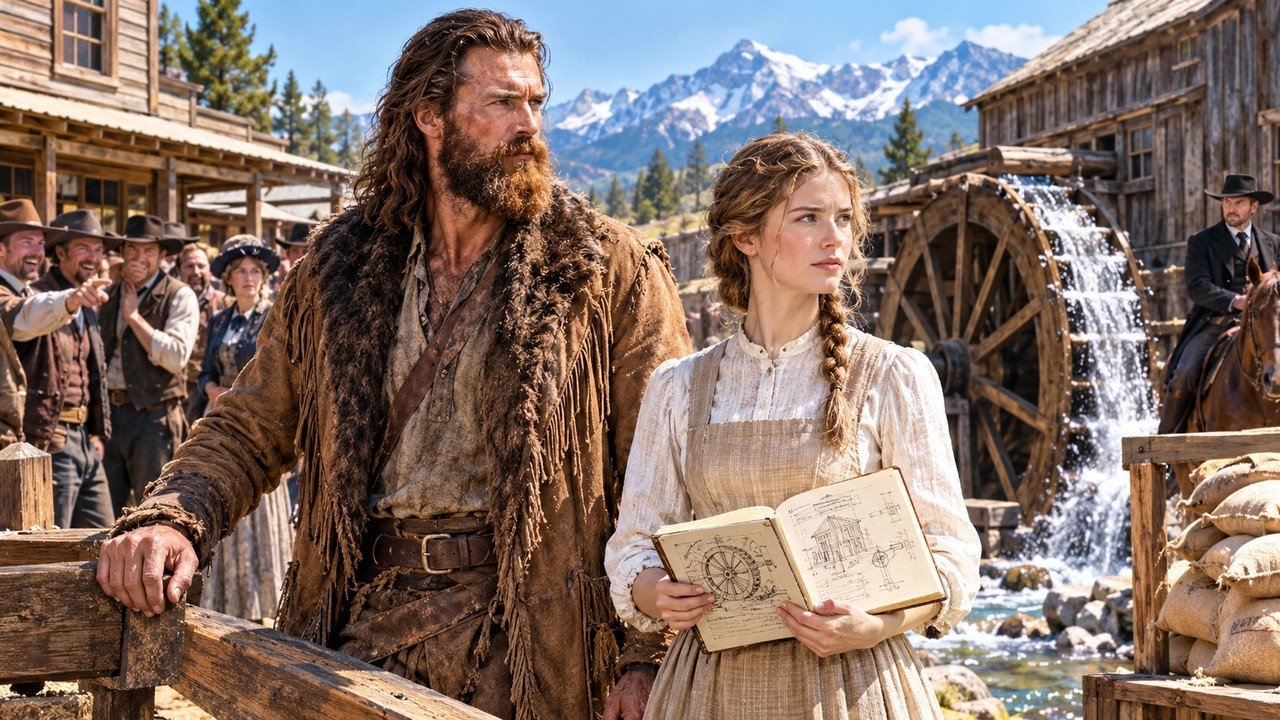
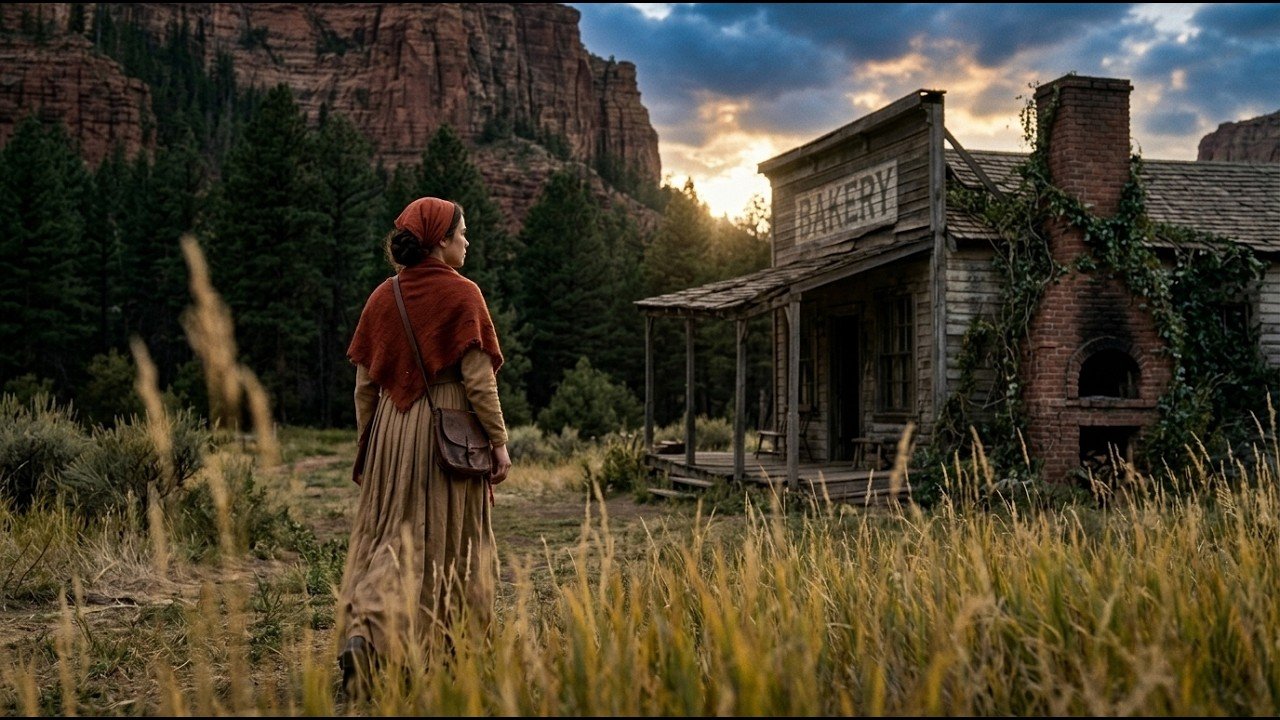
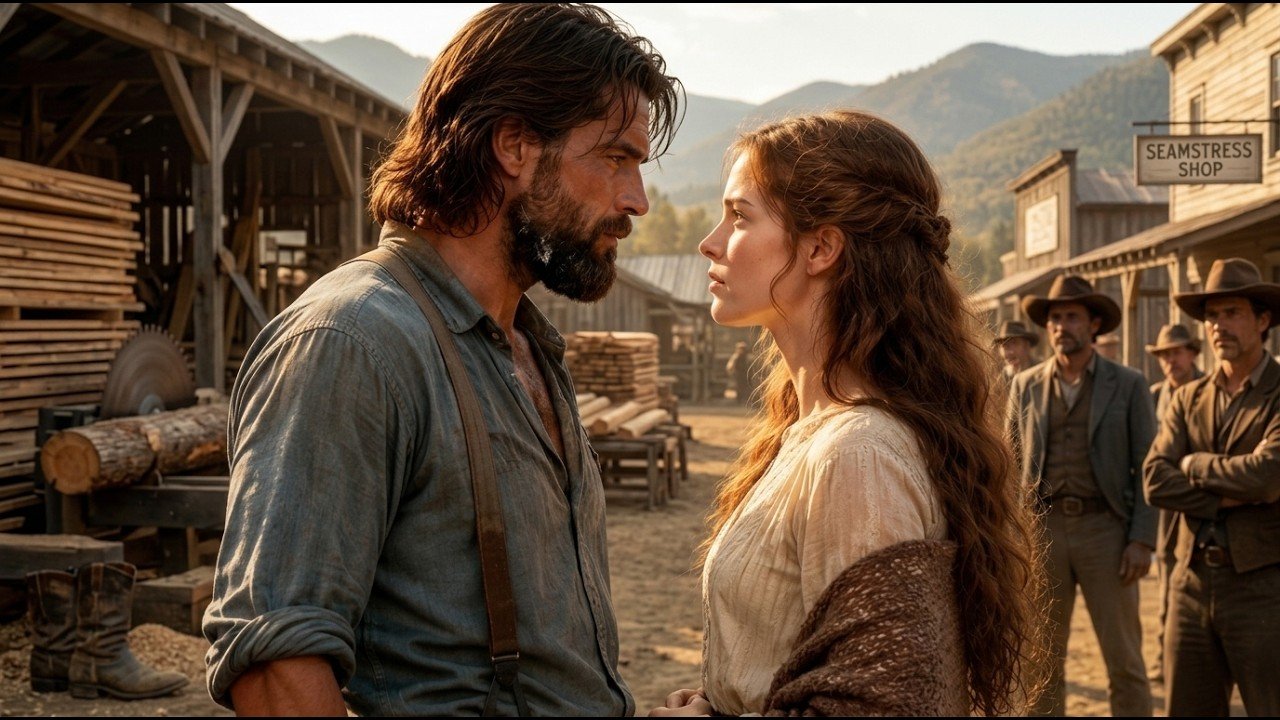
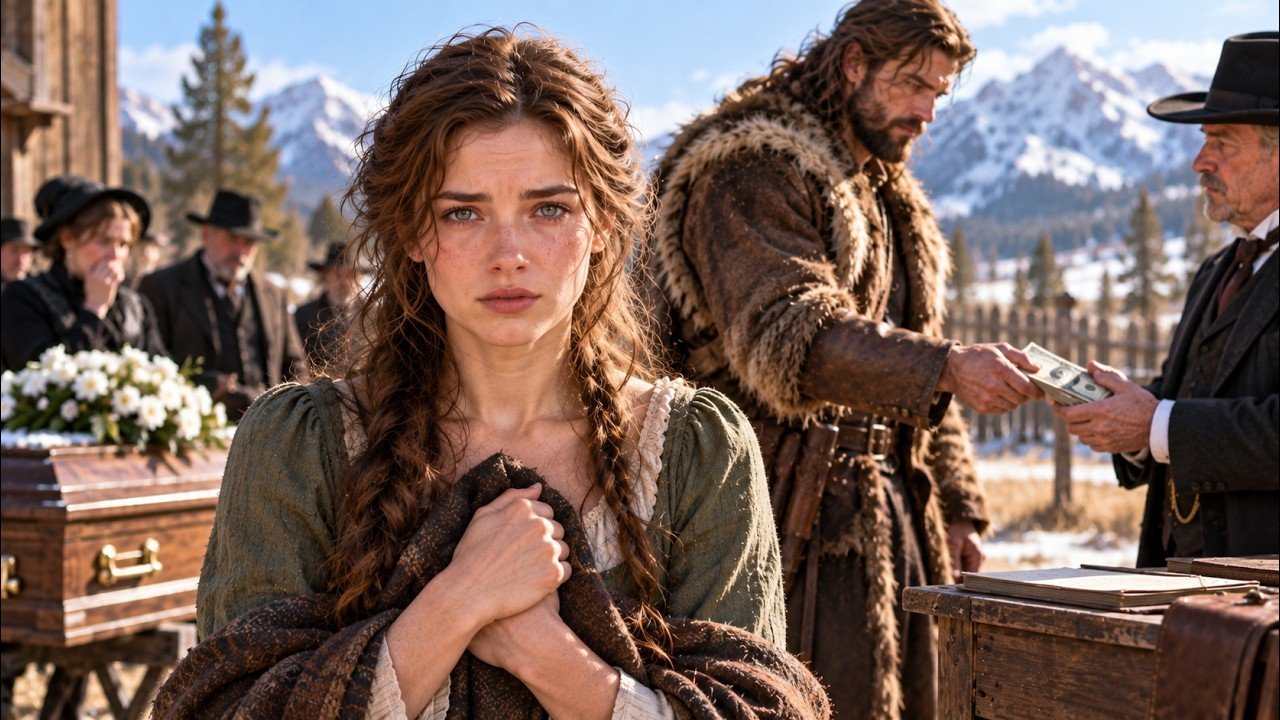
The good people of Cold Fork, Wyoming, like to say they were God-fearing and fair-minded. They proved neither the morning Dolan Rest walked his mail-order bride down the main street past the general store. She wore a white dress that had seen better years, carried a small bouquet of dried wildflowers, and walked with a white cane tapping steadily against the frozen mud. The laughter started before they reached the church steps. They didn't bother to hide it. Dolan Rest was not a man who came to town often. He trapped the high country above the Absaroka Range, a stretch of wilderness so severe that even the Crow men who had hunted it for generations spoke carefully of its winters. He was 38 years old, wide across the shoulders as a barn door, with dark auburn hair worn long and a beard that had gone untrimmed since sometime the previous spring. His buckskin coat was blotched with pine tar and old blood. When he walked, the frozen ground seemed to compact beneath him, as though the earth itself stepped out of his way. He had come down to Cold Fork for the same reasons he always did: ammunition, sugar, and news. He got all three and one thing he hadn't expected. Her name was Iris Novak. He knew it from the agency letter the postmaster handed alongside a box of .44 cartridges. 29 years old, widow, deaf since a fever two winters paSt. Had a quarter section on the eastern bench that her late husband Radoslav had filed before a mine collapse crushed him and three other men in the Bitterroot. She had no family west of Chicago, no means of income, and a debt against the land she could not service alone. She was looking for a practical arrangement. So was he. Dolan had read the letter twice standing in the cold outside the post office. Then he folded it, put it in his breast pocket, and walked to the land office to look up what a quarter section on the eastern bench was worth. He found Iris Novak waiting on the bench outside the telegraph office. She was small and severe in the way that prairie weather makes women severe, stripped of softness without destroying dignity. Her eyes were dark brown and absolutely clear, and they fixed on him with an alertness that startled him. He was used to people looking at him with unease or contempt. She looked at him the way a surveyor looks at a mountain, measuring, assessing, deciding whether the terrain was workable. She watched his lips when he spoke. He didn't know that at firSt. He introduced himself, and she tilted her chin slightly, and he repeated himself more carefully, shaping the words slowly without knowing why he did it. She nodded and extended her hand. Her grip was firm and rough, the hand of someone who had been splitting her own wood. They were married 4 days later by the circuit judge, not the reverend, because the reverend had made his opinion known through his wife, who had made it known through the dry goods counter, who had made it known to the entirety of Cold Fork within approximately 6 hours. A deaf foreign widow and a mountain hermit who smelled like a tannery. A match made in desperation, not in heaven. Neither of them would last the season. When Dolan and Iris walked out of the judge's cramped office and down the main street toward the livery where his wagon was tied, they passed the length of that town's opinion. Men on the porch of Elgin's Mercantile, women at the post office window, a group of boys who had been told not to laugh and were doing it anyway behind their hands. Dolan felt the familiar cold coiling in his chest, the one that arrived whenever he was reminded of what the world thought of him. He had spent 20 years being thought of as barely human, a wilderness animal that occasionally wandered into town to buy things. He had made a kind of peace with it. Then he felt it, a light deliberate pressure against his left forearm. He looked down. Iris had not taken his arm. She had simply rested two fingers against his sleeve, barely touching, the way a person rests two fingers against a wall to orient themselves in the dark. Her face was forward and utterly composed. Her white cane placed across her opposite arm since the street was paved and she'd memorized its slope in a single walking. She wasn't holding him for support. She was telling him something without words. She had already decided not to be ashamed of this. Dolan straightened his spine and walked. He didn't look at any of them. The Novak quarter section was 11 miles east of Cold Fork, where the land tilted up toward the bench and the creek ran clear over limestone. The cabin was sound, which surprised him. He'd expected ruin, but the logs were chinked carefully and the roof had been patched recently with fresh shakes. He could see by the newness of the wood that she had done the patching herself. He helped her down from the wagon and began unloading the supplies he'd brought. She walked straight to the cabin door, placed her palm against the wood for a moment as if greeting it and went inside. He stood in the cold yard with a 100 lb sack of flour over one shoulder, watching the closed door. After a moment, he followed her in. She had already built the fire. He set the flour down. She was moving around the cabin with her hands at her sides, navigating the space by memory and an absolute internal certainty he found unsettling in the best possible way. She stopped at the table and turned to face him. She watched his face with that same measuring quality. He pointed at the loft, then at himself, meaning he would sleep there. She could have the ground floor bed. He'd heard enough cautionary tales about mail-order marriages gone wrong to know that clarity was mercy. She looked at him for a moment, then shook her head once very slightly. She pointed at the loft and then at herself. She pointed at the main room, at him, and then at the good iron stove, the better warmth she was indicating. Easier access to the fire if he needed to get up in the night. She was being practical. So was he, he told himself when he accepted the arrangement. The first week was silence of a particular kind, heavily inhabited silence, the silence of two strangers learning the rhythms of a shared space. Dolan chopped wood and restacked the pile on the south wall of the cabin. Iris made a thick venison stew from the haunch he'd brought down in the wagon, seasoned it with dried herbs she kept in labeled paper packets, and it was the best thing he'd eaten in two years. He told her so, or tried to. She watched his face and eventually smiled, brief and certain, and turned back to the pot. He noticed on the third day that she was carrying a small folded notebook everywhere she went, at the table, in the yard, at the edge of the creek where she sat sometimes in the late afternoon. She wrote in it constantly in a small dense hand. He did not ask about it. He respected the privacy of a person's interior work. On the fourth day, she left it open on the table, turned to a page of detailed sketches. He almost passed it without looking. Then one diagram caught his eye and he stopped, his hand resting on the back of the chair. He bent to look. It was a technical drawing, a detailed, precisely annotated plan for a water-powered grain mill, but it was unlike any mill design he had seen in the occasional illustrated agricultural magazines that made their way up to Cold Fork. The foundation was set into solid rock rather than mud, braced with a particular lattice of stone anchors. The water wheel was oriented to take the winter flow of the creek, which ran fast and low through the limestone channel, rather than the wide spring current. The gear ratios were written out in a careful numeric column. The angles of the millstone housing were calculated in half degrees. He stood up. He looked at the closed door of the cabin. He looked at the notebook again. That evening, when she came in from the wood pile, he was still at the table. He pointed at the notebook. He looked at her face. He pointed at his own eyes, and then at the creek, and then back at the sketch. She sat down across from him. She took the notebook and flipped back several pages, then several more. Page after page of calculations, material loads and structural weights, lumber requirements broken down by species, spring water flow estimates from three separate seasons of observation, measurements Radoslav must have taken before the mine took him. She laid her palm flat on the pages. He understood. Her husband had dreamed of this. He had gathered the data, and then he was gone, and she had spent the following 18 months, much of it deaf and alone on this bench, teaching herself to read engineering principles from a borrowed manual and refining every calculation he had made. She had corrected several of them. He could see where she'd crossed out his numbers and written her own in a different ink. Dolan sat back in his chair. The fire crackled. Outside, the November wind was starting its serious work against the logs. He picked up the pencil on the table and wrote one word on the margin of the nearest page, when. She looked at the word for a moment, then she took the pencil and wrote back, spring thaw, water level will peak. I I the wheel in before May. He looked at her. She was watching his face with that steady evaluating attention. He nodded. Cold Fork got its entertainment through the dark months in installments. First, it was, "Did you hear the trapper stayed? He didn't just drop the deaf widow off and ride back up the mountain." No, he's been up at the Novak bench cutting timber in the freeze. Second, the deaf widow rides into town alone and goes straight to the blacksmith, places an order for custom iron fittings. Specific dimensions, she writes them out herself on a list the blacksmith said went to half a page. Third, they hired Lucius Branch's boy to haul lumber up the creek trail. The boy came back talking about a grid of string covering the creek bank. Said the deaf woman had laid it out herself. Every intersection staked and measured in the dark by touch. Niles Hacker, who held the paper on what remained of the Novak property debt, heard the same gossip as everyone else. Hacker was a compact man with expensive tastes and the particular cruelty of a person who had turned financial patience into a philosophy. He had extended the note twice because he believed the land would come to him eventually and he preferred not to be seen as a villain. He simply waited. The mountains did the dirty work. But a mill changed the arithmetic entirely. A mill was not a homestead scratching for survival. A mill was a commercial operation. A mill on the Limestone Creek with good head pressure, 11 miles from a town that imported all its milled timber from 60 miles south, was a money-making concern. Hacker went to visit his lawyer on a Tuesday in December. The lawyer found that the remaining debt on the property was $32. He also found a clause in the original land note, buried in the final paragraph, that permitted the lender to call the full balance due with 30 days notice if the property changed use from residential to commercial without the lender's written consent. Hacker rode up the bench road on a Thursday morning with his lawyer's letter in his coat pocket. The temperature was 8°. He found Dolan and Iris working at the creek bank framing the foundation for the mill's main support posts. Dolan was driving an iron spike into a pre-drilled hole in the limestone with a sledgehammer. The sound carried a half mile. Hacker pulled up his horse and waited for the hammering to stop. When it didn't, he called out. Dolan set the hammer down and turned. His face was expressionless. He recognized Hacker from the land office. Iris was watching. She had heard nothing, but she felt the change in Dolan's posture and turned as well, her feet finding solid footing on the bank without looking down. Hacker addressed Dolan, which was both instinctive and a mistake. He explained the clause. He was calling the note. $32 due in 30 days or the bench property reverted to his holding. Dolan listened to all of it without expression, then he turned to Iris. He didn't know the full sign language she had begun teaching him from a small primer book she kept on the kitchen shelf, but they had developed a working grammar of their own over the past 6 weeks built from gesture and expression and the particular attentiveness of two people who had learned to read each other because the alternative was isolation. He told her what Hacker had said in three simple gestures and a held up number with his fingers. Iris looked at Hacker. She didn't reach for her notebook. She didn't appear frightened or shaken. What crossed her face instead was something Dolan recognized from the night he had read her engineering plans, the same clean focused attention. She looked at Hacker as if he were a problem in the notebook, a number that needed recalculating. She held up one finger. Wait. She walked to the supply pack she kept at the base of the nearest poSt. From it she withdrew a folded document, unfolded it carefully, and carried it to Hacker's horse. The land deed, filed with the county in Radoslav Novak's name, with Iris Novak listed as surviving heir and sole claimant. But beneath it was a second paper, smaller, and it was this one she held up for Hacker to read. His lawyer had not found the amendment because it was filed in the district land records 3 days before the original note, which made it a prior covenant. Radoslav had been a cautious man with a bitter experience of creditors. Before he signed anything, he had recorded the property's stated purpose as agricultural, including milling, because the creek ran through it, and that was a natural use of running water on productive land. The clause Hacker's lawyer had found did not apply. Commercial milling was not a change of use. It was the original intended use on record. Hacker read the document twice. His face went through several colors. He tried the angle that the amendment was of questionable validity, that it would require a judge to interpret. Iris watched Dolan's face, got the summary of this, and wrote in her notebook, tore the page out, and handed it to Hacker. He read it, and his mouth tightened. She had written, "I will welcome the judge's interpretation. I will bring the three men from the district recorder's office who witnessed the filing. I will also bring the registered surveyor I've retained for the mill's commercial permit, who will confirm water rights under section 9 of the territorial code. You may wish to discuss the cost of that proceeding with your lawyer before Thursday." Hacker stared at the note. He looked at the deaf woman standing on the bank of a frozen creek in a work apron, perfectly composed, having demolished his legal position with a page from a notebook. He looked at the mountain of a man standing 10 ft behind her with a sledgehammer resting on one shoulder. He folded the note and put it in his coat pocket without giving it back. He pulled his horse around and rode down the bench road without another word. Dolan walked to Iris. He raised his eyebrows in the questioning way she had identified for him early on. She glanced at the retreating shape of Hacker's horse. Then she turned back to the post they had been setting. She picked up her chalk line and began marking the next anchor position. She was not celebrating. The work was the celebration. He had come to understand this about her. He picked up the sledgehammer. February came in with a temper, 3 ft of snow in 9 days, and a wind that drove needles of ice sideways off the bench. The work stopped being voluntary and started being survival. They took turns through the night feeding the stove, sleeping in 2-hour rotations, watching the thermometer they'd nailed to the cabin wall. At 20 below, the horses needed extra checking. At 30 below, the creek itself might freeze through and threaten the flume they'd already set in the limestone channel. Dolan did most of the night checking. Iris was a lighter sleeper and often had her eyes open when he pulled on his coat, but he shook his head and pointed at the stove, meaning he'd handle it. She had learned the cold better than he'd expected, better than most men he'd known, but the night wind off the bench at 30 below was its own particular violence, and she had not grown up with it. One night at the depth of February, the temperature fell to a point where even the mercury sat sluggish and unhelpful at the base of the thermometer tube. Dolan went out to check the horses and didn't come back in the expected time. Iris lay still for 4 minutes by her internal count, then she got up, put on her heavy coat and her felt-lined boots, took her cane and went out. The cold hit her like something solid. She navigated the yard from memory, the 22 steps to the barn, the specific feel of the latch. She got the door open. Both horses were down, not dead. Collapsed from cold stress, their body temperatures dropping. She could feel the absence of normal warmth from them even before she found them with her hands. Dolan was beside the mare, his big hands working her chest, trying to encourage circulation. He had already brought straw to pack around them both and had thrown his own coat over the gelding's flank. He couldn't do both at once. Without pausing, Iris laid herself down on the frozen barn floor against the mare's back, pressing her full body length against the animal and pulling her own coat around them both like a wing. The mare was large. The cold coming off the ground was brutal. Iris worked her arms under the horse's neck and held on. Dolan, across the barn with the gelding, felt the sharp lurch in his chest when he heard the creak of the door and realized she had come out. He couldn't see her well in the dark. He called to her, knowing she couldn't hear, not wanting to leave the gelding whose breathing was shallow and faSt. He worked on the gelding through the night. Iris stayed against the mare through the night. By the time the sky went from black to the deep pewter of pre-dawn, both horses were back on their feet, shaky, water-eyed, but standing. Dolan stood in the barn door in the gray light and looked at Iris. She had straw in her hair and her face was pale from the cold, cut with windburn. She was holding the mare's halter and running a hand down the animal's neck, assessing. He put his hand on her shoulder, carefully. She turned. He thought she might look tired or frightened or ask some question with her expression. She looked instead the way she always looked, focused, operational. She tilted her head toward the cabin, meaning, "Go warm up. There's work to begin later." He caught her hand as she turned. She stopped and looked at him. He didn't have the words in any language for what he meant to say. The gap between what the night had been and what could reasonably be put into gesture was too wide. He held her hand for a moment with both of his, her cold fingers between his larger, colder ones, and hoped she understood. By the way her expression changed very slightly, becoming less operational and more simply human, he thought perhaps she did. March came and the snow began to pull back up the mountain. The creek ran fast and gray with snowmelt, higher than its winter channel by 2 ft, thundering through the limestone cut with a pressure that set the completed flume vibrating. This was what Iris had planned for. The high water pulse of early spring, violent and brief, was when the wheel would jet generate its maximum power. She had designed the gearing to handle it. She had tested the math four times. Word had reached Cold Fork that the deaf widow and the mountain man had built something up on the bench. People rode up to see, not out of goodwill, but out of the specific fascination that communities hold for visible proof that they have been wrong. The mill was not a shed. It was a two-story timber structure seated on the limestone outcropping, its wheel housing cantilevered over the flume on the iron brackets Iris had specified from the blacksmith's work liSt. The foundation stones were mortared with a mixture Iris had worked out through three weeks of reading a construction manual by the fireside, her fingers tracing the chemical formulas as she worked through the conversions in her head. The wheel was 16 ft in diameter, its paddles angled at 17° to cup the current most efficiently. That 17° had been a full afternoon of calculation, Dolan watching her work at the table, the pencil moving through figures he couldn't follow until she set the pencil down and tapped the final number as if she had arrived somewhere she had known all along was there. On the morning they opened the sluice, the whole bench was silent except for the creek. Dolan stood at the gate lever. Iris was inside at the main drive shaft, her hands resting lightly on the housing timber feeling. Dolan pulled the lever. The water hit the paddles with a sound like cannon fire. The wheel lurched, caught, lurched again against the winter stiff grease in the bearings. For 3 seconds nothing turned. Then the sheer brute weight of the water won and the wheel began to move. Slow at first, groaning in every joint, then faster, finding its rhythm, the limestone beneath the foundation humming with the transferred energy. Inside Iris felt it through her hands before she heard anything. The building came alive. The drive shaft turned and the gear teeth caught and the secondary shaft spun up and the millstones began to rotate slow and heavy, the enormous weight of them finding their pace like a sleeping animal waking. She stepped to the hopper and dropped in the small sack of wheat she had been saving for this moment. The The stored it. Flour began to fall from the spout, pale and fine, the first clean grain any mill within 60 miles had ever produced. She collected a handful in her palm. She walked outside into the spring light where Dolan was still standing at the sluice lever, looking at the turning wheel with an expression she had never seen on him before. Not pride, exactly. Something older and quieter than pride. She held the flour out to him. He looked down at her palm. He looked at her face. He reached out and took a pinch of the flour between his rough fingers, feeling its texture, the fineness of the grind that her gear calculations had produced. He met her eyes and nodded once slowly. The nod that meant yes, this is right. This is what it was supposed to be. Niles Hacker was the first paying customer, though he pretended otherwise. He sent his foreman in May with a wagon of wheat and no message, as if placing a business order with a mill were simply a commercial transaction and had nothing whatsoever to do with the deaf widow he had tried to break in December. The rate was 8 cents per bushel. The foreman paid it without negotiating, which told Dolan that Hacker had instructed him not to make trouble. By summer, Cold Forks' relationship with the Bench Mill had become one of those uncomfortable dependencies that small communities develop for things they initially despised. The nearest alternate mill was 63 miles south on a bad road. The Novak Rest Mill, as the land office had it listed, ran 6 days a week through the growing season and turned out milled grain at a quality no one in the valley had previously accessed. You could taste the difference in the bread. People who had laughed on the main street in November now made the 11-mile ride with their grain wagons and stood in the yard waiting their turn, mostly not meeting Iris's eyes when she came out to record the weight and discuss the schedule. She let them be uncomfortable. It cost her nothing. She had not built the mill to make them comfortable. Dolan managed the physical operation of the mill, the maintenance, the handling of the heavy grain sacks, the seasonal calibration of the wheel, but the business was Iris. Every transaction went through her notebook, her careful columns of weights and fees and due dates. She had learned by the third month of operation which customers paid reliably and which needed a reminder, which ones tried to shave of an ounce from the declared weight of their grain, and which ones were honest to the last kernel. She charged accordingly. She expanded the rate system in July, adding a priority service at a premium for customers who needed their grain back within 24 hours. Dolan thought this was aggressive. He told her so by way of a look and a doubtful tilt of his head, which was the medium of disagreement they had developed. She wrote him a two-line note, "Everyone needs flour before a storm. A storm costs them more than our premium. They will pay it and thank us." They paid it. On a September evening when the light came across the bench at a low amber angle and the aspens had gone to gold, Iris found Dolan at the creek cleaning the flume channel of the debris that accumulated over summer. She came to stand beside him, not with her notebook or her cane, just her hands in her apron pockets and her face turned toward the water. He had been learning her language more seriously since May. The small primer book had become a worn and annotated thing, full of his marginal notes in handwriting that improved as the months went on. They still mixed methods, written notes and gesture and expression, but the conversations had grown longer and more layered. They talked about things now that had nothing to do with the mill. He had told her about a mountain he had camped on for 2 weeks one October watching the elk migration below him. She had told him about her father's bakery in Chicago, how she had grown up understanding the work of grain before she ever came west and found herself on a limestone bench above a fast creek. He looked at her standing beside him in the September light. He said, aloud and also with his hands, both at once in the way he had recently begun, "I think we built something real here." She watched his hands and his face together. She considered this for a moment with the particular solemnity she brought to things that mattered. Then she signed back, slowly and precisely, so he would catch each word, "We built several things." He understood her to mean the mill, the cabin, the winter, the horses, the accumulated months of shared work. He understood her to mean also the thing between them that had no name yet, but was solid enough that he noticed its weight every day, the way you notice the weight of something good, not as a burden, but as a confirmation of substance. He reached out and tucked a loose strand of hair back from her face, the way the wind had brought it across her cheek. A simple, careful gesture that he had not made before. She went very still for a moment. Then she leaned slightly toward him, not much, just enough that the distance between them became something different from what it had been. Down in Cold Fork, the gossip had long since moved on to other failures to predict and other people to underestimate. The deaf widow and the mountain man barely merited discussion anymore. They were simply a feature of the valley now, like the creek itself, like the bench where the aspens turned earliest in fall, present, reliable, significantly more useful than anyone had expected. In the mill, the wheel turned with the cold coming water. Flour accumulated in the bins, the limestone held. Iris Novak Rest had never needed anyone to believe she could build something. She had needed a limestone creek, a winter long enough to finish the calculations, and one man who was willing to set down his sledgehammer long enough to read what she had already drawn. She had found all three on the same piece of ground.