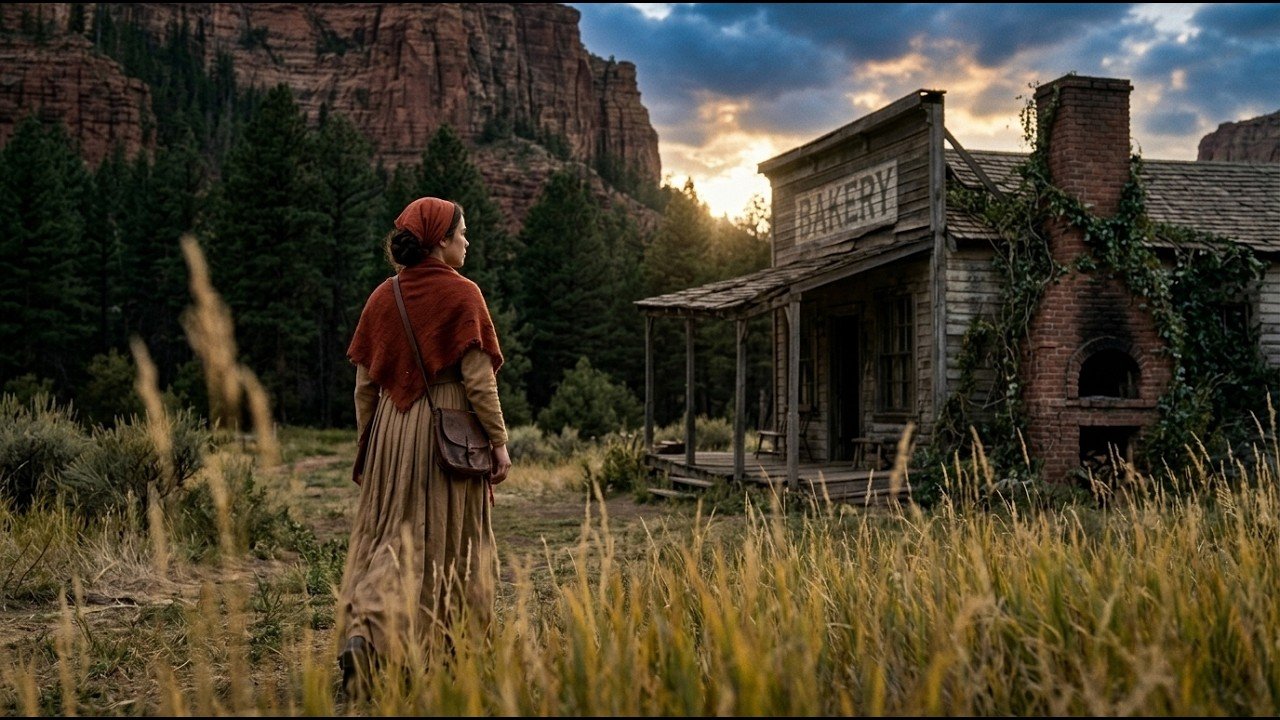
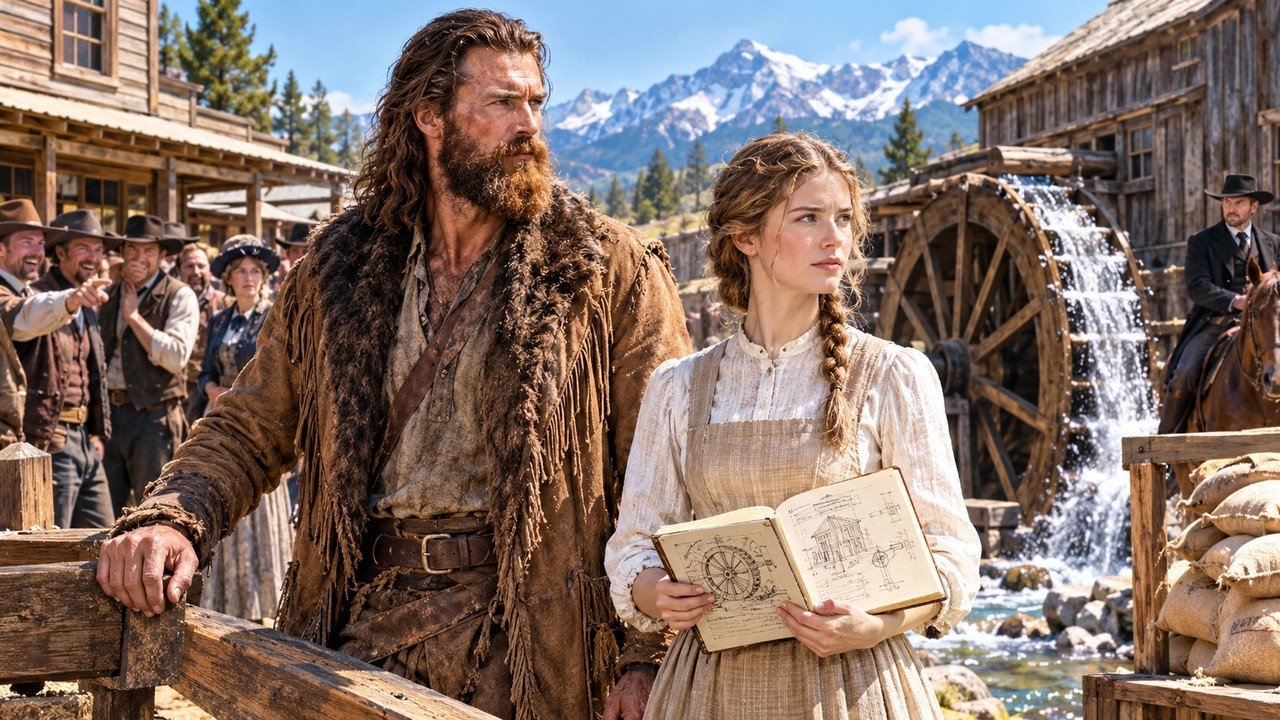
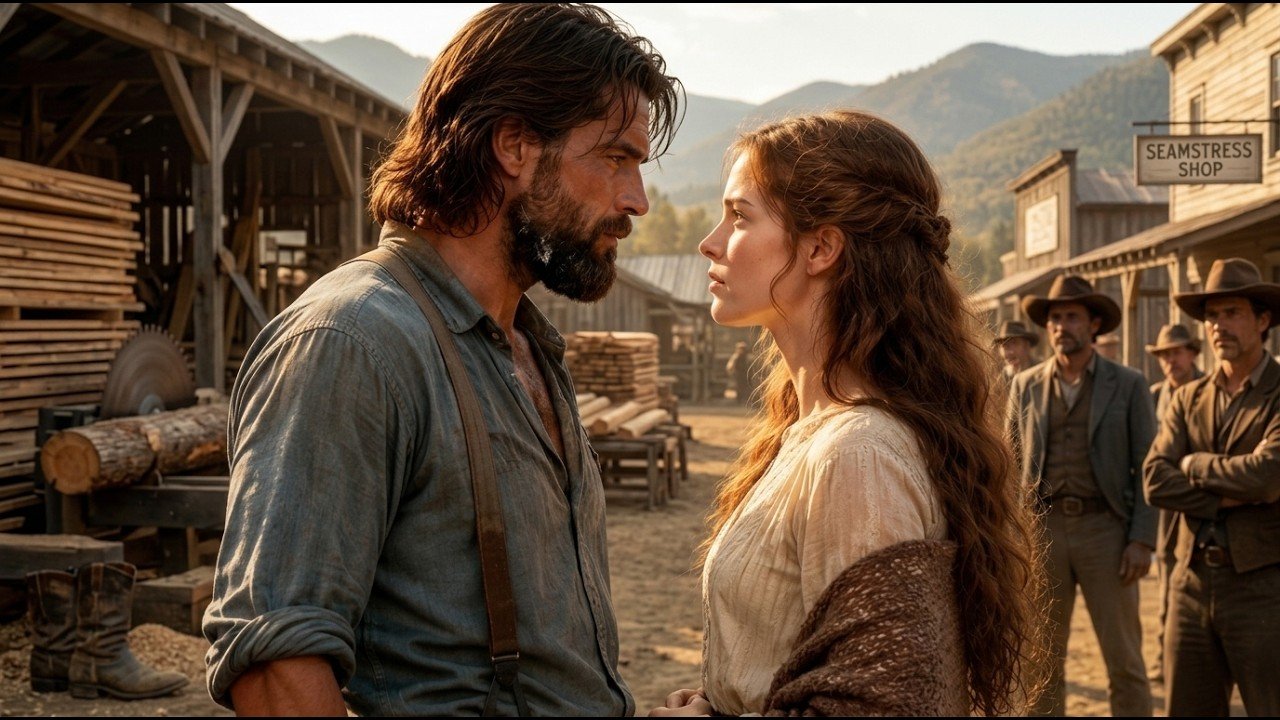
A Mountain Man Took In the Bride Another Man Rejected—“You’re Stronger Than He Knew”
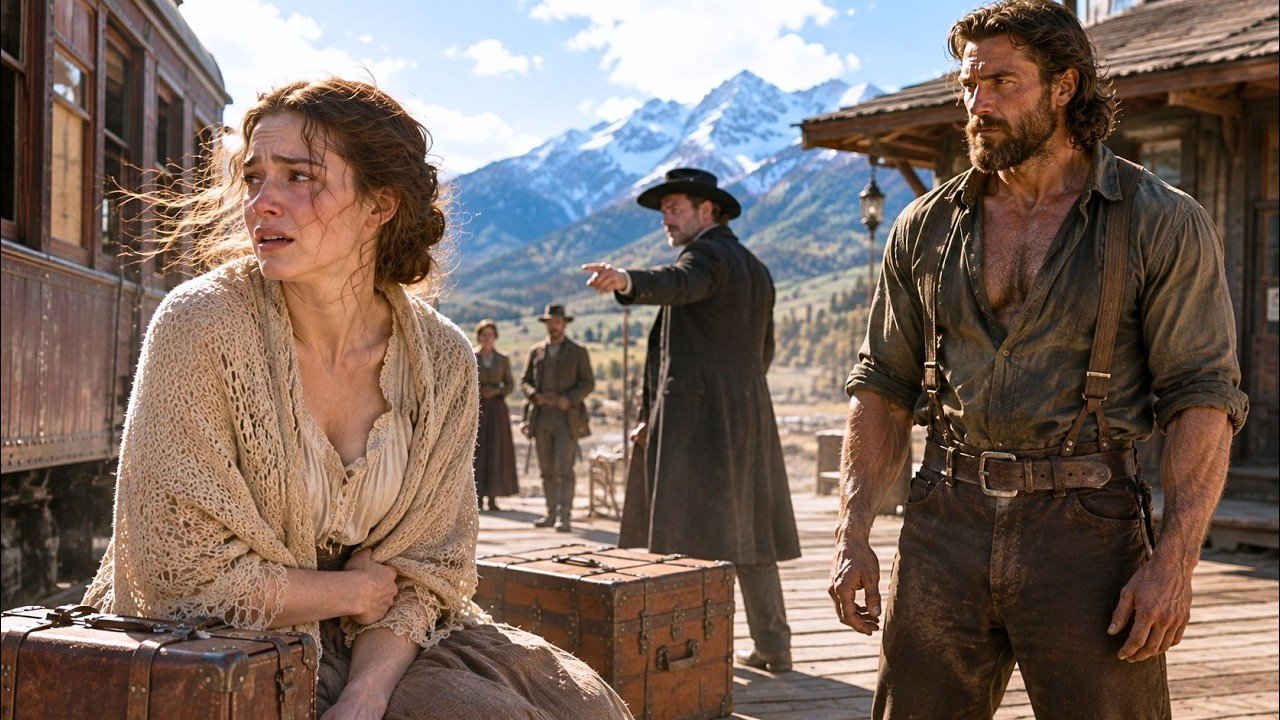
Horus Tilling looked her up and down the way a man inspects a horse he's already decided not to buy. He stood on the platform at Ironwood Crossing Single Track Station, arms folded across his chest, mouth set in a thin, satisfied line, the expression of a man who had made up his mind before she even stepped off the train. The October wind cut across the platform, and Lenora Bell stood there with her one trunk and her traveling case, still holding the letter he had written her, the letter that had promised a future, a home, a husband, a life. Horus said it loud enough that the station master heard. Loud enough that the two women waiting by the freight door heard. Loud enough that the boy leading a mule past the water trough stopped and turned his head. "You'll never last a Montana winter," he said. "I needed a strong woman." You're a seamstress." He said the word like it was a diagnosis. The train had been moving for 3 days. Lenorbel had spent most of those three days sitting upright in a secondass car that smelled of coal's smoke and other people's food, watching the landscape outside the window shift from the flat orderliness of Pennsylvania into something wilder and less forgiving. The mountains had appeared on the second day, distant and gray, and she had pressed her fingers against the cold glass and thought, "There it is. There is the place where my life begins again." She was 27 years old. She had been a seamstress in Philadelphia for 9 years, working in a shop that made alterations and bridal wear, which meant she spent most of her working hours making other women's futures look beautiful, while her own sat sat in a drawer with Horus Tilling's letters. They had corresponded for 14 months. She had his photograph, a formal sitting, stiff collar, serious expression, and he had hers. He had written about his general store, about Ironwood Crossing, about the opportunity the Montana Territory offered to a man willing to work and a woman willing to stand beside him. He had never once mentioned that he expected her to be large, that he had imagined something substantial, something capable of hauling flower sacks and wrestling wagon wheels, something built for the physical punishment of frontier life. He had not asked about her build in any of his letters. He had seen her photograph, but there is a difference. This is Lenora would later understand between knowing something in your mind and accepting it in your gut. And Horus Tilling standing on that platform watching her descend the train steps with her one trunk and her traveling case and her careful posture felt the gap between his expectations and the woman walking toward him open up like a crack in spring ice. She saw it happen on his face. The smile started the professional welcome to Montana smile of a man greeting his future wife and then it stalled. His eyes traveled over her quickly the way a shopkeeper inventories a shelf and his expression didn't go hostile. It went calculating. Lenora, he said. He said her name like he was testing whether it still fit. Orus. She extended her hand and he shook it. And even that small gesture told her something was wrong. His grip was brief and business-like. The handshake you give a supplier, not a woman you've been writing love letters to for over a year. You're smaller than I pictured, he said. I'm exactly the size I am in my photograph. Photographs don't show everything. He picked up her trunk. She noticed that he inspected its weight before he lifted it. And his expression confirmed something and started toward the station house. Come on, we'll get your bags inside. Lenora followed him. She was watching the back of his neck, the set of shoulders, reading the language of a man who had already made a decision, and was looking for the right words to deliver it. She had sewn wedding dresses for 9 years. She had stood in rooms full of women making the most important choice of their lives, and she had learned to read hesitation the way other people read weather. Horus set her trunk down inside the station and turned to her, and the station master suddenly became very interested in his paperwork. I'll be honest with you, Horus said. Because it's better now than later. Is it? I needed a woman who could handle frontier work. Real work. I'm not talking about needles and thread. Lenora. I'm talking about hauling water, managing livestock, surviving a Montana winter when the temperature drops to 30 below and the wood supply runs short. That kind of work breaks people who aren't built for it. He paused. You're not built for it. She stood very still. The station master's pen scratched across paper. Outside, the mule boy had stopped walking entirely. You're a seamstress, Horus continued. And that word that flat, diminishing word landed like a stone. I'm sure you're good at it. But I made a mistake in my letters. I described what I needed, and I let myself imagine something different. That's not your fault. But I can't go through with this knowing what I know. Lenora's hands inside her gloves had gone cold. Not from the weather. You're telling me, she said carefully, that you are ending our engagement here at the station before I've set foot inside the town. I think it's kinder then. You are telling me, she said again, and something in her voice made him stop that after 14 months of correspondence and a 3-day train journey during which I gave up my employment, my apartment, and my established life in Philadelphia, you are standing in this station house, telling me I am not physically adequate. Horus had the grace to look briefly uncomfortable. "I'm trying to be practical." "You are trying," Lenora said to make yourself feel better about a cowardly decision. "The station master stopped writing entirely." Horus's jaw tightened. "Now listen here. I have listened," Lenora said. "For 14 months, I have listened to everything you wrote. I came here in good faith and you did not have the decency to raise this concern in any letter or to ask a single direct question because if you had asked and I had answered honestly you would have had to make this decision before I bought a train ticket. She picked up her traveling case. So yes, I understand what you're doing. I simply wanted you to understand what it is. She walked out of the station. She didn't run. She didn't let her eyes fill. She stood on the platform in the October cold with the mountains behind the town and the narrow street ahead. And she did the arithmetic she already knew was necessary. How much money she had, how many days it would last, what a return ticket to Philadelphia would cost, whether she had anything in Philadelphia left to return to. The answer to the last question was the worst part. She had given notice at the shop. She had ended her lease. She had sold most of her furniture. Going back meant starting entirely over with less money and less pride. And the story of a woman who traveled to Montana to be rejected at the station would follow her the way bad stories follow women who can't outrun them. So she stood there and she calculated. And that was when she heard boots on the platform boards behind her. She didn't turn around immediately. She heard the boots stop a few feet back and she heard a voice that was lower and rougher than Horus Tilling's careful merchant's tone. The voice of a man who spent more time outdoors than in say he's an idiot. She turned. The man standing behind her was nothing like Horus. Horus was tidy, buttoned up, the kind of man who kept his fingernails clean and his ledger balanced. This man had two days of beard and a wool coat that had been repaired at both elbows and boots that had been through seasons of serious use. He was tall, considerably taller than Horus, with the particular lean solidity of someone whose physical work was real rather than performed. He was probably 35, maybe older. Hard to tell with men who worked outdoors. He was holding his hat in one hand and and looking at her with an expression she couldn't entirely read. Not pity, not the cautious interest of a man who thinks an available woman is an opportunity. Something more careful than either of those things. I'm sorry, she said. Do I know you? No, I was at the freight window. He nodded back toward the station. I heard. Then you know I've just had a memorable morning. I know Horus Tilling, the man said, and I know he's been trying to find a wife for 2 years, and I know he has a list of requirements that would exhaust a draft horse. And I know he's turned away two other women before you, though not at the station. He paused. Not this publicly. Lenora looked at him steadily. Are you trying to make me feel better or worse? Neither. I'm trying to be straightforward with you because I have a problem and I think you might have a solution. He put his hat back on. My name is Ror Varden. I run a timber claim 12 mi up the ridge. I need someone to manage my books and keep the cabin through winter. I've had three hired hands since September, and all three left before the first snow. I'll pay wages, provide food and a private room, and have you back in town by spring with enough to take any train you want. Lenora stared at him. You're offering me employment. I'm offering you options, he said. Which is more than Tilling offered you. She looked at him for a long moment. In 9 years of working with brides, she had learned to distinguish between men who meant what they said and men who said what they thought you wanted to hear. Horus had been the second kind all along. She saw that now with the clean, painful clarity of hindsight. His letters had been full of warmth and promise, and she had read them as the truth of his character rather than the performance of a man trying to secure what he wanted. This man, Ror Varden, was saying something specific and limited and honeSt. No warmth, no performance. Just here is my problem. Here is what I can offer. Here is what I need. I told Horus I was a seamstress, she said. I also did all the bookkeeping for the shop I worked in. I can read a ledger. I know you can read a ledger, Ror said. I watched you doing the arithmetic in your head the second you walked out of that station. That stopped her. You were watching me think. You stood on this platform and your face went through every number you had. I've seen men do it before a hard season, counting what's left, calculating what it costs, figuring out if it's survivable. He looked at her steadily. He said, "You were too fragile. I was watching what happened when he humiliated you in front of three people, and you didn't break. Those aren't the same thing. Lenora was quiet for a moment. The wind came off the mountains and pulled at her coat, and somewhere down the street, a door opened and closed, and the ordinary business of Ironwood Crossing continued without any awareness that she was standing on this platform, making the most consequential decision of her life. "You have no family," she said at the claim. "No, no other workers." "Not currently. And you're asking a woman you met 4 minutes ago to come 12 m up a mountain with you?" I'm asking a woman who just demonstrated more composure under public humiliation than most men I know to consider a business arrangement that benefits both of us. He paused. The answer will probably be no. I understand that. But I watched you standing here calculating and I thought it was worth saying out loud. Lenora looked down at her traveling case. Then she looked up at the mountains behind the town, the blue gray peaks going white at the top. The treeine dark and dense below the snow line. The whole enormous indifferent wall of the Montana Rockies sitting there like a problem that didn't care whether you solved it or not. Then she looked at Ror Varden. "Where's your wagon?" She said. "Something shifted in his expression, not quite surprised, but close to it by the freight house." "Then let's get my trunk," Lenora said before I change my mind. The wagon ride to the claim took most of the day. Ror drove and Lenora sat beside him on the bench and they didn't talk much at first which suited her fine because she needed to think. The road out of Ironwood Crossing was decent enough for the first few miles wheeldduted but level following the creek bed north before turning east and beginning to climb. After the first hour it stopped being a road and became a track, two parallel lines pressed into the earth by repeated wagon wheels. And after the second hour, it became something Ror seemed to navigate more by memory than by any visible markings. The trees got taller, the air got colder, the sounds of the town, which had never been loud, disappeared entirely, and were replaced by wind and the creek of the wagon, and the sound of the two mules working steadily uphill. How long have you had the claim? She asked. Somewhere in the third hour, 6 years. Alone, had a partner the first 2 years. He left. Why, Ror considered this? He said the ridge had a personality and it wasn't friendly. Lenora looked at the treeine. And what did you say? I said he was right, but I wasn't planning to be its friend. She almost smiled. Do you have a system for the books or have you been keeping track in your head? Got ledgers. Haven't opened them in 4 months. Why not? Because every time I open them, I find something I don't want to know. That was honest at leaSt. She had met merchants who hadn't opened their books in years for exactly the same reason. And the books the say same. And the books always said the same thing. In the end, the problem was larger than you thought, and it had been growing while you weren't looking. How bad is it? She asked. I don't know. Take a guess. He was quiet for a moment, watching the track ahead, where it curved around a rocky outcrop. The Copper Creek buyer pays me by the board foot. I've been taking his word for the measurements. Lenora let that sit between them, and you've never verified them. Didn't have time. Ror. She stopped herself. Mr. Varden Ror is fine. Ror taking a timber buyer's word for the measurements is the same as letting him set his own price. I know that. Then why? Because I'm alone up here and there are 16 hours of work in a day, and I can't be in the forest felling timber and in the cabin checking arithmetic at the same time. He said it without defensiveness, just flat fact. That's why I need someone who can. She didn't answer immediately. She was looking at the calculation again, not her own money this time, but his. A man working alone, capable enough to run a timber operation in the Montana mountains, who had been handing someone else the pencil, and trusting the result. "What's the buyer's name?" She asked. "Pike, Bramwell Pike, runs a supply and timber operation out of Copper Creek," she filed the name. The cabin appeared in the last of the afternoon light, not the ruin she had half expected, but a solid structure built from the same timber the ridge produced. Low and wide with a stone chimney and a covered porch, and a wood pile along the east wall that was large, but clearly not large enough. There was a small barn, a root cellar, a water barrel under a roof spout. Ror brought the wagon to a stop and climbed down, and began unhitching the mules without ceremony. Lenora climbed down herself. He didn't offer his hand, which she appreciated because she didn't want the assistance, and looked at the cabin and tried to assess it the way she would a practical problem rather than a dwelling. One chimney, probably one main heating source. The porch faced south, which was smart. The wood pile was along the east wall, where it would catch morning sun and stay accessible from the cabin door. Whoever had built this had thought about function first, which was either Ror himself or someone who knew what they were doing. The room I mentioned, Ror said, leading the mules toward the barn is off the main room to the right. I sleep on the left. There's a bar on the inside of your door. She looked at him. I'm not going to pretend the arrangement isn't unusual, he said. Just want you to know the bar is there. It was, she decided, the most matter-of-act thing anyone had said to her all day, and it was somehow more reassuring than any amount of formal reassurance would have been. The first week nearly broke her. Not Ror the ridge. She had understood cold before Philadelphia winters were not gentle, but Montana in late October at elevation was a different category of cold entirely. It lived in the gaps. It found the place where your collar didn't quite close, and the space between your glove and your sleeve, and it settled there and stayed. The water barrel froze every night and had to be broken in the morning. The fire needed feeding at intervals she had to learn by experiment before she stopped waking up at 3:00 in the morning to find the cabin dangerously cold. Ror was up before light every day and outside working by the time she had the breakfast fire going. He came in for a meal at midday, ate without discussion, and went back out. He came in at dark, ate the evening meal she had managed to construct from the stores in the root cellar, and was asleep not long after. He gave instructions without apology or softening. The first morning he walked her through the water situation, the fire protocol, the root seller inventory, the mule feeding schedule, and the location of every tool she might need, and he did it quickly and expected her to keep up. When she asked a question, he answered it directly. When she made a mistake, burned the porridge on the third morning. Badly, he looked at the pot, looked at her, and said, "The fire is hotter in the morning than you think. AdjuSt." and went back to eating what remained. She opened the ledgers on the fourth day. She had waited until she was confident she could sit at the table and give them real attention. And she brought them out from the shelf where they'd been stacked behind a box of hardware and set them on the table. In order there were six of them, covering the past four years, and opened the most recent one. It took her 40 minutes to understand the basic system, which was messier than she expected, but not incomprehensible. Ror was not an accountant, but he wasn't careless. The entries were there, dated and itemized, just disorganized in ways that made the totals unreliable at a glance. She pulled out her own notebook and began transferring entries. Ror came in at midday, looked at the four open ledgers and the notes she'd already filled, and set his plate down without comment. Eight. When he was done, he looked at her work again. Find anything yet? Not yet. I need two more days to build an accurate ledger before I can start looking for discrepancies. He nodded and went back outside. She found the first discrepancy on the sixth day. It was small enough that it could have been an innocent error, a boardfoot measurement in April that was 8% in April was 8% lower than her calculation of what that quantity of timber should have measured. But when she went back to March, the same buyer's entry was low by 11%. In February, it was 6%. None of these gaps were large enough to look suspicious in isolation. Taken together over four years of consistent business with Bramwell Pike. They told a story that made her sit very still at the table and do the addition three times before she trusted the number. She was still sitting there when Ror came in that evening. He took one look at her face. How bad, he said. Over 4 years, accounting for the pattern I'm seeing. I believe Bramwell Pike has underpaid you by somewhere between 18 and 24% of your timber's fair market value. She put her pen down. I need to complete the full calculation, but that's the range. The cabin was very quiet. Say that again, Ror said. She said it again. He sat down heavily in the chair across from her and looked at the ledger and looked at her notes and said nothing for a long time. Outside, the wind had picked up and was pressing against the cabin walls with a low continuous sound that Lenora was beginning to recognize as the ridge's usual conversation with itself. "Can you prove it?" He said finally. "I can document a pattern." "Whether that rises to proof depends on whether you can get anyone to look at it." "Pike has contracts with six other men on this ridge. Then they've likely been shorted, too," Lenora said. "Which means the pattern is larger than your ledgers alone." Ror leaned forward and put both hands flat on the table and looked at her notes with an expression she was starting to learn not rage, which she might have expected, but the focused, quiet look of a man filing information away for later use. Finish the calculation, he said. I intend to. He got up and went to the stove and poured himself coffee and stood with his back to her for a moment, and when he turned around, he looked different, not softer. Exactly. But like something that had been braced for a long time had been allowed to shift slightly. You've been here a week, he said. 6 days. And you found this. The pattern isn't subtle once you look at the numbers side by side. He's been counting on the fact that no one was looking. I wasn't looking. Ror said you were felling timber alone on a mountain. That's not an excuse. It's not, she agreed, but it's a reason. He was quiet again. Then Horus Tilling said you were a seamstress. I was a seamstress who does forensic accounting. I kept books for a bridal shop for 9 years. When the owner is not watching, anyone who keeps books learns quickly whether numbers are honeSt. She picked up her pen. Horus didn't ask about the accounting. He asked about my arMs. Ror looked at her for a moment with something that might have been the beginning of respect if he'd let himself hold it that long. Then he finished his coffee and went to bed. Lenora sat at the table until nearly midnight, working through the numbers, the wind pressing at the walls and the fire making its small sounds and the ledger spreading out around her like a map of someone else's invisible damage. By the end of the second week, she had the full account, 22% on average over 4 years. The total was significant enough that when she wrote the final number in her notebook, she underlined it twice, not for emphasis, but because her hand needed something to do. She was also starting to know the cabin. Not the way you know a familiar place, but the way you know a difficult one, its patterns and its demands. The way the morning cold was different from the afternoon cold, the way the fire in the small stove needed management rather than just fuel. The way the water situation was a daily negotiation rather than a solved problem. She had stopped burning the porridge. She had learned the root seller's inventory well enough to begin planning meals a week ahead. She had reorganized the supply shelf in a way that made the actual quantities visible rather than buried under the disorder of someone who lived alone and didn't bother with systeMs. Ror noticed. He didn't say so directly, but she caught him once looking at the reorganized shelf with the expression she now associated with him, processing new information. Quiet, attentive, filing. He had also been teaching her, not in any formal sense, but when something needed doing outdoors, and he needed an extra pair of hands, he brought her along without ceremony, and showed her what he needed her to do, and expected her to do it. She had held a guide rope while he repositioned a load on the timber sledge. She had learned to handle the smaller of the two mules, a badteeered animal named Luther, who had an opinion about everything, and expressed it physically. She had learned to read the weather by looking at a particular formation of clouds above the eastern ridge because Ror pointed at it one afternoon and said, "That means wind in 4 hours always." She found she liked the learning. She had not expected to. One evening in the third week after supper, Ror came to the table while she was still working and sat in a small tin of salve without comment. "What's this?" She said. "Spruce salve for your hands." She looked at her hands. She had not thought about them much. There was no point in thinking about a problem you couldn't address, but they had become rough in the past three weeks in ways that would have horrified her former self. Blisters at the base of each finger, a long scratch across the back of her right hand from the rope work, the knuckles red from the cold. She looked up at him. He had already sat down across from her and was reviewing the inventory list she'd made. "Thank you," she said. He didn't answer. Just moved his finger down the list to something he wanted to discuss. She opened the tin and the smell of it sharp and clean. Piney filled a small corner of the cabin. She worked it into her hands while he pointed out that the salt supply was lower than she'd accounted for. And she explained that she'd found a further cash in the back of the root cellar, and they talked about supplies and winter calculations for 20 minutes before she realized that her hands had stopped hurting. She didn't call any of it romantic, but she noticed it. The storm came on a Tuesday. She knew it was coming before Ror left that morning because the cloud formation above the eastern ridge was different from anything she'd seen in 3 weeks. Not the usual weather in 4 hours pattern, but something denser, lower, moving faster, she told him. He looked at the sky for a moment. Might pass north of us. Might, she said. I'll be back by mid-afternoon. He wasn't back by midafter afternoon. By 2:00, the light had gone yellow, strange. The kind of light that doesn't belong to any ordinary time of day. By 3:00, the first snow had started. Not the gentle kind, but the driven sideways kind that means business. And by 4:00, she couldn't see the barn from the cabin door. She fed the fire. She watched the door. She counted the time. At 5:00, Luther appeared at the edge of visibility, coming out of the treeine toward the barn at a trot that meant he was unhappy and unguided. Luther alone, Ror's mule. She stood in the cabin doorway, looking at Luther standing by the barn door in the blowing snow, and felt the cold enter her chest in a way that had nothing to do with temperature. She went back inside. She put on every layer she owned. She found the rope coiled on the peg by the door, a long rope, 60 ft at least, and she tied one end to the porch post and checked the knot three times. She pulled on her heaviest gloves and her coat and her hat, and picked up the lantern. Then she loaded blankets onto Luther. She had never handled Luther in the dark before. She had barely handled him reliably in the daylight, but the mule was cold and frightened and willing to be led, and she got the blanket secured as well as she could manage, and tied the free end of the rope around her own wriSt. She walked into the blizzard. The wind hit her like something physical and considered, like it had been waiting for her, specifically. The snow came horizontal and the lantern was almost useless but slightly better than nothing. She followed the rope with her body, one hand touching the line, moving toward the timber trail because that was the direction Ror had gone, and that was the only information she had. She found him 40 minutes later. He was in the timber, partially sheltered by two large pines that had created a small windbreak, lying on his side with one leg pinned beneath a section of pine that had come down sometime in the early hours of the storm. He was conscious, barely. "Get back to the cabin," he said when he saw the lantern. His voice was rough and much slower than usual. "Where is the logging jack?" She said. "Lenora, I know you have a logging jack. Where is it?" He looked at her for a moment with an expression she couldn't fully read in the lantern light. Something between disbelief and the beginning of something else. 20 ft northwest under the tarp. She found it in 15 minutes. She found the rope coiled near it. And she understood from 3 weeks of watching Ror work roughly how the jack worked and roughly what she needed to do. She positioned it under the fallen section of pine, and she ran the rope from the jack's anchor point to Luther's, and she told the mule out loud firmly, the way Ror spoke to him to hold. Luther held. She worked the jack. The pine section lifted 3 in. Ror dragged himself clear. He couldn't stand on the injured leg. She put his arm over her shoulders, and he put his weight on her, and she took it all of it, the full substantial weight of a large man in a Montana blizzard, and she walked. She followed the rope back, hand over hand, Luther on her other side, Ror leaning on her in a way that was going to cost her something she wouldn't be able to name until the next morning. She walked and she didn't think about anything except the next section of rope and the cabin at the end of it. They came through the door at 7:40 in the evening. Ror collapsed into the chair and she got the fire roaring and she pulled off his boot and looked at his leg and it was bad swollen already. The skin discolored, but she didn't think it was broken. Not completely. More likely a bad sprain with some damage she couldn't assess. She packed it in snow for 20 minutes, the way she had read about once in a medical almanac she'd found on the shop owner's shelf, and then wrapped it tightly with strips of cloth from a spare shirt. He watched her work. He didn't say a word until she was finished. Then he said, "How did you get Luther to hold?" "I told him to." Lenora said that mule doesn't hold for anyone. He held tonight. She tied off the bandage. You're going to need to stay off that leg for at least 2 days, possibly three. I can, she said. I'll manage the fire and the animals. We have enough stores. I've already inventorieded them. She looked up at him. I know what we have and I know what we need and we're fine for 10 days if we're careful. So, you are going to rest that leg. He looked at her. She was aware suddenly of what she must look like wet through, windburned, her hair coming entirely loose from its arrangement, her hands shaking slightly now that the crisis had passed, and her body was remembering what it had done for the past 2 hours. You came into the blizzard, Ror said. Yes, I told you not to. You didn't tell me anything. You were pinned under a tree. He was quiet for a long moment. Outside, the storm had reached its full intensity, and the cabin walls were doing the work they had been built to do. The fire was solid. The lantern was lit. The room was warm in the way that warm means everything when cold has been real. You're shaking, Ror said. I know. He reached across the table and picked up the tin of spruce salve and held it out to her. She took it. Their fingers didn't touch quite, but almoSt. And in the long silence after that, with the blizzard pressing at the walls and the fire doing its steady work, and both of them slowly understanding that the night had changed something between them that neither one yet had words for. Lenora Bell sat across from Ror Varden and thought he said I wouldn't break. He was right. But she hadn't known it yet then, standing on that platform in the October cold while Horus Tilling said the word seamstress like it was the end of the conversation. She knew it now. She slept for 11 hours. She didn't mean to. She meant to stay up through the worst of the storm and check the fire and make sure Ror's leg was properly elevated. But somewhere around 10:00, she sat in the chair with her coat still on. And the next thing she knew, it was morning, and the storm had gone quiet, and her neck had a cramp in it from sleeping sideways, and Ror was watching her from across the room with his leg up on a stool and a cup of coffee already in his hand. You made coffee," she said, which was the first thing her brain produced. Carefully, he nodded toward the stove, pots there. She stood up slowly. Every muscle in her back and shoulders had something to say about the previous night, and she let them say it without reacting. She poured coffee and stood by the stove and looked out the small south-facing window at a world that was white and utterly still. The storm had deposited itself everywhere it could reach and then departed, and the ridge looked like something that had been remade from scratch overnight. "How's the leg?" She asked. "Stiff." "Not broken. I think you were right about that." He shifted on the chair, and she could see the effort it cost him not to let the discomfort show in his face. He wasn't entirely successful. The swelling's down some from last night. "Keep it elevated. At least through today. I have timber that needs. It will still need it tomorrow, she said. One day won't ruin you. Two days of using that leg wrong might. He looked at her over his coffee cup. This was becoming a recognizable expression, the one where he was deciding whether to argue and concluding it wasn't worth the energy. She appreciated that about him. Some men argued on principle, as if conceding a practical point was the same as conceding something fundamental about themselves. Ror didn't do that. When the logic was sound, he accepted it. Even when it required him to sit still and rest, which he was learning was one of the things he found most difficult. "The animals," he said, "I'll handle them this morning." Luther's particular about I know how Luther is, she said. We came to an understanding last night. Ror looked at her again, and in that look was something she was still learning to read a quality of attention that was different from how he looked at the ledgers or the supply lists or the weather. More personal somehow, even though he kept it brief. You should have stayed inside, he said. It wasn't an accusation, just a statement of what he still believed to be true, delivered alongside the obvious fact that he was sitting here alive because she hadn't. Probably, she agreed. But then you'd be dead in the timber, so he didn't answer that. He looked at his coffee. She put on her coat and went out to the barn. The cold after the storm was a different kind of cold, still dry, sharp as new glass. The snow was mid thigh in places where it had drifted against the barn wall, and she had to push through it to get the door open. Luther gave her a long, unimpressed look when she came in, and the second mule, a calmer animal named Clara, shifted and stomped once in greeting. She fed them. She checked the water. She found the small shovel behind the barn door and cleared a path from the cabin to the barn so that Ror, when he was eventually upright again, wouldn't have to navigate a drift on a damaged leg. It took her an hour and a half, and by the time she came back inside, her shoulders were done with her for the day. Ror had moved from the chair to the bench by the window. He had the most recent ledger open on his knee and her notebook beside it, and he was comparing pairing entries with the focused expression she recognized from the evenings when he reviewed the inventory lists. He looked up when she came in. You were right about February, he said. She hung up her coat. I know the margin's not random. No, it's very consistent, which is worse than random. Random is error. Consistent is deliberate. She poured water into the cooking pot and set it to heat. He's been doing it long enough that he probably doesn't think about it anymore. It's just his system. His system, Ror said. And the flatness in his voice was not anger exactly, but the thing that sits underneath anger when a man is keeping the lid on. I want to go back further, Lenora said. Do you have anything before these ledgers? Any records from the first years? Box under the bed. I don't know what's in it. She found it after lunch. A wooden crate with a warped lid containing a combination of old supply receipts, two ledger books she hadn't seen before, some folded papers that turned out to be correspondents, and at the very bottom, a set of tally sheets in a different hand from Rors. She brought the whole box to the table and started sorting. Ror watched from the bench. "The tally sheets," she said. "These aren't yours. Connells, my partner the first two years. He kept talls. He was more organized than me. Something in Ror's tone shifted when he said Connell's name. Not grief exactly, but the quiet weight of an old absence. He had a system for everything. Drove me half mad at the time. His system might save us now. She unfolded the tally sheets carefully. They were dated and itemized boardfoot counts, measurements, the buyer's figures alongside Connell's own. He verified the counts himself. That sounds like Connell. Then we have comparison data going back 8 years, not four. She looked up. "Ror, if Pike has been doing this for 8 years, "Don't tell me the number yet," he said. "I need to be sitting somewhere more comfortable before you tell me that number." She almost smiled. "Fair enough." She worked through the tally sheets for the rest of the afternoon, while the cabin filled with the small sounds of an ordinary day, the fire, the wind returning in smaller gusts. Roor shifting on the bench once the sound of him moving carefully to the door to check the sky and moving carefully back, testing the leg with more confidence than that morning. By evening she had the preliminary calculation. 8 years, she said when he was at the table eating the stew she'd made from dried meat and root vegetables. Tell me. She turned her note toward him and put her finger on the number she'd written at the bottom. He looked at it for a long moment without expression. Then he set his spoon down. That's he said, then stopped. Yes, that's almost 3 years of fair wages at minimum. The early years have some gaps in Connell's tallies, so I've been conservative. The real number is likely higher. Ror sat back in his chair and looked at the ceiling and said nothing. She let him have the silence. She'd learned in the second week that he processed things this way, not through immediate reaction, but through this period of quiet that looked like stillness and wasn't. He's doing it to the others, Ror said finally, still looking at the ceiling. Yes, Hendricks up at the north claim. The Pel brothers, Abrams, if they're selling to Pike. Yes, most likely. Ror brought his gaze back down from the ceiling and looked at her with an expression that had crossed from the contained place into something raw. Why didn't anyone catch it? Same reason you didn't. They're working alone or in small groups. They're physically exhausted most of the year, and Pike is counting on the fact that a man who's been in the timber since before dawn doesn't go home and check mathematics at night. She paused. He's not subtle. He's just consistent. And consistency works because people have limited attention. You caught it in 6 days. I wasn't tired in the right way, she said. My hands were tired. My brain was fresh. He looked at her for a moment. Really looked the way he had looked at her on the platform. When he said he'd been watching her think I need to talk to the others, he said once my leg is right. You'll need their ledgers, too, if they have them or any records, even informal ones. Abrams keeps everything. Hendricks, he stopped. I'll figure out who has what. You'll need to look at all of it. I know. She picked up her fork again. Eat your stew. We'll figure out the rest when you can walk without wincing. I'm not you winced when you sat down. I saw it. He picked up his spoon without arguing. They ate in the quiet that had become their particular variety of comfortable. And Lenora thought about the numbers in her notebook and about Bramwell Pike in his office in Copper Creek, adding up the margins he had been skimming for 8 years, and probably never once imagining that a rejected seamstress from Philadelphia, sitting on a mountain with a man she barely knew would be the one to read his system clearly enough to name it for what it was. The thought made her tired and energized in equal measure. She was going to take it apart. But that was going to take time. And first she needed Ror's leg to heal. And first she needed winter to run its course. And the ridge was still covered in 5 ft of new snow. And the cold was settling in for a long stay. And there was still months of work to do before any of that became possible. She opened her notebook to a new page and started making a liSt. November arrived like it had something to prove. The temperature dropped to ranges that the body processed less as sensation and more as information. Information about what happened to living things when they stopped moving. Ror was back on his leg within 4 days, which was faster than she thought was wise and slower than he wanted, and she had made her feelings clear on both counts. He hadn't argued, which meant he agreed with her more than he was willing to say. The daily rhythms of the claim settled into a pattern that was demanding in ways she had stopped resenting because resentment required energy she couldn't spare. The fire was constant. The animals were constant. The food supply was a daily calculation. And she managed it the way she imagined a general managed a campaign with information at the center. Waste treated as the enemy. Improvisation deployed where the plan had gaps. She made a discovery in the third week of November that had nothing to do with the ledgers. She discovered that Ror Varden had a temper. She'd known he was capable of anger. She'd seen the contained version of it when she showed him the numbers, but she hadn't seen the uncontained version until Luther got loose on a particularly miserable Wednesday morning, and Ror spent 40 minutes in kneedeep snow, chasing the mule through the timber before finally getting hold of his harness. And when he came back to the barn, he hit the wall once with the flat of his hand hard enough to leave a mark and said something she didn't know men said, which told her something about how far he was and from his usual self. She was standing in the barn doorway and he saw her and stopped. "Sorry," he said. "He's a difficult animal," she said. "He's a monster in a mule's body, and I should have sold him 3 years ago. He was catching his breath, which was visible in the cold." "I don't." "Why not?" He looked at Luther, who was standing in his stall, looking profoundly unconcerned. He's the better puller. Clara is steadier, but Luther's stronger. You need both for the timber work. So, you keep the difficult one because he's capable. When he decides to cooperate, he said this through his teeth. That sounds familiar, Lenora said before she had fully decided to say it. Ror looked at her. She held her expression neutral. After a moment, something shifted in his face, not quite a smile. Ror didn't do that easily, but the thing that lived near a smile in a man who had forgotten how to produce one readily. "Get inside before you freeze," he said. "I'll finish out here." She went inside, but she heard through the cabin wall the sound of him laughing briefly, quietly to himself, and that small sound did something to the interior of her chest that she chose not to examine too directly. The second time she saw him afraid was different. It was a Sunday in mid- November, and she was working at the table, and he came in from outside in the middle of the day, which he never did unless something had broken or the weather required it. And his face was wrong in a way she couldn't immediately name. "What happened?" She said. He sat down. Just sat down without taking off his coat, which he also never did. Found evidence of a big cat up on the north face. Recent following the timber line, he put his hands flat on the table. There have been mountain lions up here before, but not this close to the cabin in winter. Means the prey thin up higher. She's coming down. A female track size could be wrong. He looked at the table. The animals need to be inside by dark every night. No exceptions. And you don't go to the barn after dark without telling me firSt. All right. I mean it, Lenora. She looked at him. His hands on the table were still in control. But there was something working behind his eyes that she recognized as fear that had been translated into practical concern, which was the only form he seemed to allow it. I understand, she said. I'll follow that rule. If I'm not back by dark, I know where you keep the rifle, she said. He stopped. You've been in my room? No. I've seen you take it from the left side of the door frame when you go into the timber. It's not in your room. She paused. I pay attention. He was looking at her with that expression again. Can you shoot? He said, "I don't know. I've never tried. Then I'll show you Saturday before we lose the afternoon light." She could have argued that this was unnecessary, that he was being cautious past the point of of practicality, that a mountain lion was unlikely to come to the cabin directly. She could see from his face that any of those arguments would be received as resistance to the one precaution that genuinely frightened him. And she understood somewhere below the rational level that the thing frightening him was not entirely the mountain lion. Saturday she agreed. He taught her Saturday afternoon in the clearing behind the barn with the cold settling in early and the light going orange over the western treeine. She was a worse shot than she expected and a better student than he seemed to anticipate. He stood behind her and corrected her grip without touching more than the back of her wrist, directing her toward the alignment she needed. And when she finally hit the mark on the birch post, he'd set up 20 yards out, he said. There, with a satisfaction that sounded like it surprised him. She shot until the cold made her hands unreliable. And then they went inside and she didn't think about the way his voice had sounded when he said there or the way standing in that clearing with him in the late afternoon light had felt like something she didn't have a category for. She thought about it a little later, just not while she was still in the clearing. December came down hard. The mountain lion didn't come to the cabin. Ror found evidence of her further north, moving toward different hunting grounds, but December brought its own category of challenges. Not dramatic ones, but the grinding kind. The accumulated weight of cold and dark and isolation and the relentless daily requirement to keep everything running. She sat sickness a second week of December. Not badly sick, not the kind that frightened her, but sick enough that she woke up three days in a row feeling like the world had been slightly tilted without her permission, and her throat hurt, and her head was heavy. And she kept the fire going and managed the meals but slower than usual and with significantly less competence. Ror noticed on the first day. She knew he noticed cuz he came in at midday and looked at her once and went back out and came back an hour late and an hour later with fresh water he'd carried up from the lower spring rather than the closer source she usually used and set it on the stove without comment. On the second day, he made the morning porridge himself, which he did with the uncertain focus of a man performing a task outside his usual range. It was undersulted and slightly scorched at the bottom. She ate every bite of it. On the third day, she felt better enough to return to the ledgers, and she found a new set of discrepancies she'd missed before smaller ones embedded in the delivery records rather than the measurement tallies, which told her Pike system had more layers than she'd initially understood. She was still working through the second layer of it when Ror came in at dusk and looked at her and looked at the ledgers and looked at her again. You were supposed to rest today, he said. I rested the first two days. You look like you should still be resting. I found something in the delivery records. It's important. He sat down across from her. Show me. She showed him. He followed the numbers with more fluency than he'd had. When she first arrived, she'd been explaining her methods as she worked, not as a formal lesson, but because thinking out loud helped her, and because he listened well, and after a few minutes, he said, "That's the weights." With a flatness in his voice, that meant he'd already started processing the implications. Yes, he's not just undermeasuring the board feet. He's falsifying the delivery weight records, which means when you try to present a discrepancy, he can point to the weight records as the authoritative measure and say your count was wrong. She put her pen down. It's a backup system. If anyone challenges the measurements, the weights appear to confirm them. Ror was quiet for a long time. He thought of everything, he said. He thought of most things. He didn't think of someone going through 8 years of records and finding both layers. She picked up her pen again. That's the gap. You're the gap, Ror said. She looked up. He was looking at her with an expression she hadn't seen from him before. Unguarded, direct, without the usual layer of self-containment that he kept between himself and most statements about the human world. What? She said, he built his system, counting on the fact that isolated men working alone don't have time to check their own records. He was right about that. He just didn't account for the possibility that one of them would have someone who does. He paused. You're the gap in his system. She held his gaze for a moment. There were several things she could have said, and she sorted through them and discarded most of them, and finally said, "Then let's make sure the gap is large enough to bring the whole thing down." Something in his expression settled, not relaxed, exactly, but resolved. Committed the way he looked when he decisent something about the timber operation and wasn't going to revisit it. Tell me what you still need. He said Hrix's records if we can get them. Abrams almost certainly has something usable and I need one example where we can prove the weight was falsified, not just undercalculated. One documented verifiable falsification breaks the whole defensive structure. Abrams had a record dispute with Pike 2 years ago. Didn't go anywhere. But I remember he said the weights didn't match what he'd seen on the sledge. If he kept any record of that dispute, Lenora said, leaning forward slightly. Even a letter, even a note in a margin, that could be exactly what we need. I'll talk to him in January when the pass opens enough to travel. And until then, until then, you finish what you're working on and stop looking like you're about to fall off your chair from being sick," Ror said. And there was something in his voice that was not quite gentle, but close enough to it that she felt it in a different part of her chest than usual. She closed the ledger. "All right," she said. "One more hour now," he said. She went to bed. She lay there in the dark with the cold outside doing its patient work and thought about the numbers in the ledger and about Bramwell Pike adding up his eight years of careful margins and about Abrams and Hrix and the Pel brothers up on there separate ridges not knowing what was being taken from them and thought about the word Ror had used gap and the way he'd said it like it meant something specific about her and not just about the accounting. She thought about that for longer than the accounting. January came and with it a period of weather that trapped them in the cabin for 11 days straight. Not a single dramatic storm, but a sustained assault of cold and snow that made travel impossible and kept them within the small radius of cabin and barn and the path between. 11 days was a long time to share a small space with another person. And she had wondered in the abstract whether it would change things between them, create friction, cabin fever, the accumulated irritation of too much proximity. It changed things, but not the way she'd expected. On the third day, Ror discovered she played cards, which happened because she found a worn deck in the box under his bed, and asked about it, and he said Connell had left them, and did she know any games, and she said she knew several, and they played for 3 hours that evening with dried beans as stakes in a game she won twice, and he won once. And he accused her of knowing a version of the rules he'd never heard of. Those are the rules, she said. Where did you learn to play? A woman I worked with, she grew up in Louisiana. Lenora sorted the beans into two piles with more satisfaction than strictly necessary. She said cards were the only thing that kept her sane through winter. Smart woman. She was. She also cheated, but only against people who had it coming, so we all agreed to overlook it. Ror looked at his bean pile, which was significantly smaller than hers. "Did she teach you that?" "She taught me everything worth knowing about cards," Lenora said innocently. And Ror's mouth did the thing it occasionally did that was almost smiling. On the seventh day she told him about Philadelphia. Not all of it. Not the version with all its dimensions and complications, but the flat version the shop. The 9 years. The way she'd stayed because it was stable and left. Because Horus Tilling's letters had described something she'd believed was possible, a different kind of life, a real one. Were you happy there? Ror asked. They were both on their side of the cabin. She at the table, he on the bench, which was their standard arrangement for evenings. Sometimes I was useful, which was enough for a long time, and then it wasn't. And then I was 27, and the shop owner's daughter was taking over, and she had her own seamstresses she preferred, and Horus's letters arrived at exactly the right moment. She paused, or the wrong one, depending on how you look at it. He was quiet for a moment. It got you here, he said. It did. She looked at the ledger on the table without really seeing it. I keep trying to decide whether that means it was wrong or right, and I don't think it's either one. Things mostly aren't, Ror said. She looked at him. He was looking at the window which was dark with early January dark and his profile in the fire light was the face of a man who had been alone in this cabin for a long time and had made a certain accommodation with that fact and was now she was beginning to understand. Not entirely sure how to revise the accommodation. On the ninth day she asked about Connell. She asked carefully having waited long enough to know it was something that could be asked without damage. He was my cousin. Ror said came out here with me from Michigan. He was he stopped seemed to be choosing. He was the kind of person who made things organized plans lists. He would have liked you. What happened? His mother got sick. He went back to take care of her and then he just stayed. Another pause. He wrote for a while, then less. Then not much. Do you miss him? Ror was quiet long enough that she thought he might not answer. Then miss the company of someone who knew me before all this. He gestured slightly, which she understood to mean the mountain, the claim, the years of solitary work. Gets to be a long time when there's no one who remembers who you were before you became who you are now. She understood that in a way she hadn't expected to. She had been who she was in Philadelphia for 9 years, a seamstress, reliable, useful, invisible in the way that reliable and useful people often become invisible. And she had come to Montana and been remade not by choice exactly, by circumstance. And necessity and the particular demands of a place that didn't care about your previous identity. She was someone different now than she'd been on that platform in October. She didn't know yet whether she liked the new version better. She thought she might. On the 11th day, the weather broke, and Ror went back to the timber, and she went back to the ledgers, and the cabin went back to its working rhythMs. And none of what had passed between them in those 11 days was mentioned or referred to or made explicit in any way. But it was there in the way he handed her things now without ceremony, as if her hands were a continuation of his own. In the way she knew, without counting or calculating, when he was 20 minutes from returning by something that operated below conscious awareness, in the way the cabin, which had felt like a temporary shelter on the first day, had become something else she didn't yet have the right word for. She went back to the ledgers. She found in the third week of January the document she'd been looking for, a folded delivery receipt from four years earlier that showed a discrepancy between the weight Pike had recorded and the weight that appeared in Connell's careful handwriting in the tally book. In a margin note so small she'd almost missed it, a single number different from Pike's number by a margin too precise to be error. Connell had seen it. He'd written it down in the way of an organized man who noted things that didn't match. Perhaps not knowing what it meant, just that it mattered. She sat with that receipt in her hand for a long time. Then she put it carefully between pages of her notebook where it would be safe. And she thought about how Ror had said Connell made things organized and would have liked her. And she thought that she would have liked him too, this careful, systematic man who had left one number in a margin that was going to be the thread that unraveled 8 years of theft. When Ror came in that evening, she didn't tell him immediately. She waited until he had eaten and the fire was properly set and he was settled. Then she put the receipt on the table between them. He looked at it. He looked at Connell's number in the margin. He looked at her. "That's it," he said. "That's it," she said. He didn't say anything else for a while. She watched something move across his face. Not just the calculation of what this meant for Pike and the contracts and the other men on the ridge, but something more personal. Something to do with Connell and the tally books and the years that had passed since then. He knew, Ror said finally. He saw it. Whether he understood the full picture, I can't say, but he saw that number was wrong. Ror looked at the receipt for another moment. Then he picked it up carefully and turned it over in his hands. We're going to make sure it counts for something, he said. Outside the ridge was dark and still under its covering of January snow. And somewhere above them the stars were out between clouds. And inside the cabin the fire was the center of the world. And two people sat at a table with a worn piece of paper between them and the accumulated weight of 8 years of careful wrongdoing that they were going to together bring into the light. They went to see Abrams in the first week of February, when the pass had opened just enough to make the journey possible, and the cold had settled into the dry, manageable kind rather than the killing kind. Ror drove. Lenora sat beside him on the wagon bench with her notebook and the ledger copies she she'd wrapped in the extra blanket Ror had put on the seat without mentioning it. The trail to Abrams's claim cut north along the ridge before dropping into a sha a shallow valley where the timber was older and denser, and it took them most of the morning to cover the distance that would have been an easy ride in September. Walter Abrams was a compact, weathered man of about 50, with a gray beard he kept trimmed, and eyes that moved quickly between Ror and Lenora when they pulled into his yard. He had the weariness of someone who lived alone, and had learned to read visitors faSt. Varden, he said, then looking at Lenora. This the woman I've been hearing about. Word travels, Ror said, climbing down. Only thing that does in winter. Come inside. Abrams held the door. I've got coffee. His cabin was smaller than Rors, but more organized. Shelves labeled. Stores visible and counted. Everything in a place that suggested a man who had been alone long enough to build himself a system of one. Lenora noted the ledger on the shelf above the stove before she'd even sat down. She does the books, Ror said, nodding at Lenora, which was his version of an introduction. I gathered. Abrams poured coffee into three tin cups and sat across from them. What'd you find? Lenora had her notebook open before he finished the question. She walked him through it methodically, the measurement discrepancies first, then the weight falsification, then the margin note in Connell's tally book, then the pattern she'd identified across 8 years of records. She talked for 20 minutes without stopping, the way she used to present accounts to the shop owner, clear and direct and without softening the numbers. Abrams didn't interrupt. He leaned forward over his coffee cup, and his expression went through several changes, she observed, without commenting on surprise first, then the specific anger of a man recognizing something he'd suspected without being able to name it. Then something colder and more focused. When she finished, he was quiet for a moment. "Two years ago," he said. I counted the load myself before it left this yard. I wrote down the count. Pike's receipt came back 18% lower. He looked at Ror. I brought it to him directly. He showed me his weight records. I didn't have the mathematics to argue. Do you still have your count? Lenora said, "I have everything." Abram stood up and went to the shelf and pulled down the ledger and two folded papers underneath it. He put them on the table. I kept them because I knew something was wrong. Just didn't know what exactly. She opened the folded papers. His count was there in his own handwriting, clear, dated, specific. The board feet and the weight noted before the timber left his property. The discrepancy between his figure and Pike's Gris seat was not 18%. It was 21. This is the documentation I needed, she said. Is it enough? Combined with Connell's note and the pattern across Ror's 8 years of records. Yes. This gives us a verified falsification on a specific dated transaction, which is what moves this from a pattern that looks suspicious to evidence that shows deliberate fraud. She looked up at him. But it would be more powerful if the other men have records, too. Hrix keeps nothing, Abram said. Los's things. But the Pel brothers, he paused. Marcus Pel has a memory like a ledger. Keeps everything in his head. Might not have paper, but he'll remember every transaction he's ever had with Pike down to the date. A memory isn't documentation, Ror said. No, Lenora said, "But a man who can recite his transaction history from memory, and whose numbers consistently align with the pattern in the written records adds weight. It makes it harder to argue the discrepancy is coincidental." She closed her notebook. "We need to visit the Pels." "There another 8 miles north," Abram said. "Trails rough in February." "When isn't it?" Ror said. Abrams looked at them, both Ror's flat certainty. Lenora's open notebook and something in his expression settled into resolve. I'll come with you, he said. Marcus Pel will talk more freely with me there. They went the following Thursday, all three of them, in Abrams's larger wagon, because the North Trail demanded it. The Pel claim sat at a higher elevation than either Rors or Abrams' exposed on two sides, the kind of location that gave you magnificent sightelines in summer and punished you for it all winter. Two brothers ran at Marcus and his younger brother Daniel, who was quieter and did most of the physical work, while Marcus managed the business side. Marcus Pel was a thin man in his mid40s with the specific intensity of someone who processes the world primarily through numbers and conversation. He listened to Lenora's summary the way Abrams had, without interruption. But where Abrams had shown his NASA's actions openly, Marcus Pel kept his face arranged in neutral attentiveness throughout only the slight tightening around his eyes, suggesting the degree to which he recognized what she was describing. When she finished, he said, "March of,875. Pike paid me for 940 board feet. I cut 1980. I know that because I counted twice. I always count twice. Do you have a record of the count? Lenora asked in my head. Can you write it out? Dated. With as much detail as you can recall about the specific load dimensions, timber type, which section of the claim it came from? He looked at her steadily. You think a written recollection made today is legally meaningful? I think it's a sworn statement of a specific transaction with specific numbers, and when it aligns with the pattern in 8 years of documented records, it has weight, especially if you can attest to counting twice as a consistent practice. She paused. Pike's defense will be that the records show errors, not fraud. The more people who can speak to specific discrepancies, they observed the time, the harder that defense holds. Marcus Pel was quiet for a moment. His brother Daniel, who had been sitting near the stove and apparently paying no attention, said without looking up, "Write it down, Marcus. It's past time." Marcus looked at his brother. Something moved between them. The wordless communication of two people who had been in each other's company through enough hard seasons that entire conversations happened in the space of a glance. "All right," Marcus said. He got up and found paper. The ride back from the pel claim took until nearly dark, and by the time Ror and Lenora reached their own yard, the cold had deepened into the serious evening kind, and Luther was expressing his opinion of the long day with his ears and his general attitude. Ror dealt with Luther while Lenora carried the notebook inside, and built the fire up from embers, and stood with her hands near the heat, and thought about what they had. When Ror came in, he found her standing at the table with four sheets of paper laid out uh side by side her transcriptions of Ror's pattern, the copy of Connell's margin note, Abrams's original count with Pike's receipt beside it, and the notes she'd taken during Marcus Pel's statement. Is it enough? He said, taking off his coat. For a formal complaint to the territorial land office? Yes. For a criminal proceeding? Possibly. For the other men to break their contracts with Pike and renegotiate elsewhere? Definitely. She looked at the papers. The criminal question depends on whether the territorial authorities are interested and that I can't control. But the practical damage ending his monopoly over the ridge contracts that's achievable. He'll fight it. He'll try. His defense will be measurement error, instrument variance, the general imprecision of field calculations. She straightened the papers into a stack. Which is why I need two more weeks to build a summary document that presents the pattern in a form clear enough that a man with no accounting background can understand why it can't be explained as error. You're writing a case. I'm writing the kind of document that makes a case impossible to dismiss without looking corrupt. She picked up her pen. There's a difference. Ror sat down. He was watching her with the particular attention she had started to notice more not constant, never intrusive, but present in a way that was different from mere observation. The way a person watches something they have stopped taking for granted. The Pel brothers, he said, you handled Marcus well. He's a careful man. He needed to understand the logic before he'd commit to anything. He doesn't trust easily. Most capable people don't. She opened the notebook to a fresh page. He trusted Daniel. Those two have been on that ridge alone for 7 years. They don't really need anyone else's opinion. And yet Daniel said, "Write it down." She looked up. "Sometimes the person who knows you best is the one who tells you to do the thing you already know needs doing." Ror looked at her for a moment. Then he looked at the fire. "Yes," he said quietly. "Sometimes that's true." She went back to her notes and they sat in the working quiet that was theirs. And outside the February cold did what February cold does. And inside the cabin there was warmth and light and two people building something that had started as a business arrangement and had become in the way of things that grow in isolated conditions, something neither one had exactly planned. The summary document took her 16 days. She wrote and rewrote the opening three times before she was satisfied that a man of ordinary education could read it and understand both what Pike had done and why the records proved it wasn't accidental. She organized the evidence chronologically, then by transaction type, then by victim, creating a picture that showed the system from multiple angles because she knew from the shot that a single angle was always dismissible and multiple angles were not. Ror read it on the evening of the 16th day. All of it. He read slowly and she let him read without commentary. When he finished, he looked at her across the table and said, "You should have been a lawyer. Women aren't lawyers." "Not yet," he said. She looked at him. He said it the way he said things about the timber as a practical observation about the current state of affairs without sentiment in either direction. Yet, she said, "Things change slower than they should, but they change." He turned the last page over. This is going to break him if it reaches the right people. Hrix knows a man in Copper Creek. Used to be a territorial surveyor now runs the land records. Honest from what I know. I'll talk to Hrix when the weather breaks. We need to talk to all of them before we go to Pike directly. All the men he's contracted with. They need to know what's coming so he can't pick them off one at a time afterward. Ror nodded. He was still looking at the document but not reading it anymore. Or the look had changed into something she recognized as the planning look. The expression he wore when he was organizing a sequence of actions in his head. March, he said. When the pass is open enough, we go to all of them and then we go to Copper Creek together, she said. He looked at her. You wrote the document. You understand the numbers better than anyone. You'd need to be there to answer questions. I know. I just wanted to confirm you meant it. I mean what I say, he said. She knew that by now. She had known it for some time. It was one of the first things she had learned about him, and one of the most important, that the gap between what he said and what he meant was so small as to be functionally non-existent, which was a rarer quality than she had understood before Montana. She picked up her pen. Then we have 6 weeks, she said. Let's use them. The 6 weeks were not straightforward. In the third week of February, Ror came in at midday again, which she had learned meant something was wrong and stood and stood in the doorway with an expression she hadn't seen before. Copper Creek Rider came up the South Trail this morning, he said. Left a message at the Hendricks claim. Hendrickx sent his boy over. She waited. Pike's changing the contracts, Rors said. New terMs. Everyone on the ridge has to sign by the 1st of March or he cancels the buying agreements. She set down her pen. What are the new terms? Exclusive dealing clause. Sign with Pike or sell to no one because he's the only buyer willing to take the mountain timber. He came fully inside and closed the door. If we don't sign by March 1st, we have no market for the spring cut. Lenora was very still for a moment. He knows, she said. Maybe. Or he's been planning this expansion for a while. Ror, she looked at him directly. He knows someone is looking at the records. He may not know who or how much, but something has made him move to lock the contracts before spring. Ror was quiet. He sat down the same way he'd sat down the day she showed him the full four-year total, the deliberate, controlled settling of a man absorbing information that is worse than he'd hoped. If everyone signs the exclusive clause, she said, anyone who later breaks with Pike can be sued for breach of contract. He'd be building a legal wall around himself before we can present the evidence. How long does the summary document take to be useful? The document is ready. What takes time is gathering the men, presenting it, and getting the testimony from Abrams and the Pel into a form that can go to the land office. We have 3 weeks before his deadline. Then we move in 3 weeks instead of six. She was already pulling the document from the shelf. I need to get word to Abrams and the Pels today, she said. And Hrix. Even if Hrix has nothing useful to contribute, they all need to know about the deadline before any of them makes a decision. I'll ride to Abrams this afternoon. Can you reach Pel 2? Not the same day. Too far. Then Abrams today, Pel tomorrow, and we meet at Hrix's place by end of week. She was already writing a summary of the deadline situation in the clear, direct language she developed for the main document. Give this to Abrams when you go. He'll understand what it means. Ror took the paper and looked at it and looked at her. You moved faSt. The situation moved faSt. We just have to move faster. He went to saddle Clara. Clara was better for the single writer distances, more consistent than Luther on uncertain trail, and Lenora spread the document on the table and began preparing a second copy from memory because the original needed to stay at the cabin in case anything happened on the road. She wrote for 4 hours. Her hand cramped around the third hour, and she stretched it and kept going. When Ror came back late that evening, he found her still at the table with the second copy complete, and a third outline started a shorter version, a single page that presented only the most critical facts in the order that would matter most to a man reading it quickly before deciding whether to sign a contract. He looked at the table. He looked at her. Abrams is in, he said. He said, and I quote, "It's about time." Good. And pel tomorrow. All right. She kept the ink. Eat something. I kept the stew warm. He ate. She watched him eat in the unfocused way of someone whose mind is still working a problem. And she thought about Pike sending riders up the ridge with with new contract terms and the precision of the timing and what it meant about his awareness of the situation. She thought about Connell's margin note and Abrams's folded papers and Marcus Pel's exact memory of 1,080 board feet. Ror," she said. He looked up. If one of the men signs the exclusive clause before we can reach him, Hrix might. He said it without flinching. He's nervous by nature, and Pike's been his only buyer for years. He might sign just to avoid the uncertainty. Can you talk to him before he decides? I'll try. No guarantees with Hrix. She nodded. There was no point in running the risk calculations out loud. Ror was already doing them and doing them more accurately than she could because he knew these men and she knew the numbers and neither of them had the full picture alone. This had become the operating principle of the past months without either of them formally acknowledging it. If Hrix signed, she said, we proceed without him. The Pel and Abrams and you are enough for a documented pattern. We just lose the human impact of one more person's testimony. Hris has a family, Ror said. Wife, three children. The timber contract is everything he has. She understood what he was saying. Not that Hendrickx's situation changed the facts, but that it changed what was at stake for a man making a fearful decision under pressure. Then we make sure he has the information before the deadline, she said. After that, it's his choice. Ror finished his stew and was quiet for a long time. You said you kept accounts for a bridal shop. He said eventually for 9 years. Did you ever have something like this? Where what you found in the accounts meant someone was going to get hurt no matter how it went. She thought about it once. The owner's son was taking money from the till. Not dramatically small amounts over a long period. When I found it, I had to decide whether to tell the owner or look away. What did you do? I told her. She looked at the fire. She didn't speak to me for a week. Then she came back and said I was right and she wished I hadn't been. Ror was quiet. The truth doesn't ask whether it's convenient, Lenora said. No, it doesn't. Outside, the February wind had found a new angle and was pressing at the north wall with persistent testing force. Inside the fire held. The document sat on the table between them, pages of careful arithmetic that represented something more than numbers. 8 years of a man taking what wasn't his, one careful margin at a time. They met at Hendrickx's claim on a Friday. Ed Hendrickx was a large soft-spoken man who was clearly uncomfortable with conflict in the specific way of someone who had been avoiding it his whole life and had built his entire existence around circumstances that allowed that avoidance to continue. He sat at his own table looking at Lenora's document with the expression of a man reading a medical verdict. His wife, a practical woman named Ruth, who had been refilling coffee cups with the efficiency of someone used to managing difficult situations, sat down beside him partway through and read over his shoulder. Ruth finished reading firSt. She looked at Lenora. You're certain of these numbers? I've checked them four times, Lenora said. The methodology is explained in the third section. Anyone with accounting experience can verify the calculation. I'm not asking if someone can verify them. I'm asking if you're certain. Yes, Lenora said. I'm certain. Ruth looked at her husband. Ed, I know, he said. If you sign that contract. I know, Ruth. The table was silent for a moment. Abrams was sitting to Lenora's left, arms folded, watching the Hrixes with the patience of a man who has already made his decision and is waiting for others to catch up. Ror was to her right, still in quiet in the way he became when the human arithmetic was being worked out in front of him, and he knew better than to rush it. "Hriris looked up from the document. He looked at Ror." "If we do this," he said, "and Pike retaliates, finds a way to block all our buyers, not just himself." "He can try," Ror said. "He can't own every buyer in the territory. He owns the road contracts, the freight arrangements." Hrix's voice was careful, carrying the specific anxiety of a man who has thought about worst cases. If he makes it difficult enough for any buyer to reach us, then we find a buyer in a different direction. Ror said Marcus Pel has a contact in Billings. It's a harder route, but it's a route. That's not certain. No, but neither is signing a contract with a man who's been stealing from you for 8 years. Ror said it without just the flat weight of a fact. At least this way you know what you're dealing with. Hris looked at the document again. Ruth put her hand on his arm. Not pushing, just present. All right, Hrix said quietly. What do you need from me? Lenora opened her notebook. They had everything assembled by the last week of February. Abrams's original count with the discrepancy receipt. Marcus Pel's written statement precise and dated noting that he counted twice and always counted twice. Ror's eight years of documented pattern with Connell's margin note as the anchor evidence. Hendricks's signed statement noting a specific delivery dispute he'd not previously been able to quantify and Lenora's summary document 41 pages which she had revised twice more after the Hendricks meeting to address the freight contract concern adding a section on alternative buyers and market routes that made Pike's leverage over the ridge look smaller than he likely wanted it to look. She was stitching the final copies pages together one evening in early March when Ror came to sit across from her. He watched her work for a moment. When do you want to leave for Copper Creek? He said as soon as the pass is fully clear. Another week, maybe 10 days. You want to go to the land office first or to Pike directly? She had thought about this. Land office firSt. We present the documentation to the territorial authority and file the formal complaint before Pike has any indication we're there. Then we go to Pike. She set down the needle. If we go to Pike first, he has time to prepare a response, move records, contact people who owe him. If the land office has the documentation first, that option is closed. Ror was nodding slowly and the other men. Abrams will come. Marcus Pel will come if we need him, but I'd like to hold him as a secondary witness if Pike contests the initial filing. Hrix should stay home. His family situation is too vulnerable and his testimony is already in writing. You've thought this through. I've been thinking about little else since February. He was quiet for a moment. Then after Copper Creek, after all this, she looked up. What do you want? He said. The question was plain and direct and somehow more complex than anything in the 41 pages on the table between them. She looked at him, the worn coat, the hands that had done 16 years of hard work, the face of a man who had been alone on this mountain longer than was good for him and had stopped expecting that to change. I want what we built here to count for something, she said carefully. The accounting, the system, the supply management, she paused. I want it to have been a foundation and not just a winter. He held her gaze. And the claim," he said, "that depends on whether you're asking me a business question or a different kind of question." The fire made its sounds. The wind outside moved through the timber with the deep sustained voice it had in early March, when the cold was losing ground by degrees, and the ridge was beginning almost imperceptibly, to remember what it felt like to thaw. Ror put his hands flat on the table, and looked at them for a moment, those large, scarred, capable hands, and then looked up at her. It's a different kind of question, he said. Lenora looked at him for a long moment. She thought about the platform in October and what she had thought she wanted then, and what the mountain had taught her about the distance between what you think you want and what you actually need. Then ask it properly, she said. When we're back from Copper Creek, when this is finished, why then? Because I don't want either of us answering something that important while we're still inside it, she said. When this is done, and we can see clearly, then ask me." Ror looked at her. Something moved in his face that was different from every other expression she had learned in these months. Something that had given up, trying to be contained. "All right," he said. Outside the march wind moved through the pines with a sound like the mountain settling into itself, and inside the cabin the fire held its ground. And on the table between them 41 pages of careful evidence waited for the road to Copper Creek to open and the season to turn and the reckoning to arrive that had been coming for 8 years without knowing it had a name. The name was Lenora Bell. And she was ready. The pass opened on a Wednesday in the second week of March. And by Thursday morning, Ror had the wagon loaded and Clara harnessed and Lenora's document case wedged carefully behind the seat where it wouldn't shift on the downhill sections of the trail. She came out of the cabin with the original document under her arm and the copy in the case and stopped on the porch for a moment. The ridge was doing what it did in early March, releasing winter incrementally, reluctantly, the snow line dropping by feet rather than inches, the timber dripping at midday and freezing again at night. The air smelled different from October, cleaner, like something that had been held closed all winter was beginning slowly to open. She had lived here 5 months. She didn't calculate it as loss or gain. She just noted it the way she noted inventory. What was here? What had changed? What remained? Ror was checking Clara's harness and didn't look up. Ready? Yes, she said, and climbed onto the bench. Abrams met them at the junction of the North Trail as arranged, arriving from his claim at almost the same moment they did, which either spoke to good planning or the kind of intuitive coordination that develops between people who have been neighbors long enough to know each other's pace. He had his own horse and his folded papers in a leather pouch across his chest, and he gave Lenora a nod that she had come to recognize as his version of a formal greeting. "Weather's holding," he said. "For now," Ror said. "Then let's move before it decides otherwise." They made Copper Creek by late afternoon. The town was larger than Ironwood, crossing a proper main street, two hotels, a territorial land office with a painted sign, three saloons, and a commercial district that included Bramwell Pikes office and warehouse operation, which occupied a substantial corner lot near the freight depot. Lenora looked at it as they passed. A solid building, well-maintained, the sign above the door reading pike timber and supy in neat black letters. The operation of a man who had built something durable over time and intended to keep building. She looked away and didn't look back. The territorial land office was a low building set back from the main street, quieter than its neighbors, with a clerk visible through the front window doing the eternal work of clerks everywhere moving paper from one stack to another. Ror tied Clara to the post, and Lenora took the document case from behind the seat, and the three of them went in. The clerk was a young man named Foster, who looked barely old enough to be managing official records. He looked up at them at Lenora, particularly with the specific uncertainty of someone not accustomed to women arriving at a land office with a document case and a purposeful expression. We need to speak with whoever is responsible for commercial contract disputes. Lenora said, "We have documentation of a systematic fraud affecting multiple timber operations on the Ironwood Ridge." Foster blinked. Mr. Garfield handles. Then please tell Mister Garfield we're here. She said, "We've come from the ridge. It's taken us most of a day, and the matter is significant." Foster went. He came back with a man of about 60 compact, gay-haired, with a kind of face that had processed a great deal of human difficulty, and arrived at an expression of professional patience. This was Garfield, whose first name turned out to be Clement, and who looked at the three of them with the measured attention of someone who sorted genuine complaints from grievances daily, and had developed a reliable instinct for which was which. "Sit down," he said. "Tell me what you have," Lenora told him. She did it in the same order she'd used with Abrams, and the Pel's pattern first, then specific falsification, then corroborating testimony. But she did it more efficiently here because she had practiced the sequence enough sometimes that she knew exactly where to place each piece for maximum clarity. She put the documents on Garfield's desk as she reached each relevant section. And Garfield looked at each reinness of a man who was not going to be rushed into an opinion. He was quiet for a long time when she finished. You built this summary yourself, he said, looking at the document. Yes, you have accounting training, practical experience. Nine years keeping books for a commercial operation in Philadelphia. He looked at Ror. This is your claim. Mine and the others. Ror indicated AbraMs. Walter AbraMs. His original count is in the documentation along with the discrepancy receipt from Pike and the Pel statement. Abrams said patting the leather pouch. I have the original Marcus Pel's handwriting that signed and dated. Garfield picked up the summary document again and turned to the third section, the methodology explanation that Lenora had rewritten twice. He read it with attention. The weight falsification, he said. This is the piece that moves it from commercial dispute to fraud. Yes, Lenora said the measurement discrepancy alone could be argued as instrument variance. The weight records are a separate and deliberately constructed backup that's designed to override any challenge to the measurements. That's not an accident. That's a system. Garfield set the document down. I'll need to retain these for examination, he said. All of them. I have copies, Lenora said. I'll leave you the originals. He looked at her with the expression of a man recalibrating. You anticipated that? I anticipated most things, she said. He almost smiled. I want to speak with the pels directly. And I'll need a formal sworn statement from each of you before you leave today. He stood. This will take time. I can't promise a resolution before summer. These matters move through the territorial process slowly. We understand that, Ror said. We just needed it in the right hands. It's in the right hands, Garfield said. He picked up the summary document and looked at it one more. The expression of a man who reads a great deal and can tell in the first 10 pages whether something is built to laSt. I'll say this, I've had men come in here with complaints against Pike before. Never anything I could act on. They came with feelings. You came with 41 pages of arithmetic. He looked at Lenora. That's the difference. She said nothing. There wasn't anything to say that the document hadn't already said better. They gave their sworn statements, all three of them. In turn, Foster, the clerk, writing everything down with a new pen he'd retrieved for the occasion. And by the time they were done, the afternoon light had gone gold through the office windows, and Lenora's hand was cramped from signing, and her shoulders had. The particular ache of a day that had demanded precision for too many consecutive hours. They came out onto the street and stood for a moment in the cooling air. That's done then, Abrams said. The first part, Ror said. Abrams looked at him. Pike, he needs to know what's happened. Not from a writer in person. Abrams was quiet for a moment. You want him to see it coming. I want him to understand it's already done. Ror said the documents are filed. The complaint is formal. He can't stop it. He can't move records. He can't arrange anything that helps him. All he can do is respond to what's already been filed. Lenora had been thinking about this since February. She had thought about it from multiple angles. The strategic angle, the practical angle, the angle that involved human psychology, and what men like Bramwell Pike did when they felt cornered. She had arrived at the same conclusion Roor had, which was not surprising because they had been thinking alongside each other long enough that their conclusions often arrived at the same place by slightly different roots. I want to be there, she said. Both men looked at her. I wrote the document, she said. I found the evidence. I want to be in the room when he understands what it means. Ror looked at her for a moment, that long assessing look she knew now, as well as any expression on any face she'd ever known, and then nodded once. "Then you will be," he said. Pike's office was at the back of the warehouse building, past the freight counter and a long row of shelving that held the supplies half the mountain operations depended on. A clerk at the freight counter told them Pike was in and available and gave them the specific look of someone deciding whether to ask questions and concluding it wasn't their responsibility. Bramwell Pike was a man of about 55, heavier than Ror, with gray at his temples and the groomed, prosperous look of a man who had done well and intended the world to know it. His office was lined with ledgers rows of them neatly ordered. The ledgers of a man who kept his records meticulously because meticulous records were he had always believed his protection. He looked up from his desk when they came in first, then Abrams, then Lenor and his expression went through a rapid sequence of adjustments. The surface adjustment was professional welcome. The one underneath it was calculation. Varden, he said. He looked at AbraMs. Walter. His gaze moved to Lenora and paused there with a question he was deciding not to ask directly. Lenora Bell, she said, I've been managing accounts on the Varden claim since October. Miss Bell. He stood courtesy he'd apparently decided was still appropriate and indicated the chairs across from his desk. Sit down. What can I do for you? They sat. Lenora placed her copy of the document on the edge of his desk. He looked at it. He looked at her. He did not reach for it. We filed a formal complaint this afternoon with the territorial land office. Ror said Clement Garfield has the original documentation. Everything we found. 8 years of measurement discrepancies in your buyer records. The weight falsification system. The corroborating evidence from Abrams and the Pels. Something happened in Pike's face. Not collapse. This was not a man who collapsed, but a compression. A drawing inward. The expression of someone recalculating a situation rapidly. That's a serious accusation, he said. His voice was level. Practiced. It's a documented finding, Lenora said. The distinction matters. An accusation is what you make when you have a feeling. What we filed this afternoon is 41 pages of arithmetic showing a consistent pattern of falsified measurements and weight records across 8 years of commercial transactions. She put her hand on the document. This is the copy. The original is with Garfield. He looked at the document, then at her. The professional courtesy in his face had been replaced by something cooler. "You've been busy," he said. "I have," she agreed. "May I ask?" He stopped himself, started again. "Varden, I've worked this ridge for 12 years. I've been a reliable buyer through bad seasons and good ones." "Whatever discrepancies you think you've found in the records?" "We don't think we found them," Ror said. "We found them. Measurement is imprecise. Field conditions vary. Anyone who's worked timber knows the weight records. Lenora said that's the part that closes the other arguments because the weight records show a pattern that's consistent, specific, and structurally designed to confirm the measurement figures. That's not field variation. That's a system. She looked at him steadily. You built it carefully. I'll give you that. It's not visible in any single transaction. It only becomes visible when you look at eight years of transactions simultaneously and compare them to independent counts kept by the people you were buying from. Pike was quiet outside. The freight counter clerk was moving boxes. A wagon went past on the street. The ordinary commerce of Copper Creek continued without awareness that something was ending in this office. What do you want? Pike said finally, his voice had changed. Still controlled, but the professional warmth had gone entirely. We want you to know it's filed, Ror said. Garfield's process will move on its own schedule. We're not here to negotiate. Then why are you here at all? Ror looked at him for a moment. Because you've been taking money from men who work twice as hard as you for a fraction of what you earn. And I wanted you to know it was a woman with a seamstress's background and a borrowed desk who found every penny of it. Pike's gaze moved to Lenora. She held it. The exclusive contract deadline, she said. March 1St. We'd recommend you withdraw it. Any contract signed under that deadline, given the pending complaint, will be scrutinized as potential evidence of coercion. Pike was very still. Is that a legal opinion? He said, "It's a practical one," she said. "I'm not a lawyer, but Garfield has 41 pages that establish a pattern of behavior, and adding a coercive contract maneuver conducted while that complaint was being filed would make your situation considerably worse." She stood, which meant the meeting was ending. Whether he'd decided so or not. You might want to consult an actual lawyer about the reSt. Ror stood. Abram stood. Pike remained seated, looking at the copy of the document Lenora had left on the edge of his desk, and his expression was one she hadn't seen on his face before. Not anger, not denial, but the specific stillness of a man understanding that the structure he'd built with such care had been read by someone patient enough to read all of it, and that there was nothing left to do now, except wait for the consequences to arrive at their own pace. They walked out through the freight area and passed the clerk and out onto the street, and Lenora breathed the cold March air told and felt something in her shoulders release that had been held since February. Abrams let out a long slow breath beside her. Well, he said, "Well," Ror agreed. "That man is going to be very unpleasant for the next several months," Abrams said. Yes, Ror said, "But he's going to be unpleasant in a cage of his own construction." Abrams looked at Lenora. The part about it being a seamstress who found every penny. "Did you tell him to say that, or did he come up with it himself?" "He came up with it himself," Lenora said. Abrams made a sound that was almost a laugh. "I'll be damned." He tipped his hat to her an act formal gesture she hadn't expected from him. "Miss Bell, it's been an honor." She felt warmth rise in her chest that she didn't try to suppress. "The honor was the arithmetic," she said. They stayed the night in Copper Creek Lenora at the hotel, Ror and Abrams at the other, and in the morning, Abrams took the north road back to his claim, and Ror and Lenora took the road that led back toward Ironwood Crossing, and eventually passed that back up to the ridge. They didn't talk much the first hour. The road was occupied with its own demand, soft in places where the march thaw had reached it, solid in others where the cold still had authority, and Clara required attention on the downhill sections. But after the first hour, the road leveled out and the pace settled and the silence between them shifted from functional to something that wanted to be addressed. He'll try to discredit the methodology, Lenora said. That'll be his first move with a lawyer. He'll find someone to argue that the summary documents calculations contain errors. Can they? They can argue anything. Whether they can find actual errors is another matter. She looked at the road ahead. I've checked it four times. But four times isn't the same as invulnerable. If they find a small error, a small error doesn't change the pattern. The pattern across eight years is self-evident once it's laid out clearly. A calculation error in one section would need to be significant enough to alter the overall conclusion. And it isn't the margin is too consistent across too many transactions to be explained away by a single arithmetic mistake. She paused. But I'd feel better if someone with formal legal accounting training reviewed it before the territorial process goes further. Is there someone in Ironwood Crossing? No. There might be someone in Helena. He was quiet for a moment. We'll find out when we need to. Garfield seemed competent. He did. She looked at the mountains. The eastern range was visible from here. The Ironwood Ridge among them. She could identify it now by its profile, which she hadn't been able to do in October. He's been trying to act on Pike for years with nothing substantial. Now he has something substantial because of you. Because of Connell's margin note, she said without that one number, the weight falsification argument doesn't have a documented anchor. Everything else could be argued as coincidence. Connell made a note in a margin and left it in a box under my bed for 6 years, Ror said. And you found it. I found it because you told me the box existed and I went looking. She looked at him. That's not a mystical chain of events. That's just someone finally looking. Ror glanced at her. You keep doing that, he said. What? Distributing the credit. The credit belongs where it belongs. You came off a train in October with nowhere to go and rebuilt a failing timber operations entire accounting system from scratch. Found 8 years of fraud and ledgers that had been sitting neglected in a mountain cabin. Coordinated four men and their documentation through a Montana winter. Wrote a 41page legal summary that made a territorial official say he finally had something he could act on and walked into the man's office and told him it was over with less visible emotion than most people bring to a card game. He looked back at the road. The credit belongs where it belongs. She looked at him. He was watching Clara's ears, which was what he did when he'd said something he wasn't going to unsay and didn't want to discuss further. She didn't make him discuss it, but she sat with it for a long time on that road, turning it over in the way she turned over numbers, checking it for accuracy, finding it held. They reached Ironwood Crossing mid-after afternoon, and Ror stopped the wagon to water Clara at the trough near the station. Lenora sat on the bench and looked at the platform where Horus Tilling had said the word seamstress like it was a closed door. The platform looked different in March than it had in October, less significant somehow. The wood was weathered. The station house needed paint on the east side. The trough needed scrubbing. It was an ordinary platform in an ordinary small town, and it had nothing particular to say about who she was or what she was capable of. She noticed Horus's store across the main street, tilling general goods and faded letters. A man was sweeping the boardwalk in front of it, not Horus himself. A young clerk in the store looked the same as it presumably had in October, unchanged and unchanging, solid in the way of things that never get tested. Ror came back from the trough and climbed up. "We can stay tonight if you need the rest," he said. "No," she said. "I'd rather be home." He looked at her just briefly, the sidelong look she had come to know as well as the direct one. Home, he said. Is that the wrong word? She said. No, he said. It's not. He clucked to Clara, and they moved through the main street of Ironwood Crossing and out the other side, beginning the long climb back up toward the ridge. The afternoon light was slanting warm and thin across the eastern face of the mountains, and the snow line had dropped another few feet since they'd come down, and somewhere above the treeine, a bird she didn't know the name of, was making a sound she'd never heard before October. She would find out what bird it was. She had time. They reached the cabin at dusk. The yard was the same as they'd left it. Clara's hoof prints going out, still visible in the softening snow. The wood pile needing replenishment. The water barrel needing checking. Everything that needed doing was still there, patient and indifferent, as the mountain always was. Ror unhitched Clara and took her to the barn, and Lenora went inside and built the fire from the embers she'd banked two days ago, and was relieved to find still alive. She put water on and looked at the cabin, her corner of it, the table she'd worked at, the shelf she'd reorganized, the chair where she'd fallen asleep in October with her coat on, and woken up to find the coffee already made. She heard the barn door and then boots on the porch and then roar coming in. He took off his coat and hung it. He didn't go to the stove or to his usual chair. He stood in the middle of the cabin and looked at her and the expression on his face was the one she'd told him to wait with the one he'd been holding since she said when we're back from Copper Creek. When this is finished, it was finished. You told me to ask properly, he said. I did. I've been thinking about how. And he looked at the fire for a moment, then back at her. I'm not good at this kind of talking. You know that. I know. I know what I want, but I'm not sure I can make it sound like what it is instead of what it isn't. Try anyway, she said. He was quiet for a moment. Not evasively quiet, working quiet, the way he was when he was organizing timber before a difficult pull. I don't want a housekeeper, he said. I don't want someone to cook and manage the cabin and be grateful I gave her somewhere to go. After Tilling humiliated her at the station, he met her eyes directly. I don't want to employ you. I want He stopped, started again. This ridge is mine, but the operation is ours. The accounting, the system, the way we work, that's not mine. That's something we made. He paused. I want the rest of it to be that way, too. Equal in the parts that matter. Yours as much as mine. She looked at him. That's not a romantic declaration, she said. No, I know. Something in his face shifted the self-deprecating tightening of a man aware of his own limitations. I'm not I don't have the language for that part. I know what I feel, but the words I have for it sound either too small or too large. Then don't use the large ones, she said. What do you feel? He held her gaze. Like the cabin's wrong when you're not in it, he said. Like I don't want to make a decision about this place without your input. Like the person who went into the blizzard with a rope and a badteeered mule to pull a tree off a man she'd known for 6 weeks is he stopped is someone I don't want to lose not as a worker as the person who he couldn't finish it she crossed the room she stopped close enough that she had to look up at him and she looked up at him and his face in the fire light was exactly the face it had been since October difficult and careful and honest in the way of someone who had forgotten that honesty could cost you something and done it anyway. Half the claim, she said. Half the decisions. Yes. And we put it in writing properly in Ironwood Crossing before a witness. Yes. He said it without hesitation. And you understand that I'll argue with you when I think you're wrong. You've been doing that since the second week. And you'll do the same. I have been. She nodded. She reached up and put her hand against the side of his face. Not gently, not tentatively. The way you touch something you've already decided is real. And he went very still in the way of someone receiving something they hadn't permitted themselves to expect. Ask me then, she said. The actual question, "Will you stay?" He said, "Not until spring." Not as anything temporary. "Will you stay?" "Yes," she said. "I'll stay." He kissed her. It was nothing like the declarations in Horus Tilling's letters, nothing like the performed warmth of correspondence designed to secure something. It was the kiss of two people who had spent a winter learning each other's edges and had decided with full information that the edges were livable, not perfect, not without friction, just theirs. When they stepped back from each other, the fire had settled into its evening sound, and outside the ridge was doing what the ridge always did, wind in the timber, cold pressing at the walls. The mountain entirely indifferent to anything happening inside this small cabin in the dark. But inside the cabin it was warm and neither of them was facing it alone. She stepped back and looked at him this large, difficult, honest man who had watched her doing arithmetic on a train platform and thought it was worth saying something and she felt the particular fullness of a moment that is significant. Not because it is dramatic but because it is true. The woodpile needs work. She said he laughed. Actually laughed. Not the brief contained version she'd heard through the cabin wall in November, but a full one, unexpected and real. "Tomorrow," he said. "Tomorrow," she agreed. And for the first time since October, she sat down in the cabin, not as a worker, not as a temporary resident, not as a woman calculating how long her money would last, but as someone who was exactly where she had decided to be. And that decision, unlike the one she'd made on the train platform in Philadelphia, was entirely her own. The legal process moved the way Garfield had warned them it would slowly and without drama and on its own schedule regardless of anyone's preference. March became April, the ridge shed its snow by degrees, the timber trails going soft and then firmer as the ground hardened into spring. Ror was back in the timber full days by the third week of March. And Lenora was managing the accounts and the new supply arrangements and the correspondence with the Billings buyer that Marcus Pel had introduced them to a man named Cathkart who is interested in Mountain Timber and not affiliated with Pike in any way that she could verify and she had verified carefully. The billings arrangement wasn't as convenient as Copper Creek. The route was longer, the freight costs higher, and Cathkart drove a harder price per board foot than Pike had nominally offered. But the price was honeSt. She knew it was honest because she checked it against the territorial timber reports that Garfield's office published quarterly, and it was within normal variance, and the measurements Cathkart's men recorded matched what she and Ror tallied before the timber left the yard. The difference between an honest 80 cents and a dishonest dollar was something she had to explain to Ror twice before he accepted it. Not because he was slow, but because a man who has been working in good faith tends to resist the arithmetic of how badly that faith was abused. The honest price is lower, he said, looking at the first Cathkart payment. The honest price is what it is. The Pike price looked higher because he was giving back a portion of what he'd already taken. She put the payment record in the new ledger, a fresh one. Started in January, organized from the first page in her system rather than retrofitted. We're not earning less. We're seeing clearly for the first time. He accepted it the second time. Abrams made the same transition in April after some of the same resistance. The Pel Pelder brothers had already shifted to Cathkart in March because Marcus Pel once he'd made a decision implemented it with the efficiency of a man who did not revisit things. Hendrickx held out until May, which surprised no one. But Ruth Hendricks sent a note with the Hendricks boy that said simply, "Ed has signed with your Billings man. Thank you for not making him feel foolish about the time it took." Lenora kept the note. The territorial process produced its first formal finding in late April. Not a criminal indictment, which Garfield had not promised, but a commercial fraud determination that stripped Pike of his certified buyer status in three mountain districts and required him to submit to an independent audit of his weight and measurement records going back 5 years. The audit Garfield wrote in his notification letter was likely to produce further findings and possible mandatory restitution to affected sellers. Lenora read the letter twice and put it in the document case. She didn't feel triumphant. She had expected to feel more than she did some version of vindication, the satisfying click of a mechanism completing its cycle. Instead, she felt the particular flatness that follows a long effort when the effort ends not with a sharp resolution, but with a bureaucratic finding delivered on official stationary. She told Ror over supper. He read the letter, put it down, ate for a moment. It's not enough, he said. It's what the process produces. He took 3 years of fair wages from each of those men. An audit and a finding doesn't return that. No, she said it doesn't. She turned her fork over in her hand. But it stops it from continuing. And the restitution process, if Garfield follows through, will return something. Not everything. Something. Ror looked at the window. Outside the April evening was doing what April evenings did at elevation cooling fast, the light going sideways and gold before disappearing entirely. I wanted more than a finding, he said. I know. You knew it would end like this. I thought it probably would. Yes. The territorial process isn't designed to punish. It's designed to stop. She set down her fork. I know that's not the same thing. He was quiet for a long time. Connell, he said. She waited. He should have gotten more than a margin note in a ledger that sat under my bed for 6 years. His voice was even, but the evenness was the kind that cost something. He saw it and wrote it down and didn't know what to do with it and went back to Michigan and nothing came of it for six more years. Something came of it, she said. We used it. Everything we built went through that one number. That's not justice. No, she said, but it's not nothing either. He looked at her. She looked back at him steadily, the way she had learned to look at things that were hard and true and required being seen clearly rather than softened. Write him, she said. Tell him what the note did. He should know. Ror was quiet for a moment. I haven't written Connell in 2 years. I know. Write him anyway. He did. She didn't read the letter. She wouldn't have read it without being asked. But she saw him sit at the table on a Sunday evening with paper and a pen and work at it for almost an hour, which for a man who found letterw writing difficult meant it said something worth the difficulty. He mailed it the next time they went to Ironwood Crossing. They went to Ironwood Crossing on a Thursday in early May to file the partnership paperwork. Ror had arranged it with the town's notary, a careful, deliberate man named Sorenson, who had been notorizing documents in Ironwood Crossing for 20 years and received the Varden Ridge Timber Company partnership agreement with the professional neutrality. He applied to everything else that crossed his desk. Lenora had drafted the document herself, which she found less satisfying than she'd expected because drafting a legal document without legal training meant second-guessing every sentence. And she had rewritten the ownership clause four times before she was confident it said what she intended. Equal ownership, equal decision authority on all matters affecting the operation. Signatures of both partners required for any sale, contract, or significant capital expenditure. Sorenson read it carefully. He looked at Lenora. He looked at Ror. This is an equal partnership, he said as if clarifying. That's what it says, Ror said. I'm aware of what it says. I want to make sure both parties understand that an equal partnership in the territory carries specific legal implications. Either partner can obligate the other contractually. We're aware, Lenora said. And both parties are entering this voluntarily without. Mr. Sorenson, Ror said. We've been running a joint timber operation through a Montana winter and a fraud case and a buyer transition. We know what we're doing. Sorenson looked at him, then at Lenora. Then he picked up his notary stamp. All right then, he said. They signed. Sorenson stamped. The Varden Ridge Timber Company became, in the eyes of the Montana Territory, a partnership between Rocco Varden and Lenora Bell, equal owners, equal authority, responsible jointly for everything that happened on that ridge going forward. Lenora looked at her signature beside Rooks on the bottom of the document, and felt something she hadn't expected. Not the flatness she'd felt reading Garfield's finding letter, but the particular solidity of a thing that has been made real in the permanent way that signatures and official stamps make things real. This was hers, not given, not contingent, hers. They walked out of Sorenson's office into the May morning and the main street of Ironwood Crossing was doing its ordinary business, the freight wagon making deliveries, the post office receiving the morning stage, two women talking outside the dry good store, and none of it acknowledged what had just happened in Sorenson's office because the town had no particular reason to care except that across the street coming out of tilling general goods with a crate of supplies under his arm was Horus Tilling. He saw them. She saw him see them. The moment of recognition, the adjustment his face made, the rapid recalibration of a man encountering something his prior calculations hadn't accounted for. He had expected, she understood, one of two things. Either she was gone from the territory entirely, or she had come down from the mountain, diminished, worn out, confirmed in his original assessment. A woman who had been through a Montana winter on a struggling claim with an unsociable mountain man should have shown it. She showed something, but not what he'd expected. She was different from October. She knew it because she could feel it, not in a dramatic way, not the way novels described transformation, but in the practical way of someone whose body had learned new competencies and whose mind had been required to operate under real pressure and had not broken. Her hands were different. Her posture was different. The way she occupied space was different. She didn't plan what she did next. She simply crossed the street. Ror came with her without being asked, which was characteristic of him. He read situations quickly, and he'd read this one. Horus set the crate down on the boardwalk when they reached him. He looked at Ror with the specific weariness of a man who has done something he knows was wrong and is assessing whether he's about to be made to answer for it physically. Ror's expression gave him nothing useful in either direction. Lenora Horus said his voice had the careful quality of a man managing an awkward social situation. I heard you'd stayed on the ridge. Varden's claim. You heard correctly, she said. I'm glad it worked out. He picked up the crate again, a defensive gesture, giving his hands something to do. I meant what I said at the station. I thought I was being practical. You were being practical about the wrong things, she said. You looked at what I could carry and decided that determined what I was worth. That's not practical. That's just limited. Horus's jaw tightened slightly. I won't argue the point, he said. I'm not asking you to. She reached into her coat and took out the document they just had notorized, the partnership agreement, still slightly warm from Sorenson's office, and she held it so he could see the heading. Varden Ridge Timber Company, both names, both signatures, the notary stamp. We filed this this morning. Equal partnership. I own half the claim and half the operation. He looked at the document. He looked at her. I see. He said, "I also built the accounting case that led to a territorial fraud finding against Bramwell Pike. 8 years of falsified records across six mountain operations." The territorial land office has the documentation. The formal finding came last week. She put the document back in her coat. The woman you said would never survive a Montana winter managed a fraud investigation, a legal filing, a buyer transition, and a business partnership in approximately 7 months. Horus was quiet. Lenora Ror said beside her, "Not a warning, just her name, said in the way he said it when he thought something was complete." She looked at Horus Tilling for one more moment, "He was not a villain." She had understood that for some time. He was a limited man who had made a decision based on a narrow definition of value and had been wrong in ways he was only now fully understanding. She didn't hate him for it. She didn't particularly forgive him for it either because forgiveness wasn't what this moment required. What this moment required was for him to see her clearly just once. And from the look on his face, he was finally doing that. Good luck with your store, Horus, she said. She walked back across the street to where Clara was tied. Ror walked beside her and didn't say anything, which was exactly right. She untied Clara and climbed onto the wagon bench and waited while Ror did the same. And when she looked back once toward the boardwalk, Horus was still standing there holding his crate, watching them go, and whatever he was thinking was his own business. Now, the summer was the hardest work she had done in her life, and she had been working since she was 16. The spring cut was larger than previous years because they had planned for it. She had done the calculations in February, projecting what the claim could produce with Ror working full days without the accounting burden and without the constant uncertainty about whether the buyer was honeSt. The numbers had been optimistic and the reality was somewhat less than optimistic as reality usually was. But the Cathkart payment in July was the largest single payment the claim had ever received, and it was every cent it said it was. She put the payment record in the ledger and looked at it for a long moment. Ror was reading it over her shoulder. She could feel the warmth of him standing behind her, something she had become accustomed to without deciding to become accustomed to it. That's the real number, he said. That's the real number. He put his hand on her shoulder. Just that. Left it there for a moment. What do we do with it? He said, "Some of it goes to equipment. The big saw needs replacing before winter. Some of it goes to reserves we keep underestimating how much we need coming into February. And I'd like a 6-month buffer instead of three." She looked at the page. "And some of it goes to the cabin expansion." He was quiet. "You don't need to," he started. "A proper workspace," she said. "Not the main table. A desk where I can keep the ledgers spread out without having to clear them for meals. It doesn't need to be large, she paused. I'm staying, Ror. The cabin should reflect that. He didn't answer with words. He moved his hand from her shoulder to the back of her neck briefly, in the way he had started to do, not often, not with declaration, just present and deliberate and warm, and then he went back to the stove, where the evening meal needed attention. She looked at the ledger. She added a line item cabin expansion workspace allocated from the summer payment to be built before the first snow. Abrams came by in August with news from Copper Creek. He arrived in the late afternoon looking the way Abrams looked when he had something significant to say and was organizing the best way to say it slightly too casual, slightly too deliberate about refusing coffee when she offered it. The audit found more than Garfield expected, he said when they were all sitting. Pike's records going back to the first years of his operation. The restitution figure, the territorialist assessor's office, said it this morning. He put a folded paper on the table. Garfield sent word. Ror took the paper. He read it. He said nothing for a moment. Then he turned it and put it on the table facing Lenora. She looked at the number. She looked at AbraMs. She looked at Ror. Per operation, she said. Per operation, Abrams confirmed. Mandatory restitution. He has 18 months to satisfy it or the territorial government seizes the warehouse assets. It was not 3 years of fair wages. It was not everything, but it was substantial substantial enough that Hrix, when he heard the figure, reportedly sat down on his porch in the middle of the afternoon and didn't get up for a while, and Ruth sent a second note that said, "Only Ed cried." Don't tell him I told you. Lenora kept that note, too, Pike. Ror said his lawyer is contesting the methodology. Abram said argued the summary document contained errors. Lenora looked up. Garfield's office brought in an independent accountant from Helena. Abram said reviewed the whole thing. He looked at Lenora directly. Found two arithmetic errors, small ones. Neither altered the overall conclusion. He paused. The accountant's report said Garfield's letter quotes it. He said the summary document was the most thorough private forensic accounting he'd reviewed in his professional career. The cabin was quiet. "Two errors," Ror said. "Small ones," Abrams confirmed. Ror looked at Lenora. She looked at the table. "Two errors out of 41 pages of calculation done by hand on a mountain in winter by firelight. She had known there were probably errors." She had checked four times and known that Fort Twine Times wasn't enough and done it anyway because waiting for perfect had never been an option. "I should have found them," she said. "You found everything else." Abram said the errors didn't change the outcome. Ror said, "I know." She picked up her pen and wrote two errors in the margin of her current notebook. Not as punishment, just as record. Something to remember. Next time I'll find five errors. Abrams made a sound that was definitely a laugh. There's one more thing he said. Garfield wants to know if you'd be willing to provide consultation on a similar case in the Bitterroot Valley. Different buyer, same type of scheme. He'd pay a formal consulting fee. Territorial rate. Lenora looked at him. He's asking me. He's asking you specifically. He said the summary documents methodology was replicable and he needed someone who understood it. Abrams shrugged. I'm just the messenger. She looked at Ror. He was looking at her with the expression she had stopped trying to interpret precisely and had started simply receiving attentive warm in the particular restrained way that was his warmth. Certain. It's your decision, he said. It would take time away from the operation. We have a system now. The operation doesn't collapse if you're gone for a week. You'd have to do the supply ordering. I know where you keep the lists. She looked at the table. She thought about Garfield's office and the 41 pages and the independent accountant from Helena and the words most thorough private forensic accounting. She thought about 9 years of keeping books for a bridal shop and being invisible in the way of useful people and thinking that was the ceiling. She thought about the platform in October and the word seamstress said like a door closing. Tell Garfield yes, she said. Abrams nodded and picked up his hat. He paused at the door. The men on the ridge, he said. All of them. They know what you did. Not just the accounting, the whole of it. Keeping at it through winter, coordinating everything. Walking into Pike's office, he turned his hat in his hands. There's a particular kind of person who does what needs doing and doesn't wait for someone to tell them it's their job. He put his hat on. Not many of them. Good to know one. He left. The cabin was quiet for a moment. Ror said he's not wrong. He's generous. She said he's accurate. Ror said those aren't the same thing. She sat with that. The cabin expansion went up in September before the first snow. Ror built it himself over three weekends with Abrams's help and the Pel brothers help on the final day, which meant the work was done faster than she'd projected and with considerably more noise than the cabin was accustomed to. She brought food and managed the planning and stayed out of the way of the actual construction because Ror in building mode was focused in the way he was focused in the timber absolute efficient and better left to work than supervised. The workspace was 12 ft x 10 ft off the east wall with its own small window facing south and a desk built from ridge timber that was solid enough to last 50 years. She stood in it the first evening after everyone had gone and the smell of fresh cut wood was still sharp in the sharpen air and put her hands flat on the desk the way she'd seen Ror put his hands flat on the table when he was processing something real. This was hers, not because someone gave it to her, because she had built thing that paid for it and made the decision to build it and stayed on the mountain long enough for it to mean something. She brought the ledgers in from the main room, set them on the shelf Ror had built to her specifications seven ledgers across, the current one at the right end. She set her notebooks beside them. She set the document case in the corner and the ink and pens on the desk and the small lamp on the left side where it would fall across the work without casting shadow. She stood back and looked at it. It wasn't much by any standard she'd have applied in Philadelphia. Small room, rough timber walls, a simple desk, a single shelf of ledgers, but it was exactly what it needed to be and it exactly where it needed to be. And for the first time in her life, she was looking at a workspace that was entirely her own in the truest sense of the word. Ror appeared in the doorway. He looked at the room, at the ledgers on the shelf. At her. All right, he said. Yes, she said. All right. The first snow of the second winter came in October, earlier than the first year, but lighter. A dusting that covered the yard and the wood pile and the barn roof and made the ridge look like it had been returned to the version of itself that she had first seen from the wagon bench when Ror drove them up from Ironwood Crossing. She stood on the porch in the early morning and watched it fall. She thought about the woman who had stood on the platform in October a year ago with a traveling case and one trunk and the arithmetic of how long her money would last running through her head. That woman had believed she was coming to Montana to begin a life that someone else had designed a safe life, a defined life, the life of a shopkeeper's wife in a frontier town where her usefulness would be measured in flower sacks and physical endurance. The rejection had felt like the end of something. It had been the beginning of something else entirely, but she hadn't known that standing on the platform. And she wanted to be honest about that, about the fact that the path from there to here had not been legible at the time. She had not known it would work out. She had only known she had nowhere to go back to and a stranger who had watched her think and thought it was worth saying something. People talked about strength as if it were a fixed quantity, something you either had or didn't, something that could be assessed at a glance by the size of your arms or the width of your shoulders. Horus Tilling had believed that. Pike had built his entire operation on a version of that belief that isolated men, physically exhausted and individually powerless, would not have the resources to look clearly at their own situation. Both of them had been wrong about the same thing. Strength was not a physical inventory. It was closer to a practice, something you demonstrated by continuing when continuation was not obviously reasonable. By looking clearly at things that were uncomfortable to see, by saying out loud the true version of a situation when the easier version was available. It was the thing that looked like stubbornness from the outside and felt from the inside like simply refusing to pretend. She had not known she had it in October. She had found out in November in a blizzard with a rope and a badtempered mule and 60 ft between herself and the possibility of dying in the timber. She didn't think of that night as her defining moment. She thought of it as one of many moments where she had made a decision that the circumstances required and lived with the outcome. The real strength, she thought, had been quieter than the blizzard it had been in the ledgers, in the hours of arithmetic, in the decision to keep looking at uncomfortable numbers until they told her everything they knew. She heard the cabin door behind her. Ror came out and stood beside her on the porch, looking at the snow. He handed her a cup of coffee. She took it. They stood without talking for a while, which was their way the silence between them had been comfortable since January, and had become, by this October, the specific comfortable silence of two people who had said the things that needed saying, and didn't feel compelled to fill the remaining space with noise. Same as last year, he said eventually, meaning the snow. Earlier, she said, yes. Earlier, he drank his coffee. The Cathkart contract, the new terMs. You want to review them before we sign this week. I want to compare the rate to the territorial report and the supply order. I've already drafted it. It's on the desk. He looked sideways at her. When? Last night after you were asleep, Lenora. I was thinking about it anyway. It was easier to write it down. He made the sound that had started as almost laughing in November and had become over months simply laughing still contained. Still his but real. The bitterroot case, she said. Garfield sent the preliminary records. I want to start on them this week. How long will it take? I don't know yet. Depends on how well they kept the records. She drank her coffee. Could be 2 weeks. Could be six. I'll manage the supply ordering while you're working on it. She looked at him. You know where the lists are," he said, with the flatness of a man referencing a previous conversation and finding it still accurate. She almost smiled. "Yes, you do." The snow fell quietly on the ridge, covering the yard in the steady, indifferent way of winter, arriving on its own schedule. The wood pile was larger this year than laSt. She had started the supply planning in August rather than October, and the difference was visible and real. The barn was properly winterized, the water situation managed. The root seller inventoried to a level that would have seemed excessive to her former self, and felt merely adequate to her current one. She was 31 months past the platform at Ironwood Crossing. She was also she understood standing here a different kind of person than the woman who had stepped off that train not better in some absolute sense not the version of improved that stories like to describe where hardship refineses a person into something purer. She was more scarred and more capable and more honest with herself about the distance between what she could do and what she couldn't. She had two arithmetic errors in a 41-page document that an independent accountant called the most thorough he'd reviewed. She had a temper when she was tired that she managed with varying success. She still occasionally burned the porridge when she was distracted. But she had built something real. Not the building behind her, though she had built that too in the way that making something possible is a form of building. Not the partnership document with Sorenson's notary stamp, though she had built that. She had built the knowledge of her own capacity, the actual tested, pressure verified knowledge, not the hoped or theoretical kind, and that was not something anyone had given her or could take from her, not Horus with his rejection, not Pike with his system, not the ridge with its blizzards. That was hers. Ror put his arm around her shoulders. Not dramatic about it. He never was just present, the weight of it warm and real in the cold morning air. She leaned against him slightly. Down below the Ironwood Crossing station platform sat in its ordinary morning, receiving whatever and whoever arrived on the day's train. Some of them would stay. Some would go back the way they came. Some would stand on the platform calculating how long their money would last and wondering if they'd made an irreparable mistake. She hoped some of those people, whoever they were, had someone to watch them think. And she hoped that if they did, they had the courage to follow a stranger up a mountain. Because the mountain, she had learned the mountain that doesn't care about your previous identity or your original plan. Or the word someone used to make you feel small. The mountain only asks one question, not who you were when you arrived, who you become when it gets hard. She had answered that question in a blizzard in November with a rope and a logging jack and 60 ft of darkness between herself and the cabin. She had been answering it every day since. Above the ridge the snow kept falling, and inside the cabin the fire held its ground, and on the desk in the east room the new bitter ledgers waited in their folder, patient and full of numbers that were going to tell her everything she needed to know. She finished her coffee. Let's go in, she said. Yes, Ror said.